The first Germanic tribes, believed to have come from Scandinavia. They migrated into north western Europe – which was sparsely populated by small farming communities, that had settled here during the Bronze and iron Ages. At the time of the initial migration (between 500 and 300BCE), the region had become under the influence of the Celts, who had moved in from the east, somewhere between 600 and 300 BC. It is believed that the Germanic tribes that evolved from here mixed in with the early farmers and with the newly arrived Celts.
This was also the case in later migrations and invasions. Within the tribal societies there was a very strong sense of local power and the various migrating tribes and sub tribes immediately established their tribal authority in the areas they concurred. While there certainly was a lot of violence involved, evidence indicates that in most situations the newcomers (often less than 10% of the total local population, sometimes as low as 2%) rapidly integrated with the local population. This in particular was the case where the newcomers settled in Celtic lands; they very rapidly replaced the local culture and language. Frankenland in modern Germany is an example of a rather rapid transformation. This and at the same marks the furthest corner of where the Franks migrated too.
At the time the Romans arrived the Germanic tribes of the Cimbri and the Teutones had reached southern France and during their annual raiding campaigns even ventured into Italy and Spain. By that time the Romans had conquered the Mediterranean and started to move north. This is when the two groups met and it was the Roman general Gaius Marius who – with their superior army – stopped them in 102BC (Battles of Aquae Sextiae and Vercellae).
Around 100AC, in what is now the north-east Germany and Poland, dozens of Germanic tribes, represented as many as 120 different groups.
After the Roman conquest of Gaul and the unsuccessful expeditions into Germania, the boarder regions between the ‘Barbarians’ and the Roman Empire was established along the rivers Rhine and Danube nevertheless, it never was a water tight border. Nevertheless, because of its strong military power, there was – for several hundred years – no further mass migration into the Roman Empire.
Trade and other opportunities however, did attract people to the border region. Also people from tribes living further away moved towards the Roman borders. This also brought tribes from further away in closer contact with each other. They started to form confederations whereby they both fought each other and together they fought the Romans.
In order to manage the continuous pressure of these people on their boarders, the Romans allowed some of them to settle in foederati within the Empire. Bound by treaties they had to provide military services to the Empire.
In the 3rd and 4th century there is further pressure from these Germanic tribes to enter Roman territory. The Third Century Crisis provided increased opportunities to explore the weakness in the Roman border regions.
The collapse of the Roman Empire was partly due to the fact that a weakening empire could no longer control it borders and this led to more serious invasions and eventually these tribes took over all of the Roman Empire with the exception of the eastern part.
The Sallii moved from the River IJssel in what is now modern Brabant, Flanders, northern, France and the Rhineland in Germany. Combined with other tribes they conquered or dominated and combined they became known as the Franks and under Charlemagne were able to largely occupy most of the rest of the previous Western Roman Empire.
From the late 4th century onward there is further pressure from these Germanic tribes to enter Roman territory, this time driven by invading tribes from the Eastern Steppes. The most notorious of them all the Huns. These invaders took two routes into Europe from the steppes along the Lower Danube through the Moravian Gap into northern Greece and from there further into Europe or continuing north of the Alps towards the River Rhine.
The Eastern Germanic tribes formed the confederation of the Goths they were pushed along towards the river Danube and eventually settled in Italy and Spain. The Vandals arrived via the norther route settled in North Africa.
The were joined by the Allemanni – they gave the name the Germany in the French language ‘ Allemagne’, in Spanish Alemania and in Portuguese Alemanha, it translate to “all men”, most likely revering to a combined confederation. They attacked the Romans from their home base of what is now the Alsace and Swiss regions in 357 and 366 but where at both times defeated, only to be successful in the great migration – where they combined forces with the Vandals – which started on the last day of the year 406.
The Saxons (combined eastern Germanic tribes) remained largely independent in north and east Germany from where they together with the Scandinavian Jutes and Angles also moved into Roman Britain and where they became the rulers after the collapse of the Empire. The Frisii also joined in but they stayed largely in their home land, the coastal regions in the north of the Low Country. together was the rather small tribe of the Tubanti (Twente) they stayed more or less in their original lands possibly for over a thousand years.
The Lombards were a reasonable late comer and started to take over several parts of northern Italy around 600AD. Others who also made a dash into Europe included the Suevi (Spain) the Burgundians (France) and the Rugians ( Austria/Adriatic) most of them were conquered and/or integrated by the dominating tribes. The Huns and Avars also created havoc but eventually became part of the Goths, Slavs and Hungarian people.
Another migration wave started from the late 8th century onward, again originating in Scandinavian by people known as Norsemen, Vikings and the Rus ; they settled in Russia, Britain, Normandy and Sicily. In other parts such as the Low Countries and France their activities – with the exception of Britain – were mainly limited to raids and short occupations.
In general all of the invaders and migrants mixed with the local population and the two rather quickly assimilated, most of the invaders also kept the Roman systems and infrastructures in place (with the exception of the Anglo-Saxons).
Another interesting theory is that tribal communities rely heavily on their internal cohesion; their culture and traditions are aimed at keeping the tribe together. In many languages the name of the tribe simple translate to ‘the people’. Once the tribes are starting to intermingle – for example through migration – that cohesion collapses. Christianity provided a higher level of cohesion, it provides a bigger world view.
Reasons for migration
The reasons for migration are not well understood. In particular the rather rapid movement from the Celts from eastern Europe remains a mistery.
Reasons for the increase in the invasions that have been mentioned include:
the need for more agriculture land,
better (more pleasant) weather conditions further south
climate changes were occurring at the time in Scandinavia; and
as in modern times the boarder regions of prosperous economies attract people who do want to share in those spoils.
Increasingly more leaking boarders allowed these people to move into the ‘Promised Lands’.
The fact that several of the tribes followed the richer farming lands and finally even ended up in Rome’s granary ‘Africa’ is a clear indication that hunger certainly played a key role in the migration. Other fertile lands also saw a succession of tribal occupations by new immigrants who took the best agriculture lands; e.g. the Salii along the rivers in the Low Countries and the Langobards in the Po valley in north Italy.
The Germanic migration from Scandinavia might also have been forced by climate changes and a deterioration of the limited agricultural lands in southern Scandinavia.
Later on the decline of the Roman Empire was a key reason for migrations and invasions. The boarder was already severely weakened after 260AC when the Sallii started to move south from that time onward there was a slow but ongoing movement southwards.
There certainly was an increase of tribal population north of the boarder looking for economic opportunities and this of course has always been a reason for migration. The ‘grass on the other side’ looked greener, especially with many business opportunities along the boarder with the Roman Empire, with large military settlements and growing cities and farming communities.
Again possible environmental changes in the Low Countries that led to high ground water levels along the southern parts of the main river system and the subsequent degradation of the arable lands saw new waves of smaller scale migration – it is most likely that this was at least part of the reason why the Romans shifted their border fortifications to the lower end of the river system here.There is also an indication that settlements along the North Sea coast were abandoned.
After the final departure of the Romans in 406 and also the departure of the large landowners there was a certain level of ’emptiness’ especially along the old border regions and in Britain. The following migration process both into France and the British Isles lasted for 200 years, so a rather gradual process. The eastern migrations of the Goths went much faster and population pressure and food shortages might have influenced these more rapid ‘invasions’.
There was also a differences in nature between the tribes that might have influenced migration patterns, while for example the Saxons proved to be formidable warriors, the Frisii, as we saw above, put their energies into their superior seamanship and became the traders of the north.
Invasions occurred when opportunities arrived for raids in plunder in more affluent area with little or no protection.
Autonomous regions
During the Roman Gallic wars many of the Germanic and Celtic tribes were conquered those who didn’t voluntarily accepted Roman rule were brutally slain and the Romans didn’t shy away from using tribal feuds to invite enemy tribes to plunder the lands of those who resisted them, as for example happened with the Eburones in Brabant.
Outside Roman civilisation, on the other side of their northern boarders lived the Frisii, Saxons, Jutes and Angles. They were great raiders and travelled the seas and rivers, but – at least in the early days – never had any inclination to migrate.
However, despite these reasonable stable situations we also see regular revolts occurring – especially in the border regions. This started already immediately after the conquest of Gaul (56BC). These guerrilla battles were often (in the short term) quite effective. Especially the war in 9CE stopped the Roman expansion north, forever. This battle has left long lasting effects that are still important today such as country boarders and cultural imprints on the people. The tribes used the leaky border region to escape and also to get reinforcement from the free Germanic people.
Part of the border between these free German tribes and the Romans was what is now the northern border of Brabant.
At the same time the border region attracted a lot of trade and this led to economic boom times, especially around the places where the Romans had their militarily bases and posts.
As is always the case more affluent societies function as a magnate to those who are less well off, especially in times of war or invasions in their lands from for example the Huns and the Avars.
All of this put significant pressure on the Roman empire, in order to alleviate some of that pressure resettling programs were launched; however, they seldom worked as planned and often resulted in dissatisfaction on the side of the newcomers and in resentment from the local population both from the native people and the Roman settlers. Especially the Goths, who in 376 were permitted to settle in the Danube region, were a victim of these often bungled Roman resettling projects. This eventually led to the split of the Goth, those who went east (Ostrogoths) and those who went west the Visigoth (brave Goths).
The early migrations and the consequent problems, forced the Romans to find better solutions. They started to create ‘foederati’ (autonomous regions). This allowed barbarian tribes to cross Roman borders and to settle with Roman territory. In exchange the new settlers provided defense assistance to the Roman border regions and paid taxes. They initially did not receive Roman citizenship.
The first of such regions was set aside for the Salii (together with other tribes, since than named the Salian Franks), they received in 358 Toxandria the region west of the Rhine – the original homeland of the Eburones. Those living on on the Roman boarder, south and west of the Rhine were known by them as ‘Germani cisrhenani’ (Cisrhenani is Latin for ‘these sides of the Rhine). Their major centre was in Tongeren (now Brabant).
With a change in lifestyle from nomads to more or less permanent settlers the leadership structure also started to change. While on the move leaders were elected on a as needed basis and dependent on their skills. Leaders now became more permanent and soon it became hereditary; they are known in German as the Heerkönige. Their line of descendant became important and myth and folklore rapidly created links back to the gods. This became the foundation of kingship.
In order to be able to fulfill their military obligations the local leaders of these regions were given the right to payments. In order to obtain such payments they tried to obtain a senior military Roman rank. One of the most successful local leaders, in this respect, was Childeric, the father of Clovis he called himself ’magister’ (general).
Other foedera followed soon after the one granted to the Salii (Saliers). However, over time the meaning of foedera changed. A ‘foedus’ simply became a mercenary contract. After 358 these Salian Franks basically protected in the name of the Romans the northern border of the Empire.
There was fierce opposition in Rome regarding the foedus (treaty) policy. And from a central government position, right so. As we will see below the Salii soon started to further colonise what we now call Brabant and Flanders. This in turn led to a position where other barbarian mercenaries were called in to tackle each other. Rome often switched alliances between the various groups, which allowed them to hang on to their positions for a little while longer. But slowly but steadily this led to an undermining of Roman control.
This development also allowed for the local leaders to build up military strength and military organisation. Wherever, Roman military functions existed (comes civitatis) they were incorporated in the new German systems. The same applied to the large Roman agriculture estates (latifundia). Furthermore, overtime the function of kingship also became administrative. Officials of the king involved in the administration were provided with privileges and soon started to form a group of service aristocrats – we also come across such developments later on where they are called minsteriales (gentry).
This new form of nobility established itself next to the ancient nobility – mostly linked to the early Germanic leaders who started to settled the land. For many, such as the Salii, Burgundians and the Goth long-hair was their status symbol. They are also known as the long-haired kings. Death was often preferred above the cutting of their hair.
All of this led to an increasing upper class in the newly emerging chiefdom societies such as the Merovingians who emerged from the Salian Franks.
Another massive migration, pushed along by the advancing Huns, took place on December 31st 406 when a huge barbarian confederation of Vandals, Suevi and Alans crossed the frozen Rhine near the military town Castrum Mogontiacum (Mainz). Reports from St Jerome written two years later indicate that they destroyed the city and that many people were massacred, the bishop, Aureus, was put to death by the Alamannian Crocus. After this event they sacked Trier and over the next three years – with their wagons with women and children and all of their belongings, workshops and loot – they slowly moved further south into Gaul. Jerome lists the cities now known as Mainz, Worms, Rheims, Amiens, Arras, Thérouanne, Tournai, Speyer and Strasbourg as having been pillaged by the invaders. After this invasion Rome lost control over norther Gaul.
Also important for our region was the foedus established in 418 for the Visigoths in parts of Aquitaine, which had Toulouse as the capital.
After the collapse of the Roman Empire the Franks were fully accustomed to Roman structures and when they took over the leadership they simply incorporated many elements of Roman life in what would become the Merovingian and Carolingian periods.
We now also start to see the arrival of the first ‘native’ scholars entering the scene writing about the history of their lands from their perspective. The key early historians are:
Jordanes for the Goths (around 554)
Gregory, bishop of Tours for the Franks (593/4)
Bede for the English (793)
Paul the Deacon for the Lombards (799)
Frankish domination
In northwestern Europe it were the Franks who did put the biggest stamp on the map especially under the Merovingian and Carolingian kings. They provided the political and linguistic foundation that included the whole region (except Britain). Their legacy is still very visible, notably in the country of France.
While the Franks were able to slightly extend their territory northwards, the Saxons stayed put east of the river IJsel, while the Frisians remained unconquered to the north, they were able to also occupy Holland and Zealand. There however, is archaeological evidence of Roman influences in these ares but is is unclear what the exact nature of this was. At that time however, these lands were very sparsely populated because of the high ground water levels in an already ‘wet’ environment during the so called Duinkerke-transgression period .
After Charlemagne conquered the Saxons shortly after 800, the Frankish influence was pushed further north and east. However, the collapse of the Carolingian Empire saw the norther part of the old Frankish Empire being largely left to its own, which led to many local rulers left in charge, only slowly merging into regional powers, further consolidation, started with the Burgundians and was finally completed by Emperor Charles the V in the 1540s.
The Franks, Goths and the Saxons were perhaps the largest confederations of tribes, but several others also emerged during the migration period. An interesting aspect here is known as ethnogenesis. The merging of peoples saw individual tribe kinship merging into super kinship and as legends merged a new culture emerged whereby the people in the super kinship saw themselves as one kinship . Over time these confederations created their own new common tradition and self-identity whereby the original tribal myths and traditions had been suppressed, morphed and overtaken by the common traditions and myths of the super kinship.
Tribal life
Tribal village life
During Roman times we see some of the Germanic and Celtic Iron Age settlements started to grow from a dozen or so people into villages; the largest ones to around 300 people. They did not develop an urbanised society. They were mainly cattle farmers but also cultivated their lands and they were well skilled in iron making, which was also exported – be it in a limited way – throughout Europe.
Also important to recognise here is that these communities saw themselves as including the living and the death, the latter were an essential part of daily life and ancestor worship was an integral part of their society. Kin ship ancestry was a very important part in the structure of the tribe, marriage arrangements, kingship rules. Elders played a key role in these arrangements and were also the people who represented the living people in relation to the dead members.
Without a lack of central control these tribes had an elaborate system of feuds, protection (gift giving), vengeance and compensation – wergeld, (also spelled weregild, wergild, weregeld, etc.) that regulated their social affairs. But this also lead to a rather violent society with lots of internal conflicts (leaders were chosen in battle) and war. The annual raids into neighbouring territories also contributed to ongoing brutality. All free men could be summoned by the king for military services which were executed under the command of a count or dux.
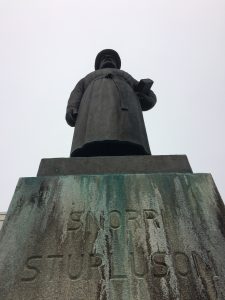
Snorri Sturluson – Reykholt – Iceland 2018
These structures were not unique to the tribes in north-western Europe, throughout the world we see that tribal structures evolved and sustained themselves along these lines. Thanks to the early 13th century Icelandic sagas from Snorri Sturluson we get great insights in tribal life of that time. Important structures such as gift giving and friendships are characteristic of the Germanic tribal systems through north-western Europe and indeed beyond.
The new tribal societies that started to emerge – the combinations of various clans and communities – could have a few thousand people, growing even into the tens of thousands during Roman times, when different tribes started to form militias as part of their ‘foedus’ with the Roman army. There could have been half a dozen more or less permanent tribes that in one way or another roamed the area, however, others might have (occasionally) wandered in from elsewhere; especially in the Late Roman Times. During Roman occupation many of these tribes were mixed. Forced migration, invitations to plunder other tribes and pressure from tribes moving into the area from further north and east of the Roman Empire, a whole new society emerged.
Also in ‘free Germania’ the people were influenced by the new society and there is evidence that, during the 2nd and 3rd centuries, also here a higher level of organisation start to occur, especially in the region within around 200 kilometres from the border, perhaps some sort of a tribal alliance might have started to occur, perhaps this is what the Romans referred to when they started to talk about the Franks, which had become more like a confederation of what in previous times had been individual independent tribes.
The Franks were organised in settlements (weiks – wijk in Dutch, -wick in English). These settlements were further divided in households (domus). The larger settlements also had a mead hall – a long house – where the chief and his warriors met and feasted after victories. This drinking hall became the center of the new civilisation were leaders met and decisions were made. Later on in or next to the chief had his farm. In the high middle ages they became the first fortified enclosures (motte and bailey castles).
Tribal leadership
The tribal system had over the previous millennia evolved into a tripartite system and consisted of chiefs, warriors and farmers. It was not until much later – when confederations started to form – that these chiefs grew into kings. There are also indications that prior to the arrival of the Romans, there was some sort of governance in place, based on hoards unearthed in what was northern Gaul, it has been estimated that in the years before the Gaul wars some 220,000 golden and silver coins were minted here. This indicates that there was some use for it and that there was some sort of governance and trade. In general of course these coins formed part of the wealth of the ruling class.
The organisation of the tribe was rather flat. The tradition was to divide the land among sons, thus keeping the tradition of chieftains alive, rather than looking at a consolidation of property and power (and thus growing into countries with political powers ruled by kings). Only from Merovingian times, are we seeing that the top warriors started to form a ‘nobility’ class (mimicking the Roman nobility structure with dukes and counts). Initially the tribal chief might also have had religious (sacral) powers. That concept could well date back to their Scandinavian origins. This tradition might also be the origin of the sacred powers of the Merovingian and Carolingian rulers.
Mund
Germanic leadership based on Germanic law is known as ‘mund’. This was based on blood relationships whereby the head of the family was responsible for the family group. The power was initially more disciplinary. Important elements included to watch over the women’s chastity and faithfulness to prevent the family honour from being harmed, in the first case if a bride is not a virgin at the time of her departure from the family, in the second, if sons are born that are not of the common blood. It also has to control the male family members who may cast shame on the family honour, who may not serve the family, or who may endanger the whole family by their imprudence (for example by drawing the family into a feud).
Eventually these ‘powers’ involved the extended families and the tribe as a whole. Tribes with such leaders also became known as ‘munds’. During Roman times related ‘munds’ started to form larger groups such as the Saliers. During these and consequent Merovingian periods to became enshrined in the first written laws such as for example Lex Burgundionum.
The legality of later chieftains and kings in the Germanic countries all the way to the Holy Roman Emperors can be traced back to the ‘mund’. Also the principle of chivalry can be retraced to it.
Early Germanic Law
The old Germanic laws were based on oral tradition and tribal customs. They were memorised by designated individuals who acted as judges in confrontations and meted out justice according to customary rule. They were also able to carefully memorise precedents. Among the Franks they were called rachimburgs. “Living libraries.
These laws started to be written down in Latin in the early Middle Ages (also known as leges barbarorum “laws of the barbarians”). This happened between the 5th and 9th centuries. They provided authority to the king as Roman Law had given authority to their Emperors. At the time they were written down, the laws of the more southern tribes were influenced by Roman Law; they were also influenced by Christianity.
All these laws may be described in general as codes of governmental procedure and tariffs of compensation (wergild). They all present somewhat similar features with Salic law – the best-known example – but often differ from it in the date of compilation, the amounts of fines, the number and nature of the crimes, the number, rank, duties and titles of the officers, etc.
Early Germanic laws and their tribes
Legislation
Tribes
Date of legislation
Leges Visiogothorum
Visigoths
5-7th century
Lex Burgundionum Lex Romana Burgundionum
Burgundians
483-532
Edictum Theoderici
Ostrogoths
ca. 520
Leges Langobardorium
Lombards
643-866(earliest Edictum Rothari 643)
Pactus Legis Salicae Lex Salica
Salii
6-9thcentury(Earliest ca 500 – Clovis)
Lex Ribuaria
Ripuarian Franks
623-639 (Dagobert I)
Pactus Legis Alamannorum Lex Alamannorum
Alamanni
7th century
Lex Biauvariorum Lex Baiwariorum
Bavarians
740-748
Lex Francorum Chamavorum
Chamavi
9th century (Charlemagne)
Lex Saxonum
Saxons
803 (Charlemagne)
Lex Thuringorum
Thuringi
9th century (Charlemagne)
Lex Frisionum
Frisians
785 (Charlemagne)
Tribal organisation
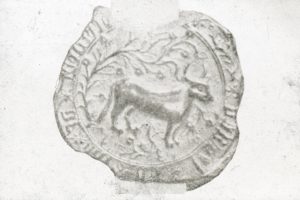
Seal of the free city of Oss 15th C S(igillum) libertatis de Osse, ad legata
All free members of the tribe could participate in the assembly (thing/ting/ding), in Carolingian times known as ‘campus’. These were meetings in open spaces (near the holy oak or linden tree, a sacred spring or river). This could also be the ‘malberg’ (mallum); this is a Frankish word indicating a hill or open field with a tree, stone or pole where the ding took place. There has been a long raging discussion regarding a reference in the Sallian Laws to ‘Mallobergium Ohseno’, this has been interpreted as a possible reference to Oss. It could be translated to the malberg of those who are herding oxes. There are more references to the importance of cattle in this area (Roman references), the hill in Oss (Heuvel) could perhaps have been such a malberg. It has also been argued that especially in the more remote areas in these region some of these old Frankish traditions lingered on while elsewhere new developments had replaced them [1. Tussen Vlaanderen en Saksen, 1990, A. C. F. Koch, Jaap Kruisheer J. C. Bedaux, p92] .
During the ding, tribal matters were discussed in a democratic way, disputes were settled, (Salic) laws declared and chieftains and kings elected. The most important ‘Thing’ took place in spring (campus martii – March), where the upcoming raiding season was discussed. Justice very much evolved around strict tribal family and boundary lines and included blood feud and weregild (this included valuations of human or human body parts). This was also elsewhere the case as the Bible talks about ‘an eye for an eye’. An interesting relation here is that there is even evidence that revenge is also something that happens in the social groups of primates.
The individual tribal feud law took place within strict rules and conditions it was one of the last remaining original vertically based (tribal bloodlines) justice elements and the various different tribal laws finally became the basis of the criminal law that only started to emerge in the Late Middle Ages. Within the nobility, the importance of the vertical based blood relation system remained in place to well into modern times.
Under Charlemagne the annual campus meetings were moved to May (campus maii). In an increasingly more Christianised society these events were also used to issue new canons and law.
The Frisian tribal assembly was called the Fimelthingh, they took place during a period of three days, during which there was the Ding Peace, no fighting was allowed during these days. We later see traditions such as Market Peace, Peace of the King and Peace of God, all dating back to this earlier tradition. In Friesland, where elements of tribal law survived well into the 16th century, remnants of weregild and revenge were still embedded in their legal code.
All good things come in 3’s
At the Thing verdicts were only given after they had been dealt with three times.
As mentioned the system of communal policy- and lawmaking lasted until well into the Middle Ages. All full tribal male members through inheritance from their parents (dual-decent) made the local political decisions and spoke law in relation to local disputes and criminal offence, under the holy tree or tree of justice. The linden tree in the arms of Oss most probably dates back from these times. These trees could also be related to the Irmensul (wooden pillars which they believed supported the earth) both Charlemagne and missionaries such as Willibrord put a lot of effort in pulling these trees down. Trees have since time immemorial been linked to bridging the earthy realm with the spiritual realm.
It were these Germanic traditions that started to form the basis for our modern democratic societies and not the Greek and Roman political systems. While for many of our political institutions we use classical names and even classical designed buildings the reality is that our democracy has more to do with the Germanic Thing than with the Greek and Roman Senate.
In medieval England the tithing (ti=10) was a self-policing body of ten men between the ages of 12 and 60 had to swear that they would upheld the law in their community. They assisted the sheriff and had to report anybody breaking the law. Obviously such a body also protected their own people within and led sometimes to intimidation and ‘silence’.
In Brabant it wasn’t until Burgundian times that the Dukes started to uniform these local legal systems and imposing more an more their ‘state’ laws upon the local population. It took several centuries to fully implement such a centralised system. Remnants of the old system lingered on. In Oss the annual ‘campus’ (jaargeding) of the local bailiffs (schepenen –scabini (Lt) – lawmakers) took place according to old Germanic tribal tradition on the Wednesday after Epiphany. Well into modern times ‘silence’ was used by the community to protect the people within their community.
Breaking kinships
The tribal inheritance laws were based on double decent, this allowed for the tracing of decent through both maternal and paternal lines. This structure allowed for a large network of interpersonal relationships and also provided women with political power (however they, by rule, were not admitted to the royal office).This system was governed by collective norms and rules but also provided a large network of support in cases of hardship, warfare and an in general harsh and hostile environment.
The Church initially through the missionaries tried to break these tribal and kinships rules as they were incompatible with canon law and this hampered the church to take control over social and religious life. For centuries the tribal elders were able to maintain control over their own kinships, but eventually the Church was able to replace these rules.
They introduced different kinship rules that to influence marriage introduced rules in relation to who was entitled to inherit kin rights and property (mainly by excluding inheritance through the maternal line). This significant reduced the more prominent role of women in society. The Church declared any generational degree above seven as mythical in order to break the relationship between the dead and the living (ancestor worship) .This reduced the importance of elders – who had an important function in relation to the ancestors. The Church now became the arbiter in these affairs rather than the elders, who had, for centuries, been the keepers of the kinship genealogy knowledge of their tribes.
Limiting the number of potential contenders for tribal leadership was supported by the incumbent ruling class of the day and this assisted the Church in transforming the tribal society. Eventually we see that these groups only consisted of three generation – children, parents, grandchildren – a typical kinship combination that occupied the many castles in Europe between the 9th and the 12 century.
Nevertheless kinship norms and rules remained strong as we continue to see them holding important secular and ecclesiastic positions, we recognise them by their dithematic kinship names (Germanic naming tradition based on two words/themes). By the 10th century however, this group starts to disappear and many of the new church, secular and military functions and positions were now taken over by secular clerks, ordained monks and episcopal administrators (ministerialis) and the newly emerging knights, often from humble beginnings. The new secular elite started to establish their own traditions with courty life and noble birth decent.
By that time the various kinships rules of all of the different tribes were replaced by uniform norms and rules set by the Church. We also see that by now the authority of the ruler was no longer depending on his relationships with his/the kinships but decided by the support from the Church. We see this reflected in table arrangements at important events. The king and his direct family no longer sit at the table with the rest of the nobility, but at a separate head table separated from them. [2. Understanding the Middle Ages, Harald Kleinschmidt, 200, p92-100]
Germanic tribes
The name Germani was given to these people by the Romans and means ‘related people’ (germ, seed). In their writings they recognised a large number of different – but related – tribes. It was the Roman-Gallo wars under Cesar that put Germania more clearly on the map.
It was not until after 600 BCE that, because of climatic changes, some of these regions became more habitable and the Celts started to settle the area coming from the east and mingled with the Bronze and Iron Age populations that had settled here as the early farmers of the region population. People lived from cattle and agriculture on the lands just behind the dunes, on the higher grounds in Drente, Twente, the Veluwe and Brabant and since the use of the since the use of the mouldboard plough also on the fertile clay grounds along the rivers. During the summer they ventured into the peat lands where they went hunting, fishing and collected edible plants and herbs.
After 100BC groups from the Germanic tribes arrived from Scandinavia and mingled with the Celts and other native people and these people as a whole took over the Germanic culture. It is still unclear what exactly happened during this period, however the end result is known. At that time there were three major cultural groupings that were going to form the basis for all Germanic people. Their names are linked to their mythology.
The mythical ancestor of all Germanic people was Tuisto (Tuisco). He had a son: Mannus he became the ancestor of the Hermiones (Irminones). He in turn had two sons: Ing (Ingaevones) and Istaev (Istvaeones). The Frisii had their own mythical ancestor Folcwald and his son Finn (Frisian). The Scandinavians never left their ancestral home.
Interestingly linguists see a link between the Indic Manu, the ancestor of the Indic people, pointing into the direction of shared Indo-European beliefs.
Proto-German tribes
Tribe
Tribal area
Main Centre
Comments
Movements
Hermiones
Elbe river system
Included: Suebi, Hermunduri, Chatti and Cherusci.
Later also formed: Goths, Cibidi, Burgundians and Lombards.
Ingaevones
North Sea Coast (Jutland, Holstein, Frisia)
Major group that moves to Britain England (Inglings?)
In Roman times made up of: Cimbri, Teutons (both Jutland), and Chauci (between Frisii and Elbe).
Mixed with Frisii, Saxons and Jutes
Istvaeones
Atlantic coast: Netherlands, Belgium, North France. As well as Rhine and Weser Rivers
Mixed with Ingaevones
Became Franks, Allemanni
These proto-tribes split into the many tribes that we know from Roman documents (perhaps as many of 70 different tribes). While the three groups also mixed between them, it looks like the Ingaevones had the most impact on what would become the Brabantine area, while the Ingaevones would be the ancestors of the Saxons and Tubanti in Twente and north Germany.
Coming from the north-west the Ingaevones on the other side of the Rhine-delta ‘wilderness’, the people on the Belgian coast were amongst the last to be replaced by the Germanic tribes. This final part of the Germanic migration coincided with the arrival of the Romans. The Roman limes (boarder) prevented the Germanic tribes to move further south. When these people were incorporated in the Roman Empire they became known as mentioned above: ‘Germani cisrhenani’.
Further south the Celtic culture and language remained. It was the Salii people who from the area of the river Ijssel had moved further west in the Low Countries, mainly in what’s now Brabant. Here they became known as the Franks who, after 400AD, conquered all of Gaul.
Brabant was a boarder region between the Germanic and Roman cultures and even up to modern times maintains aspects from both people. In the North the newer Germanic culture (and language) had a larger impact but the south (the area in Gaul) maintained the Celtic culture which turned into a Celtic/Gallo-Roman culture (and adopted the language from this mixing pot).
Once peace was established and the Roman Limes was established along the rivers Rhine and Danube the old Iron Age culture was driven back some 100 to 200 kms from the boarder and in this ‘independent’ region a market zone established itself, highly influenced by Roman culture. The Romans heavily depended on produce from this region. Roman coins, often in hoards, are found throughout this zone.
Beyond that the Iron Age cultures continued in the ‘Rich Burial Zone’ to well into modern Scandinavia and Poland and beyond this into modern Russia the ‘Warrior Burial Zone’ – the migrating Germanic tribes brought many aspects of this culture with them when they moved into the area that before them had seen a very strong Celtic influence.
The various Germanic and Celtic Tribes
The table below shows the various tribes that we come across in Roman texts. They all originate from the proto tribes mentioned above. However, not all these tribes lived all in this area at the same time and there are certainly tribes (or sub tribes) that were missed by the Romans. The opposite might also be true some of the tribes mentioned in their documents relating to certain events or observations might have been overstated and some of these tribes might perhaps simply have been sub-groups.
Key tribes in the area we now call Brabant were:
Eburones (their lands were called Toxandria) perhaps as north as northeastern Brabant,
Nervii (Brabant and Rien – Antwerp area), and
Tungrii (Masau) these latter ones migrated into these regions after the extermination of the Eburones by Caesar.
Salii (Salian Franks) through Roman resettling programs they were migrated to Toxandria.
In Twente – including Ootmarsum and Wietmarschen – were the Tubantii.
Early Germanic tribes in and around Brabant
Tribe
Tribal area
Main Centre
Comments
Movements
Nervii
East of the Scheldt (civi: Famars, Liberchies, Doornik, Kortrijk)
Bagacum/Bavay
Their culture was Celtic‘Spartan’ warriors,Joined Eburones in 57BCE
Near annihilation in 53BCEConquered by the Franks in 275 and finally fully taken over by them in 432
Batavii
River island between Waal and Rhine
Nijmegen
Warriors part of Roman army. Battle for independence 69CE
Originally part of Chatti(Hesse/Saxony)
Chauci
Between Frisii and the Elbe
Tiberius led a campaign in 5AC. Loyal to Rome
Merged with Saxons
Chamavi
North West Germany
Hamburg/Hamm?
To Gueldres (Hamaland – Gelderland)
Salii
East of IJssel/IJsselmeer
Deventer?
Pirates, seafarers
To Tungii and further south
Tubanti
Twente/Westfalia
Oldenzaal?
Fought the Romans in 14AC and 308AC
Moved into Twente proper, part of the Saxon alliance
Frisii
Most coastal areas Holland to Helgoland
Utrecht (Trajectum)
Traders
All of northern Netherlands
Tungrii
Ardenne and Meuse Valley
Tongeren (Atuatuca)
Still mentioned in 5th century
Moved the Toxandria.Lands occupied by Salii
Caninifatii
Coastal area north of Rhine delta
Joined Batavii Revolt in 69
AtrebatesGaul
Around Artois northern France
Arras
Participated in the revolt of 57BCE
ViromanduiGaul
Diocese Nyon, Picardy France
Vermand/St Quentin
Joined revolt 57BCEPracticed human sacrifice
Eburones
Between Rhine and Meuse (Limburg)
Tongeren
Ambiorix led revolt 54BCE
Plundered by Sicambri after defeat from CeasarIntegrated in Tungri
Ubii
Right bank of the Rhine
Oppidum Ubiorum (Cologne)
Alliance with Romans in 55BCE
Assisted the Romans to fight the Batavii in 70
Condrusi and Segni
County of Liège/Ardenne
Namen?
A group was left behind after a raid from the west
Came from west GermanyIntegrated in Tungri
Sicambri
Lower Rhine next to Menapii
Joined revolt Arminius 9BCEClovis was called a Sicamber (honourable name)
Forcible moved south in 11BCE merged with Salii
MoriniGaul
South of Nervii/coastal wetlands
Terouanne/Terwaan
Reclaimed land through polders
Concurred by Rome in 33BCE
Menapii
From mouth of Rhine along the Scheldt, north of Nervii
Cassel northern France later Doornik
Mont de Cassel (Roman) still a strategic pointJoined the Revolt in 57BCE and Eburones Revolt of 54BCE
Ceasar put Atrebates in control of Menapii
RemiGaul
Northern Champagne plain, Ardennes, Meuse Valley
Reims (Durocortum)
Renown for their horses and cavalryMost pro-Roman in Gaul
Saxons
Lower Elbe (Holstein, Drenthe, Groningen, Twente)
Perhaps the land of the Chauci?
Confederation of German tribes. Last to be converted
Anglo-Saxon expansion
Tencteri and Usipetes
Eastern bank Lower Rhine
Took over some lands of Menapii Defeated by Caesar in 55BCE
Forced to migrate by Suebians (Swabia)
Treviri
Lower valley of the Moselle
Trier
Joined the revolts of 54, 57 BCE and 69AD
Celto-Germanic origin
Cherusci
Northern Rhine Valley
Osnabruck/Hanover
Battle of the Teutoburg Forest 9CE
Possible Celtic origin
Chatti
Upper Weser
Hessen (named after them). Thor’s sacred oak near Fitzlar.
Joined revolt Arminius 9BCE. The place name Hatten (Gelderland) is named after them
Some moved west known as Batavii. Chatti merged into the Franks.
Leuci
What is now Lorraine
Toul (Fr)
Supplied wheat to Caesar in 58
Mediomatrici (Mettis)
Current diocese of Metz
Divodorum (Metz)
Part of the Belgae tribe
Were Celtic but Treviri occupied it before Roman times
Belgae during Roman times
The Eburonen, Condrusi, Caeros, Segnii and Paemani formed the Germani cisrhenani. They merged into the tribe later known as Tungrii. The Nervii, Attrebates and Morine appear to be of Germanic origin, their tribes settled in northern Gaul and adopted the Celtic language and culture.
Ambiorix Leader Eburonen – Tongeren
Since the Hallstatt period the Celtic culture had been adopted by the local population, but as indicated before the effects of this were marginal as most people basically continued the life style they had been following for the last 2000 years.
As we will see with the Eburones, in the battles with the Romans the local Celtic population was decimated either killed or taken into slavery. This allowed Germanic tribes to penetrate deeper into the areas previous held by the Celts.
The Germanic society similar to the Celtic society, 500 years earlier, was based on war, peace means stagnation and destabilisation. The society could not be kept together without violence and war; prestige needed a continuous state of conflict.
The Salii and the Franks
The most successful of what would become the Frankish tribe were the Salli, they came from the Low Countries (near the river IJssel) and moved to Brabant and what is now Belgium including norther France and later merged with their compatriots (Ripuarian Franks) on the other side of the river Rhine (centred around Cologne).
In the meantime other land and booty hungry tribes tried to emulate the success of the Franks; they included the Bavarian, Langobards and Allemanni. By the 5th and 6th . However, eventually it would be the Franks who would dominate their territories. Not far behind these Germanic tribes were the Slavs who occupied the lands left vacant by the Goths. And to a large extend the boarder became the one that separated these two large peoples from each other, since that time. Eastern Franconia – where the Franks replaced the Bavarii – became the boarder region.
For an overview of their history see: Merovingians
Battavii
The Batavii were a Germanic (sub) tribe, originally part of the Chatti who lived further east in what is now Hessen, mid Germany. Between 49 and 15BCE they arrived – as a rather small group – perhaps on a raid or a campaign and for whatever reason they settled on the river island known as the Betuwe (named after them). The tribal name Batavii comes from bat “excellent” and avjo “land”, refers to the region’s fertility, today known as the fruit basket of the Netherlands (De Betuwe). They rapidly took control of the area and dominated the local population. The Romans called all of the population – natives and migrants – Batavii. It has been argued that from here they moved further west along the rivers into the Rhine Delta.
Site of the Roman Temple Empel – 2013
Interestingly coins have been found in the river are that were based on coins that were used in their home land. Many of these coins has been found at Rossum, Lith and Kessel. The temple that was built on the Eburon (?) sanctuary in Empel is distinctively Batavii. The temple was dedicated to Hercules Magusanus, linking the Roman God Hecules to the Celtic-Germanis God Magusanus and the German God Donar. However, their archeological presence in Brabant doesn’t last long there are no further traces from them after the 1st century AC.
They were loyal to the Romans and one of their leaders, the first Batavian commander we know, named Chariovalda led a charge across the Weser against the Cherusci – lead by Arminius – during the campaigns of Germanicus. The Batavii delivered in comparison far more ancillary troops to the Romans that the other tribes, perhaps at least one son in every household served in the army.
It came as a surprise that in 69 they revolted against the Romans.
It is uncertain what exactly happened with the tribe immediately after the uprising. There will certainly have been assimilation with most likely the Frisii, but it looks like that the original Frisii as mentioned by Tacitus were replaced or at least mingled with migrating Angles and Saxon, the same people who also migrated to the British Isles. As we will see below the Batavii mingled with the Salii
Large army settlements such as Ulpia Noviomagus Batavorum (Nijmegen) required large amounts of food and materials, and the Batavii and Frisii were certainly attracted to such places. The Batavii already had their own settlement here, but after the revolt that was taken over by the Romans and they now had to build their own city on the outskirts of the camp, which became known as Oppidum Batavorum. (Oppidum is the Latin name for a large warehouse where local goods were stored however, it is suggested that these trading places were indigenous in its origin). A century later a rather large city was established 2 km further on known as Ulpia Noviamagus Batavorum (New Market – Nijmegen). It became the capital of the Civitas Batavorum. Apart from the Betuwe also a large part of Brabant was part of this military district.
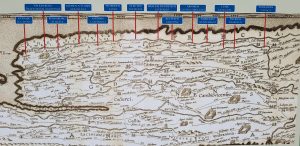
Peutinger Map with Dutch cities
All indications are that they again became loyal Roman citizens but the life and culture of the local population remained largely untouched by the Roman occupation. There is no mentioning or evidence from Roman or Romanised settlements outside the few main Roman centres in the area. Typical Batavii villages within their tribal land consisted of between 6 to 12 farms.
The Saxons
The word ‘Saxon’ is believed to be derived from the word seax, meaning a variety of single-edged knives.
The Saxons as we know them were, similar to the Franks a confederation of Germanic tribes in this case the Chauci, Angrivari, Cherusken and Tubanti. As such they start to appear in the 3rd century. Their earliest known area of settlement is Northern Albingia (north of the river Elbe), an area approximately that of modern Holstein. As a confederation they occupied the region between the Ijselmeer and the rivers Eide and Elbe to the east.
A few centuries later they could be divided into three groups, however all of the individual groups remain largely autonomous. They are:
A central group – also called the Angarians, who lived along the river Weser
Eastphalians to the east boardering the river Elbe
The Westphalians to west boardering the river Rhine
Tubanti
The current region of Twente most probably is very similar to the tribal area of the Tubanti, a Germanic tribe that later became incorporated in the supra tribe of the Saxons. The Tubanti also lived an area north of modern Twente, now Germany, known as Grafschaft Bentheim and includes also Wietmarschen and Nordhorn.
Interestingly in Roman times the tribes here were described by the Romans as the Frisii, indicating a strong influence of and possible an alliance with the Frisii.
Ootmarsum and Nordhorn are situated on the important trading route Brussels – Amsterdam – Bremen – Hamburg. There are indications that this route could even have its origin in Roman times and that parts of it were used during the campaigns of Drusus, Tiberius, Germanicus and Varius into the Germanic lands.
During the Saxon migration, the Tubanti were pushed further west into Twente.
Twente
In 797 the Tubanti farms of Mander and Hezinge (both near Ootmarsum) are mentioned in official documents [3. Charter from Oodhelm dated 29 June 797 whereby donated the farms to the Church of Wichmond near Zutphen] .
According to the few historic records there are, Saxons didn’t have a king, but they were governed by several ealdormen (or satrapa) who, during war, cast lots for leadership but who, in time of peace, were equal in power.” Once the Saxons became more established their area was divided into three provinces — Westphalia, Eastphalia, and Angria — which comprised about one hundred pagi or Gaue. Each Gau had its own satrap with enough military power to level whole villages which opposed him.
The caste structure was rigid; in the Saxon language the three castes, were called the edhilingui (nobles – edelingen in Dutch), frilingi (free men), and lazzi (slaves/serfs). The edhilingui could have been the originals descendants of the Saxons who led the tribe out of Holstein and during the migrations of the sixth century. They were a conquering, warrior elite. The frilingi represented the descendants of the amicii, auxiliarii, and manumissi of that caste, while the lazzi represented the descendants of the original inhabitants of the conquered territories, who were forced to make oaths of submission and pay tribute to the edhilingui.
The Lex Saxonum regulated the Saxons’ unusual society. Intermarriage between the castes was forbidden and wergild were set based upon caste membership. This was also known as ‘zoenrecht’ a form of reparation payment it was expressed in a person’s value in monetary terms. The edhilingui were worth 1,440 solidi, or about 700 head of cattle, the highest wergild on the continent; the price of a bride was also very high. This was six times as much as that of the frilingi and eight times as much as the lazzi. The gulf between noble and ignoble was very large, but the difference between a freeman and an indentured labourer was small.
Interesting wergeld also had to be paid if women were touched inappropriately.
Even after the Middle Ages ‘zoenrecht’ was still practiced, often mediated by the church. There are numerous ‘zoen’ letters in the church archives (including in those in Oss), whereby for example the family of a murdered victim agrees to certain compensation arrangements; this can include a financial contribution, a pilgrimage and/or a certain exile period, praying on the grave of the victim -undressed or just in underwear – was another frequent elements of the punishment.
The Saxons held their annual council (Thing) at Marklo where they “confirmed their laws, gave judgement on outstanding cases, and determined by common counsel whether they would go to war or be in peace that year. All three castes participated in the general council; twelve representatives from each caste were sent from each Gau.
The Saxons homeland was finally conquered by Charlemagne during the bloody Saxon wars from 772 to 804. Interestingly 200 hundred years later they became the rulers of the Holy Roman Empire.
There are indications that the Frankish invasion created an internal border between the earlier conquered Frissi and the Saxons. Most probably this border was further west of the current boarder between the Netherlands and Germany. It was not until Charles V that the border moved further east to where is currently is.
The river Vechte could have been an important part of the border Charlemagne established. During his reign the missionary Liudger was, in 796, send to this region to convert the Saxons. In Nordhorn, at the age old river crossing, a church was built and the farmers in the region were ordered to burry their deaths in graves, this was against tribal tradition whereby people were either cremated or buried in tumuli. Next to the church a Schultenhof was established for the local official (Schulte, Schout, Bailiff) certain income rights (land rights) were added to this position. He was in charge of executing the order to watch against any cremation. He was also in charge of guarding the river crossing (on the old Roman road?). This position also allowed him to check the carts on which the farmers would have to bring their death to the church, they were ordered to pass the Schultenhof on their way to a burial. Tradition had that until approx 1920 farmers from the neighbourhoods Altendorf and Deegfeld still used the ancient old dirt road to carry their death to the church rather than the paved way.
Anglo-Saxons in Britain
During the dying days of the Roman Empire, Emperor Honorius told the British cities to start looking after their own defense needs. Legend has it that one of the local warlords, Vortigern, invited the Saxons from the other side of the Channel to settle in what is now Kent in exchange for their military services to fight the Picts and the Scots. However the emigrants turned the tables and defeated Vortigern and established their own kingdoms of Sussex and Essex. From then onwards (approx 430) more Saxons together with the Angles and to a lesser extend the Jutes and Frissi started to arrive/invade Britain.
The Romanisation of England also had not been as thorough as for example in Gaul. In the proceeding centuries before the Romans arrived the land was occupied by the Britons; the collective names of Celtic people. By the time the Romans arrived the Picts (Scotland) had already separated from this group to follow their own distinct Cetlic traditions. The Romans never conquered the north (Scotland), the West (Wales), the southwest (Cornwall) nor Ireland. The Celts in the occupied regions however, never adopted the Roman culture in the way that this happened on the continent. Some historians believe that certain elements of the Arthur legend might refer to the resistance of the Celts against the Romans.
Unlike their Germanic ‘brothers’ who conquered continental Europe the Saxons (as the combined British invaders were labelled) had no concept of the Roman Empire nor their traditions and – unlike anywhere else in Europe – they shattered the whole Roman structure in Britain. Cities, roads and buildings all fell into decay. Bishops disappeared as did the Latin language; Christianity was replaced by their pagan religion, some of the Celtic Catholics fled to Wales, Ireland or Gaul (Brittany).
A century or so later from Ireland missionaries came back to England to start the conversion all over again, they introduced the Celtic variation of Christianity.
The last Romano-British territory in south western part fell to the Saxons in 577 . Over time seven Anglo-Saxon kingdoms emerged: Northumbria, Mercia, East Anglia, Essex, Wessex, Kent ans Sussex, all according old Germanic culture and traditions.
One king became the wide-ruler (bretwalda) of all the Saxon kingdoms In 560 Ethelbert, king of Kent became the bretwalda and married a Frankish princess. Later on she brought him in contact with (Roman) Christianity and was consequently converted by the Roman bishop Augustine (of Canterbury), he became the first Archbishop of Britain. Legend has it that the pope, at the Roman slave market, came across people who called themselves Angles to which the pope replied that he wanted to make angles of the Angels and subsequent Augustine was send, in 596, to the land of the Angles. Soon after that, missionaries started to arrive from the British shores in continental Europe.
Christianity also again stimulated learning and scholarship. The 8th bishop of Canterbury Theodore of Tarsus (Syria) established the Canterbury school, soon after his arrival in England in 669. He also started a thorough reorganisation of the Church in this country.
If it wasn’t for the these changes the Monk the venerable Bede and the scholar Alcuin (who in 782 became the key adviser to Charlemagne) would not have become the most knowledgeable Europeans in the 8th century.
In 757 King Offa II became the head strongman and was able to subdue all of the seven states and he built a 170 miles long defense wall to stop the Welsh from constant plunder, this wall is till in existence and is known as Offa’s dyke. There were strong relations between Charlemagne and Offa. His eldest son married one of Offa’s daughters.
As indicated below the Vikings created havoc in the 9th century, resulting in the establishment of permanent settlements on the island. While King Alfred was able to win back some territory, a permanent Danish occupation was now established. He was able to strengths the ties between Wessex and Mercia in order to establish a more powerful resistance against their common enemy. Alfred also built a navy to fight the Danes at sea.
In his campaign against the Danes he also obtained the support of his sister Ethelfelda, who was married to King Ethelred of Mercia. Together they launched a number of hit and run raids. After the death of her husband she was elected queen and signed treaties with the Scots. This further strengthened the fight and while the Scots were fighting the Danes in the north, she was able to reclaim Derby and Leicester from the Danes. In 925 Alfred was succeeded by one of his many sons, Athelstan who was able to subdue Wales, Scotland and Cornwall and became the first king of all of Britain.
Alfred followed Offa and also reached out to the content. His sister Edgiva was married to Louis D’Aquitaine and his other sister Elgiva to Charles III (the Simple) of France. Athelstan followed in his footsteps and arranged for his sister Ethelda to be married to Hugh Count of Paris (the father of Hugh Capet the founder of the French dynasty that lasted for nearly a thousand years), his other sister Edith was married to Otto I of Germany.
After Athelstan death rivalry started to flair up again and towards the end of that century the Vikings had regained a lot of their strength and were able to receive Danegeld from the British.
King Aethelred “The Unready” tried to pay the Vikings 10,000 Roman pounds (3,300 kg) of silver. Of course the Vikings after this never gave up and the extortion went on for nearly 200 years. It has been estimated that over that period this amounted to some sixty million pence. England looked much like a disorganised state, more like a range of competing fiefdoms, unable and unwilling to cooperate with each other. Regular raids from the Danes secured an ongoing payment of Danegeld. Disunity was also used by competing groups of Vikings to make alliances with the quarreling fractions, only adding to the misery.
A remarkable woman at that time was Queen Emma of Normandy (985-1052) who saw seven kings rule during her lifetime, two of them where her husband and two her sons. In 1015 she was instrumental in the defence of London. Her son Eduard the Confessor was the last Anglo-Saxon king when he died in 1066 he was succeeded by Harold Godwinson, who was defeated and killed in the same year by the Normans under William the Conqueror at the Battle of Hastings.
The Frisii and the Frisians
The Frisii were mentioned by Tacitus and were ‘conquered’ by Drusus in 12, but the Romans never had a good grip on the Frisii, they remained a problem for the Romans (and later for the Merovingians and Carolingians).
The heartland of the Frisians remained the current Dutch provinces of Friesland and Groningen. Most likely after the depopulation of the Rhine river delta, during most of the first millennium, Holland became also part of Frisia, perhaps as far south as Antwerp as could be concluded from the very early relationships in relation to the foundation of the first abbey of Holland in Egmond.
Occupation of most of these lands was limited by the changes in sea levels. Sometimes that meant that they wear only able to occupy the dune strip along the coast with the North Sea and on the sand and clay deposits of the rivers.
While there is no definitive proof the origin of this tribe is most likely linked to the Danish island of Bornholm in the Baltic Sea – Old Norse: Burgundarholmr, “the island of the Burgundians”. Similar to the Goth they might have crossed to mainland European the first century AD and travelled via the rivers Vistula, Oder and Elbe to arrive somewhere around the start of the 5th century at the river Main. By that time their leader was Gibicar (Gibicca) who led his people together with other tribes during the great migration from 406/407 over the river Main into the Roman Empire. The Roman Limes here followed the river Main and the Burgundians settled some 100 km further to the west roughly in the area of what are now the cities of Worms and Speyer. They supported the puppet emperor Jovinus and forced this anti-emperor to declare them imperial allies, this allowed Gibicar’s son Gundagar (Gunther) to proclaim the Kingdom of the Burgundians.
However, as soon as proper Roman authority was re-establish they called in the Huns to assist them in fighting the Burgundians and in 436 Gundagar was defeated with perhaps as much as 20,000 killed. The scale of the massacre was such that it did find its way in Norse and Germanic sages such as the Nibelungen. What happened with the remaining Burgundians is unclear, there are indications they settled some 400 kilometres further to the south. However, their warriors are reported in 451 to fight on the side of the Romans in the victorious Battle of the Catalaunian Fields against the Huns. Most likely because of this the Burgundians, this time, did get the proper Roman approval in their new area, this was known as Sequaini; later known Sapaudis/old Savoy and now the County of Burgundy which is currently largely France-Compté including parts of Switzerland such as Geneva and this latter city became their first centre.
There warrior nation became even more apparent when within a decade after receiving their new status had already extended to the west including Lyon, Dyon and Vienne. Eventually the extended their territory all the way to the Mediterranean, occupying all of the Provence, the territory is also called Lower Burgundy.
To maintain the right relationships with their neighbours marriage arrangements were used. King Gundioc married his sister to Ricmar Flavius Aerius the Roman ruler in the area during the dying ages of the Empire. The next king, Chilperic married his daughter to Clovis.
Internal feuds after the fall of Rome saw the Burgundian lands split in three regions, this severely weakened its position and had severe consequences for its future development.
Under King Gundobad (480-516) and Sigismund (516-523) the Lex Romana Burgunionum was written and extended. What made this different from other codes so far was that this was an extension to Roman Laws specifically dealing with the customary law of the Burgundians.
After Clovis successful campaign against the Visigoth, he moved his attention to Burgundy and the next king, Gundimar (523-534) saw himself trapped between the Merovingian forces entering his lands from both the north and the south. While Burgundy remained his own entity their kings from now on were subjected to their Merovingian overlords.
We continue the story of the Burgundians in a separate chapter of the Merovingian Empire.
Fifth Century Migration
Towards the collapse of the Roman Empire in the late 4th century and early 5th century further large scale migration from these Germanic people occurred throughout Europe. Some of them were driven by Asiatic steppe tribes and the Huns from even further east.
The Huns
The Huns most probably originated on the Mongolian steppe, sometimes around the middle of the 8th BCE and are linked to the people known as the Xionghu (Hiung-Nu). Climate changes (lack of water) might have driven them into China, where they relentlessly attacked the empire. At least in part the Great Wall of China was built and upgraded to keep the Huns out of China. We visited the Great Wall of China in 1987. They were finally defeated by the Chinese in 151BCE and driven westwards onto the steppes. However, whenever, weaknesses occurred in the Chinese Empire the Huns were back and every time they were pushed further and further westwards. On these steppes they became the most remarkably horsemen the world had ever seen. They literally lived on their horses and could travel as much as 2400 km a week. It was this militarily invention that allowed them to create havoc across Asia and Europe.
In the 3rd century, the Han Dynasty had collapsed and Chines power started to rapidly diminish. In 304 the eastern branch of the Huns (Xianbi) together with other northern barbarian tribes were invited to become allies – big mistake. By 316 they had taken full control over northern China. This situation released the pressure of the Huns and allowed for a more settled period. However, this didn’t last very long. One the allies of the Huns the northern tribe of Taw Ba was able to wrestle power from their other allies, this led to internal revolts and as a result one offshoot of the Taw Ba, the Geougen launched their own war campaign in northern China, here they defeated the Huns living north of the Caspian Sea. This created a whole new wave of Hun migration westwards. The domino effect extending across the lands of the Mongols, Kazakhs, the Black Sea and Steppes people and finally ended in Europe. It is this particular situation that can be truly called mass migration. From here on the raids of the Huns were more of an invasion.
While their effects were already felt many centuries earlier, finally by 370AD they arrived on the European scene. The reputation of their ruthless violence was widespread and caused massive panic. That reputation still lingers on in our modern times. They crossed the frozen river Danube in 394/395, providing a perfect ‘bridge’ for their cavalry.
Under their rulers Rua, Bleda and Attila the raiding nomad culture was transformed to a more semi sedentary barbarian empire. Recent excavation have revealed rich palace like structures. They also manipulated conquered tribes in Central Europe to pay allegiance to them and provide military support in their wars against both the western end eastern Roman emperors.
Initially their threat was rather easy to neutralise a relative small annual sum of money (350 pounds of gold a year) was negotiated in 425 as ‘protection money’ that stopped them raiding Constantinople. A decade later diplomatic relations were established between the Emperor and the Hun king Rua. After his death in 435 the Huns elected a new leader: Attila. The situation started to change under his regime. Extortion money started to see significant increases to 700 pounds and later on even 2,100 pounds. In 447 he again crossed the Danube and defeated the Roman forces that were send against him.
He now also started to send exploring parties further west most likely to see if more treasure could be raided here. Intriguingly one of the parties brought with them a letter from Princess Honoria, the sister of the western Emperor Valentinian, complaining about her distaste for her husband. She included her ring which Attila saw as an invitation to invade the west and claim her as his bride.
For the next three years the Huns terrorised the west with numerous raiding parties. They were continuously confronted by Roman armies. Both armies contained large number of other peoples such as the Alans, Goths, Suevi and Vandals.
In 451 the Huns crossed the Rhine and destroyed Metz, from here Attila’s campaign of terror and destruction included Cologne, Trier, Amiens, Paris, Cambrai, Tournai, they were finally stopped – during the Battle of the Catalaunian Plains near Chalons in Austrasia (modern day France). The battle has brought together one of the largest groupings of European political entities ever -under the Roman military leader Flavium Aëtius. One of his allies was Merovech, king of the Salliers from where the Merovingian and Carolingian dynasties evolved. The Visigoth – who had one of the largest armies of that time – played a key role here as well under the leadership of Theodoric I, who perished in the battle.
After Atilla’s sudden death in 453 -during the wedding night of the last one of a string of wives – his empire very rapidly disintegrated, it lacked the integrity of a secure homeland and an economic base to support it.
As a consequence of the rather abrupt end of the Huns, the other tribes got a taste of what would be possible if they started to pursue their own interests. The Alans, Vandals, Visigoths and Ostrogoths as well as smaller groups such as the Suevi and the Burgundians all started to flex their muscles and soon started to attack the empire both from within and from the outside.
On the positive side the Huns had also introduced a great innovation in Europe; the stirrups, which gave horsemen a much better chance to stay on their horses.
The Huns, 10,000 virgins and Ravenstein
Ravenstein – 2014
There is an interesting legend links Atilla’s with Ravenstein (near Oss). This was in relation to the destruction of Cologne, while the historic facts are not correct it is likely that the core of the story does have some historical value. Part of the destruction of the city was the massacre of ‘10,000 virgins’ including Saint Ursula, one of her followers, Princes Cunera of York was saved by the Frisian King Radboud and he brought her to his castle in Rhenen, here she became very popular amongst the poor people. This drew the envy of the Frisian Queen Aldegonda who had her strangled. Three centuries later,bishop Willibrord buried Cunera’s remains of in the church of Rhenen . During the Reformation these remains were transported for safeguarding to Bedaf near Uden, which at that time was part of the independent (catholic) Land of Ravenstein.
Interestingly it was Roman Emperor Theodosius (based in Constantinople) who after the collapse of the Huns built a relationship with the remaining Huns and they became one of the most feared parts of his army.
Most of the Germanic and other Eastern invaders, while moving into the new lands, previously occupied by the Romans, left most of the Roman institutions such as law, administration and the Catholic Church alone and Roman law was accepted and integrated in the new societies. They also in general avoided clashes with the local aristocracy. Intimidation through a system of homage was also used to get the support of the Gallo-Roman upper-class.
In archaeological excavations of medieval churches and castles in place conquered places by these invaders, often Roman remnants of temples, villas and bath houses are uncovered.
Originally many of these places were owned by the Roman senatorial class and during the decline of the empire they assumed military style protection, their houses became fortresses and often free smallholders put themselves under their protection and as such created small settlements.
In the depopulated region of Brabant very little ‘conquering’ took actually place. Nevertheless the tribal wars and raids as they had existed for centuries continued unabated during this new period.
The Alans
As discussed above, the migration avalanche that was unleashed on Europe by the Huns started further in the east. One of the first people they encountered on their way to Europe were the Alans – nomadic pastoral steppe people on the Iranian high-plateau. They were a numerous race with branches living along the river Don, in the Urals, around the Black Sea, the Caspian Sea, in the Caucasus and even along the Ganges. They were conquered by the Huns in 371 and many of them became their vassals, which further increased the firepower of the Huns.
Either the direct confrontation with the Huns or the shear fear that they evoked created massive migration among many of the various branches of the Alans. Panic saw possibly hundreds of thousands of people on the move. As we will see below, in 375 they invaded the lands of the Ostrogoths and the Visigoths and also pushed them deeper into western Europe, there they were joined by the Vandals who were living further to the north-east and most likely their migration was also, perhaps an indirect result of the invasion of the Huns.
The Suevi
The Suebi or Suevi at a certain stage occupied more than half of current Germany, and were divided into a number of distinct tribes under distinct names.
Compared to other Germanic tribes, they were very mobile, and not reliant upon agriculture. Various Suebic groups moved from the direction of the Baltic sea and river Elbe, becoming a periodic threat to the Roman empire on their Rhine and Danube frontiers. Toward the end of the empire, the Alamanni, referred to as Suebi, first settled in the Agri Decumates and then crossed the Rhine and occupied Alsace. A pocket remained in the region now still called Swabia, an area in southwest Germany whose modern name derives from the Suebi. Others moved as far as Gallaecia (modern Galicia, in Spain, and Northern Portugal) and established in 410 the Suebic Kingdom of Galicia. It reached its maximum power under king Rechila (438-448) who extended its territory into the provinces of Lusitania and Baetica, plundering cities such as Meridia and Seville.
Its independence lasted for 170 years until its integration in 585 into the Visigothic Kingdom.
The Goths
The homeland of the Goths is most likely southern Sweden (Gotland). Some of them were led by a legendary King Berig across the Baltic where they settled in what’s now Lithuania. From here they travelled over the next hundred years along the Elbe and Danube river systems south. They appear in Roman chronicles regarding settlements and raids along the river Elbe, Danube, Black Sea and Aegean Sea and they are involved in battles against the Persian (245) and Roman (269) armies.
The Goths used the Third-century Crisis in the Roman Empire to build up their political power. Once Emperor Aurelian finally re-established Roman authority around 275 he gave up the province of Dacia where he allowed the Goths to settle under self-governance rule. This resulted in a peaceful period that lasted for a century. During this period the Goths became known as two distinct groups. These names were given later in history. The Goths didn’t name themselves as such. Most likely they would have called themselves ‘the people’ or ‘the army’ the two groups are:
Visigoths (also Tervingi or Vesi) – in the Roman province of Dacia (modern Romania), between the rivers Danube and Dniester. Sometimes referred to as ‘the other Goths and in German ‘Westgoten’. ’Their ruling family was the Balthi.
Ostrogoths (Greutongi) – further to the east. They called themselves the ‘real Goths’. Their ruling family were the Amali.
The names of the ruling families were not necessarily always hereditary.
During the reign of Emperor Constantine, the Goths followed him in accepting Christianity (the Arian version).
It was the Goth bishop Ulfilas who in the 4th century translated the bible from Greek in Gothic and as such this became the only Germanic language of which written records exist.
Visigoths
In order to protect them from the Huns, in 376, Emperor Valens allowed the Goth to cross the Danube and settle in Trace, as long as they handed over their weapons. An estimated 75,000 crossed the river in whatever watercraft they could make or lay their hands on. There was not enough food to feed these new migrants and soon this led to starvation. This led to rebellions against the Romans. The unbelievable happened in 378, near Adrianople, massive strategic mistakes on the side of the Romans saw them totally and utterly defeated by the Goths. This led to a geographic split between the eastern and western Roman Empire as the Goth now controlled the Balkans. This was the worst defeat the Romans had suffered since the defeat by the Carthaginian Hannibal 600 years earlier.
The division of the Empire was of severe strategic consequence. The Romans heavily depended on their large army force and troop transport by sea was extremely costly and could require a thousand boats as it needed two sailors for every soldier.
While the Visigoths had a formidable army, they did not have the structures needed to run a state, nor are there any indications that at any stage this was something that they wanted to do. In 382 the Visigoths signed a treaty with the Emperor Theodosius The Great that granted them autonomy (foedera). Under the treaty they agreed to provide troops for the Roman Empire. However after the death of the emperor the empire was split again and his 18 and 11 year old sons, Arcadius (in
Visigoth treasure. Church San Roman, Toledo- 2013
the east) and Honorius (in the west – Milan) were unable to take effective control and the Goth troops were basically in charge of the capital Constantinople.
For reasons unknown, the Goths – under the leadership of their newly elect chief Alaric which means ‘the ruler of all’ (from the Balthi family)- decided to continue their migratory lifestyle and started to move west. This travel followed their age old pattern of raiding and pillaging. This way they moved through Greece and the Balkan provinces: Pannonia and Illyricum and from here to Italy.
As we also saw after the battle of Adrianople the Goths can’t be seen as a cohesive people let alone a nation or state. Their raiding armies are only in more recent history described as Goths, they included a whole range of Germanic tribes such as the Suevi, Alans, Franks, Germans and even Huns.
They would roam through Europe and sometimes stay for several years in one area, to then move on again for new treasury, military bravery or perhaps simply for food.
The damage that was caused by the Goth during these raids was devastating and Stilicho – the partly Vandal, partly Roman general under Honorius – was able to slow down the raiding. However, both sides avoided outright battles. In 402 Alaric besieged Milan – the imperial capital at the time. Stilicho was initially able to relief the city, but Honorius was so frightened that he moved the capital to Ravenna. However, bribed by Stilicho for 2 tonnes of gold, the wandering Goths were persuaded to move northwards into what is now Austria. Paranoid by any threat to his position as emperor he saw a potential rival in Stilicho and Honorius had his general beheaded in 408 and the Goths seized the opportunity to move back into Italy. Legend has it the Alaric met Honorius in Ravenna where the emperor offered him the provinces of Gaul and Spain together with 5,000 pounds of gold and other treasure as well as a ton and a half of pepper. But also this relief was short lived and in 410 Alaric was back this time in front of the gates of Rome. While the city by that time had lost its strategic value, the symbolic value of the first sacking of the city in its 800 years of history was enormous.
On his way from Rome to conquer Africa he died at Consentia in southern Italy, Alaric died that same year and his successor Ataulphus (Ataulf = the Noble Wolf) led – in 414 – struck a deal with Rome and left Italy for Spain. On its way, in southern Gaul, he married Honorius’ sister Galla Placidia. During an internal feud in 415 he was, together with his family, murdered in his palace in Barcelona.
Kingdom of Tolosa
Visigoth church El Salvador Toledo. Carved pillar – 2013.
The next effective ruler Vallia negotiated a deal whereby the Visigoth were recognised as imperial allies and received a permanent home in Aquitaine (one of the three parts in which Gaul traditionally was divided), where they, in 418, established the Kingdom of Tolosa (Toulouse). From here – under the leadership of their king Euric (Erwig) they expanded their territory and by 474 the whole Iberia peninsula was under their control. Eurric also ordered the “Codex Euricianus’ (471) the first attempt in the post-Roman world to write down a body of Germanic laws.
After their cousins the Ostrogoths sacked Rome in 476 the balance of power in Europe started to shift. With the whole of Italy now in their hands, they became neigbours. At the same time their other neighbours the Burgundians had taken over large part of the Provence (Lower Burgundy). The next Visigoth king Alaric II prepared the ‘Bervarium Alarici (506), which became the standard work of Roman Law for all of post-Roman Gaul that lasted until the 11th century. He married the daughter of the Ostrogoth king Theoderic, aimed at eventually combining the two Gothic empires.
In 506 Alaric II (who was married to Theodegotho, daughter of Theodoric the Great), aimed at eventually combining the two Gothic empires. He created the ‘Bervarium Alarici’ also known as Lex Romana Visiogothorum – the Roman Law of the Visiogoths.
However, danger arrived from the north were the Merovingian Clovis started to expand its power they were able – through marriage arrangements – to subdue the Burgundians and started to attack the northern regions of the Visigoths. He also signed a treaty with the Byzantine emperor to jointly attack the Visigoths, Clovis from the north and Byzantines from the south.
In the spring of 507, Clovis won the critical battle of Poitiers near the current village of Vouillé – the French remember this as the place ‘where France started’. Alaric II was killed by Clovis himself and before the end of the year Clovis had already sacked Tolosa and the Visigoth were pushed back over the Pyrenees. This brought the whole of Gaul under Merovingian control.
Kingdom of Toledo
Alaric II son Amalaric now only held on to the southern part of the Visigoth empire, Spain. Here he established the independent KIngdom of Toledo. In order to keep the peace he married Chrotilda, the daughter of Clovis. However, he had not counted on their religious difference, Almaric didn’t want to convert to Catholicism and the queen didn’t want to become an Arian. The queen’s brother Childebert I launched a holy war against Almaric, he won and Almaric was killed and Childebert took treasure as well as the queen back home. The next period is one of infighting and disease. Three successive Visigoth kings were assassinated, revolts became endemic and the plague of 543 also created havoc in this region.
In 551 one of the revolting nobles invited the Roman Emperor Justinian to assist his cause. This provided the Romans again with a foothold on the Iberian peninsula again. In the mean time the other Germanic rulers here, the Suevi in what is now Galicia, converted from Arianism to Orthodox Catholicism, which further isolated the Arian Visiogoth. In 555 Justinian’s army conquered Cartagena. In order to end their isolated position the Visiogoths also converted to ‘true’ Catholicism , this made it possible to get an agreement that provided them with access to the Mediterranean.
With the Merovingian Empire in disarray during the period of Clovis grand children and great grand children, the Visigoth took the opportunity to extend their power, they defeated the Suevi in the north and by 625 had sized all of the remaining Byzantine territories. They even conquered the till today fiercely independent Basques. However, this period was followed by one of those so typical for the Dark Ages ongoing internal infighting and civil war. In 711, one of the warring Visigoth fractions sought help from outside and invited the Count of Ceuta in North Africa, he responded positively with an army of 7,000 Berber Muslims from Mauretania (and hence called the Moors) under the leadership of Tariq ibn-Nusair they landed at a place they called Gebel at-Tarique (Gibraltar). The warring Visigoth fractions were even not prepared to form a combined alliance to fight the invaders.
Remnants of Visigoth Basilica San Vincento Cordoba (now Mezquita Cathedral) – 2013
The Ostragoths
This strengthened Germanic foedera of Italy started to demand similar concessions as the Goths had received in Toulouse. When the Emperor Orestes and his son Romulus Augustus refused, the newly appointed leader of the Italian foedera Odoacer – in 476 – killed Orestes, sacked Rome and disposed Emperor Romulus. The reign of the Roman Emperors in the west had ended. As the new king of Italy, Odoacer kept the Roman institutions in tact and this secured him the support of the leading nobility. Interestingly he offered suzerainty to the East Roman Emperor. However, all but in name were the emperors capable of exercising effective control over the western part of the empire.
By 714 the Moors had conquered the total peninsula, except for the Basque country and the mountain area of Asturias. The reign of the Visigoth had ended. After their migration period and establishing two kingdoms they disappeared from the European scene their people integrated in what would become the Spanish nation.
Apart from the Goths who had formed the what became known as the Visigoth, the remaining people in the Black Sea – Dniester region stayed there under Hun rule. Part of the tribute they had to pay to their overlords was participation in the many raids and wars that the Hun unleashed over Europe. The situation ended when the Huns were defeated and their leadership started to flex their muscles for the top position, it took them 18 years to sort that out when an Amali soldier of the Roman Imperial army, Theodoric Strabo, emerged – in 471 – as the strongman and proclaimed himself King of Trace. He started the challenge the Eastern Emperor Leo and under pressure the Emperor granted him authority over all of the Goths within his empire.
Odoacer raised an Italic-Germanic army with which he defeated the Vandals in Sicily. He was able to conquer the whole island by 477. He made pacts with the Visigoths and Franks and joined them in battle against the Burgundians, Allemanni, and Saxons.
However, the next Byzantine Emperor Zeno nullified the treaty with Strabo and started a campaign of bribing, playing the different Ostrogoth clans out against each other. For that purpose he also created a king amongst the Ostrogoths and recruited out of his own army, confusingly also named Theodoric. For the next five years he played his game of bribing, privileges and shifting support. After the death of Strabo in 481, the other Theodoric became the leader of all of the Ostrogoths and received the title ‘the Great’.
After the invasion in Noricum, Zeno convinced his Ostrogoth vassals that Odoacer was an enemy and should be removed. Zeno promised Theodoric the Great and his Ostrogoths the Italian peninsula if they were to defeat and remove Odoacer. In the same year, 488, Theodoric led the Ostrogoths across the Julian Alps and into Italy. With this betrayal, the Byzantines killed two birds with one stone. In they removed the Ostrogoths from the Balkans and their border and at the same time conveniently caused Odoacer to disappear from the scene as he was defeated and personally killed by Theodoric at a banquet in 493.
In 493, Theodoric became the new king of Italy and established an Ostrogothic kingdom that was ruled from Ravenna. The remainder of Odoacer’s foedera joined the Ostrogoths and were allowed to remain in Italy. In that same year he married (on his request) Audofleda the sister of the Merovingian king Clovis. They had one daughter Amalasuntha. She married Eutharic, an Ostrogoth nobleman from Iberia (Spain).
While Theodoric’s previous overlord, the eastern emperor, tried to claim authority over the western Empire he was unable to gain control. Re-enforcing his Roman legitimacy, Theodoric recodified 154 Roman Laws from now on equally applying to Goths as Italians. Interestingly he was seen as a heretic Emperor by the Catholic Church as he was an Arian. However, he was very tolerant and let the Arian and Roman Catholics live next to each other. In Austria there is a site where an Arian and a Roman catholic church stood next to each other.
Theodoric also left some beautiful architecture behind in his capital Ravenna, among the finest of its time, some of these buildings still exist in their full glory such as the basilica San Vitale and his tomb, which resembles a yurt, referring back to his ancestors who originated from the steppes.
This is another example that the so called barbarians were far more civilised than that the Romans were giving them credit for.
Basilica San Vitale Ravenna
Emperor Justinian I, court officials, Bishop Maximian, palatinae guards and deacons.
Theodoric’s plan was to groom his son in law Eutharic to be his successor however, when he suddenly died that plan came to an end. Rather unexpectedly his widow – Theodoric’s daughter succeeded the king after his death in 526, this lady Amalasontha, became the ruler of Italy as regent for her son Athalaric. Together with the two other leading women of that period, Empress Theodora and Antonina the wife of general Belisarius – she played a key role in the late Roman Empire.
She wanted her son to be educated as a Roman, but the Ostrogoth nobility forced her to let him go in order to receive a Gothic upbringing. She however, did not give up her regency. She corresponded with the Emperor in order to receive his support to fight off the Gothic intrigue at her court in Ravenna. However, real control was now in the hands of the Romans.
The Ostrogoths started to regroup themselves north of the river Po under a new leader Vitigis succeeded by Hildebad, Eraric and finally Totila. He defeated the Romans at Verona and marched into Tuscany, bypassed Rome and captured Apulia (Italy’s boot). He captured Naples a year later he negotiated with the Roman nobles an agreement and without any battle he was able to take this city in 546. However, very little glamour was left in the Eternal City, the 3,000 men garrison had fled the city that was only occupied by some 500 people.
The invasion of Slavs delayed Justinian’s response but finally a sea battle was launched to relief Roman troops in Ancona on the Adriatic Sea. The Romans did win this battle because of superior naval strategies. From here the Roman army moved north and a final battle was fought in June and July 552 near Taginae (northeast Umbria) where the Ostrogoths cavalry was decisively defeated by Roman archers. The Romans took back Rome and a year later the the final battle against the Goths was fouth at the foot of Mt Vesuvius.
After this event the Goths did no longer play a significant role in the European history.
They however left some striking architecture behind in Ravenna, the tomb of Theodoric, the Church of San Vitale and in particular the baptistery, with images that shows the Arian beliefs in relation to how Jesus received his divinity only at the moment of baptism. The Basilica in Aachen, built by Charlemagne in 800, was modeled on the San Vitale.
Rugians
Another northern tribe (probably from Norway) that of the Rugians had settled in Rugiland (Pannonia – Austria/Hungary). In 487 the Ostrogoth commander Odoacer led his army to victory against the Rugians in Noricum, however, he could not provide the city with a permanent defense and he did not incorporate it into his own kingdom. The remaining Rugians fled and took refuge with the Ostrogothsin Italy.
The kingdom of Rugiland was now left open and by 493 was settled by the Lombards.
The Vandals
The wealth of Hispania also attracted yet another migrating tribe, the Vandals. There were two major groups the Siling and Hasding and also included Alans and perhaps even Roman provincials. They were most probably also pushed along by the Huns from their ancestry lands around the Sea of Azov (northern part of the Black Sea). They had established themselves around 400 in southern Gaul. Together with the Alans they had started to cross – in 409 – the Pyrenees into Hispania. The Romans were keen to drive the Vandals back and the Visigoth were recruited by them to do that job, they did such a thorough job, that with the exception of Andalusia (Vandalusia), by 427 there were no Vandals left in Spain,
The Vandals ended up at Gibraltar, but unlike the Goths, they were skilled sailors and in 429 all 80,000 of them did cross over to Africa, where they conquered what is know Tunisia and eastern Algeria. This province had been in Roman hands for 700 years. Ten years later – under the leadership of Gaiseric – they had taken Carthage. In 442 they signed a peace treaty with the Romans. However, true to their raiding nature (and their name) they created havoc all around the Mediterranean pillaging as far away as Sicily and Apulia (SE Italy). In 455 they conquered Sardinia and established a force on the island and as such took control over the territory.
Roman Africa was the food bowl of the empire and the loss of this critical province greatly contributed to the demise of the empire, it led to famine and uprisings in Rome and huge ransoms were paid to the Vandals in order to receive the all important grain shipments.
Increasingly Gaiseric attracted other Germanic tribes in his federation, notably the Alans and the Suevi.
From their new homeland in North Africa, the Vandals increased their raids into Italy – were disarray reigned between rival child emperors and their supporters – and in 455 they sacked Rome and took the loot back to Africa. The Vandals rapidly transformed themselves and accepted the Roman culture, they certainly had shed their barbarian image. At the time of Gaiseric their military strategic skills equaled that of the Romans.
The Romans didn’t want to let all of this unpunished and in 470 Emperor Leo brought a formidable force together. The campaign saw a range of strategic mistakes that led to the Vandals defeating the Romans.
After Gaiseric’s death in 477, Vandal inheritance law saw the eldest son taking his place. This law also secured the succession of less powerful rulers and a steady decline of the Vandal empire started to set in. Disunity allowed the deposed pro-Roman Vandal king Hilderic to strike a deal with Emperor Justinian that saw, in 533, a new campaign launched aimed at overthrowing his usurper Gelimer.
This campaign was led by the famous general Belisarius. He was accompanied by his wife and friend Antonia, a formidable person in her own right. She also was the friend of another giant of these times, Empress Theodora and both these women were ex prostitutes, which also says something about Roman tolerance and equality, liberty and anti-discrimination (we also find this back in the Codex Justianius and as such also these also became elements of modern European law).
Within four weeks after the landing, Belisarius had already conquered Carthage. Gelimer asked for assistance from his brother Tzazon who led the large occupational force on Sardinia. It is estimated that the Vandal troops outnumbered the Roman at least 3:1, perhaps even more. However, in the three battles that followed – where Antonia led the Roman infantry – the Vandals were decisively defeated and North Africa was once again in the hands of the Romans.
Gelimer escaped to Numidia, the Romans pursued him and in the end he surrendered. In triumph Belisarius brought back many of the treasure that Gaiseric had taken during the sack of Rome.
[4. Justinian’s Flea, Willem Rosen, 2007, p134-142]
The Lombards
Also this Germanic tribe originated in southern Scandinavia and started to cross the Baltic to start their own travels south, soon after the start of the Christean era. By the middle of the 2nd century they had reached the Rhineland. On their way south there were various interactions and alliances with other Germanic tribes. As happened with other migrating Germanic tribes also parts of the Lombards sometimes intermingled with other tribes and a significant part might have become past of the Saxon federation.
Another northern tribe (probably from Norway) that of the Rugians had settled in Rugiland (Pannonia – Austria/Hungary) but after a battle with the Romans in 493 they fled with the Ostrogoth and the Lombards took possession of this vacant land. In 540 the crossed the Danube where they received imperial permission to settle in Pannonia .
Lombard bands on capitals – Milan Cathedral – 2015
Under their ambitious king Audoin they fought the Gepids mainly in the Serbian/Hungarian region and they assisted the East Romans in their fights with the Goths. After, in 553, the Goths were defeated, the Lombards were dismissed. General Narses stayed in Rome as the military ruler of the region. Legend has it that after the death of Emperor Jusinian he was insulted by the Sophia the wife of the new emperor Justin (the mad) and in 567 he invited the Lombards under the leadership of their king Alboin to enter Italy to take what they wanted. This became a very destructive invasion for Italy. They made their capital in Pavia. Italy now had two rulers the Lombard kingdom ( one strip of land north of Rome and another one south of Rome headed by the ancient city of Benevento) and the East Roman Imperial Exarchate ruled from Ravenna and included the boot of the country plus Sicily, Sardinia, Corsica as well as a strip from across the center of the peninsula from Rome to Venice.
The Lombard kingdom was rather loosely governed and the rulers in Pavia and Benevento and a third one ruling from Spoleto in northern Italy operated rather independently. A further division between the two main ruling entities was that they followed different religions, Arianism was followed by the Lombards while the Byzantines were Catholic. The dukes of Spoleto were among the most active and continuously attacked the Byzantine dominions. With Byzantium rule weakened in Italy the Pope in Rome was able to slowly increase its independence from Constantinople. Among the more prominent popes of these times were Leo I (who confronted the Huns) and Gregory the Great who implemented significant reforms among other he introduced celibacy among the clergy.
Gregory was also able to convert Agilulf one of the Lombards and thus made himself even more independent of the Byzantines. From now on there was a third power in Italy that of the Papacy.
In 758 the Lombard king Desiderius captured Spoleto and later also Benevento. He also was a good intriguer and tried to set Carloman up against his brother Charlemagne and let him marry one of his daughters. In order to avoid war between the two brothers their mother Bertrade persuaded Charlemagne to marry one of the other daughter of Desiderius. However, Carloman died before that happened and left a wife and two young sosn behind, Charlemagne now promptly took over Lombardy, without marrying Desiderius’ daughter. The King was not happy and tried to force the Pope to recognise the rights of Carloman’s son in doing so he invaded the Papacy. This was a perfect opportunity to invade the country , the kingdom collapsed in 773 and Desiderius was exiled to Francia and Charlemagne took the title King of the Lombards. While the Lombards faded into history the title became a hot pursuit for many centuries to come as it was to grow into the title of King of Italy.
By the tenth century, the once feared and respected Lombards had lost most of their importance and started to disappear from the European records. Later on the century, the invading Normans had little problem with conquering large parts of their territory.
The Normans (Vikings)
Who are they?
The name ‘Vikings’ is a rather recent one and it is unknown where the name comes from there are several theories, one is that it is linked to the name of a bay near Oslo called Vik. During the reign of their chieftain Halfdan (ca 880) this area expanded rapidly into what now is Oslo. [5. The Vikings, Jonathan Clements, 2005]
Their lands were outside the Roman Empire and therefor their culture remained tribal. Especially in the northern areas there was very little fertile grounds. Fishing was their main activity, which made their excellent seafarers. They developed one of the most innovative and effective boat types, the long boat, ideally suited for raiding.
The first images of such boats date back to 1000 BC on rock engravings on the island of Gotland. The first known ship burial site is also found here.
Viking Ship Museum Sankt Jorgensbjerg – Denmark – 2018
In general the name Vikings started to be used for the Scandinavian raiders who started to create havoc from the late 8th century onward. During the 9th century there are several reports of infighting between tribal rulers on the various Danish islands this could lead to exile, those who were even to violent in their eyes were also exiled (some of them became the founders of Iceland), another important element is that piracy was part of their internal warfare and this made them one of the most skilled seafarers of their time. So it could well be that their raiding was already well established before they ventured overseas. As mentioned above, this raiding culture was also well established in other parts Germanic and Celtic societies an interesting element of all of these tribes was that the ruler did not have any heavenly mandate, rulers were elected from among the tribe – mostly the strongest – and had to rule with their tribal assemblies. Trondheim, which remained a rather independent region within Norway kept their own assembly system to well into the 12th century. The assembly they established in Iceland -the Althingi (note ‘thing’ as mentioned above) – is the oldest – still functioning – parliamentary institution in the world.
Althingi
Althingi – Þingvellir – Lögberg – 2018
The Althingi started as a general outdoor assembly around 930AD. It was here that the country’s most powerful leaders met to decide on legislation and spoke justice. All free men could attend the assemblies, which were usually the main social event of the year and drew large crowds of farmers and their families, parties involved in legal disputes, traders, craftsmen, storytellers and travellers. The centre of the gathering was the Lögberg, or Law Rock, a rocky outcrop on which the Lawspeaker took his seat as the presiding official of the assembly. His responsibilities included reciting aloud the laws in effect at the time. It was his duty to proclaim the procedural law of Althing to those attending the assembly each year. The place of where the origfinal Althingi took place was situated approximately 45 km east of what later became the country’s capital, Reykjavík.
They were largely restricted in their migration and raiding by strong countries who could stop them. First the Romans – especially in Britain -they had built strong fortifications along the coast to protect themselves against invaders (especially against the Saxons). Also the Franks under Charlemagne were able to contain these raiders. But during the ‘Dark Ages’ there were no longer strong nations in this part of the world and the ‘Vikings’ could more or less do what they pleased. They were assisted by the fact that because of the strong nature of the former empires there were very few defense structures in place around monasteries and towns and once the border protection had collapsed there was nothing stopping them to follow the coasts and look for easy raiding targets. During this period we for example see that monasteries are moved inland, less vulnerable from attacks from sea. Once the Vikings encountered stronger and better organised empires such as Byzantium and the Caliphate they changed from raiders to traders. They had an interesting trading organisation. Their ships – the knorr – were collective property, the owners selected the captain and he could rent space on the ship, payment could take place in the form of labour on board the ship. All participants receive an equal part of the ship for the loading of their goods, except the captain how received a larger part. At the destiny of the trip each went their own way and was in charge of his own trade.
But they are better known for their raiding and during some 200 years they were a very powerful force in European history. The key to their success was their violent nature – violence was seen as a sport and bravery was highly valued in their society – they were a savage people, that for reasons of climate and population growth, literally burst out of their countries and once they were given the opportunity they started to raid their weakened neighbours in Europe.
They were not all that different from Goths, Saxons, Mongols and the Huns, but at this point in history they were the masters of the sea. Not all that different from the Arabs, who were the masters of the desert. They both used these advantages to raid their neighbours and rapidly withdrew either to the sea or the desert if their ‘more civilised’ opponents put their forces in front of them. They both avoided fortified places as they did not master the siege techniques and in the end that stopped their advantages and allowed their opponents to fight back.
Also remarkable is that they were able to settle rather quickly – this started first with overwintering – and were able to establish governance and administrative systems that allowed them to become nation builders. This was financed by the ongoing extortion (Danegeld) that they were able to extract from the Anglo-Saxon, Byzantine and and Frankish rulers. As mentioned above the Vikings established the parliamentary democracy in Iceland, the world’s oldest lasting one. They also are the founders of the Russian Empire; they forced the Anglo-Saxon kingdoms to unite under King Alfred and later on from Normandy – the territory they established in France – they totally submitted England and they are also the founders of the County of Holland.
Pre-Vikings: Cimbri, Suiones and Chauci
Scandinavian people from have been active migrants from well before the time of the Vikings. A key reason why these Scandinavian tribes became such important migrants has most likely to do with the climate realities of the north. It was impossible to expand northwards, where only the Sámi ventured following the reindeer migration patterns. For the Germanic farmers only parts of Denmark and Sweden had arable land that they could settle. Their cultural centre was in Uppsala (north of the current town in Gamla (old) Uppsala) just north of modern Stockholm. There are indications that here in the 9th century significant landholdings were established and the possible presence of regional kings and queens. It was also the most sacred place within the lands of the Normans, with a temple dedicates to the Norse Gods, the temple was destructed in the late 11th century and the current church is believed to been built on top of the remnants of the temple. Next to is was a sacred grove were sacrifices of male animals (including humans) hung from what were seen as the most sacred trees in the land. Archaeological evidence has shown that the site was at least already in use around 500BC.
In times of over populations there was no other way for them to move southwards or eastwards across the Baltic and the North Sea. In situations of population pressure, violence becomes an important survival element. The strongest wins the leaders position in the homeland, others will have to find their luck elsewhere.
People originating from Germanic tribes in Denmark, the Cimbri, were among those from other parts of northern Europe who were defeated in southern France – as we saw above – by Caesar before he launched his campaign into Gaul. The Roman historian Tacitus mentioned in the 1st century the Suiones, who were living beyond the Baltic Sea and who were rich in arms, ships and men. The Goth also came from Scandinavia and ventured both into Eastern Europe and Southern Europe as we saw above.
The Chauci, a tribe that lived in north Germany/south Denmark, while led by Gannascus, a leader from the Canninefates from the Rhine/Maas delta – who had Roman military experience – ventured along the coast of north-western Europe. They raided what is now the Belgian coast in 41 and by 48 had reached the Rhine, where they were defeated by the Romans.
In the early 6th century a small fleet of them were spotted in the river Meuse in the Low Countries. Many of these travelers were most likely involved in trade.
Opportunistic raiders
Initially these raids and pirate activities only took place in Scandinavian and Baltic region. It was not until the late 8th century that they started to arrive further south in larger numbers. There were several distinct groups of Vikings/Norsemen/ Normans involved from Norway, Sweden and Denmark. The ones that started to raid Ireland, England, France and the Netherlands were descended from Danish Vikings. Initially they arrived at the coasts of England in 787.The first recorded raid was in 791 when the monastery of Lindisfarne was sacked, situated on a tidal island on the north east coast of Northumberland.
Charlemagne knew of this raid as his adviser Alcuin, a Northumbrian scholar in Charlemagne’s court at the time, wrote:
Never before has such terror appeared in Britain as we have now suffered from a pagan race. . . .The heathens poured out the blood of saints around the altar, and trampled on the bodies of saints in the temple of God, like dung in the streets.
From then onwards they certainly created an enormous amount of damage and fear (the name still caries a particular connotation with it) but they also became active participants in political and economic affairs.
Traders
What is often forgotten is that they were also among the early European traders that started to emerge in the early Middle Ages. Kaupang/Skiringssal (Norway), Hedeby (Denmark), Reric (Baltic) and Birka and Gotland (Sweden) were together with Dorestad (River Rhine) the most important trading towns of northern Europe.
The Viking settlement of Hedeby – 2018
From a European perspective one of the major (positive) contribution of the Vikings was that they connected large parts of the world from their homeland west to Iceland, Greenland and Newfoundland, to the east to Russia and from there into Asia (Byzantium, Black Sea and the Caliphate) and to the south England, Frankish Empire and all the way to Sicilly.
Iceland, Greenland, Newfoundland
The heydays of the Vikings coincided with the Medieval Warmth that provided favorable ice conditions that allowed them to cross the northern seas. Interestingly these were no areas for raiding as there was nobody to raid they had to settle. On one of those trip in the 860s Gardar the Swede was thrown of course and arrived in Iceland – he found it so barren and unpleasant that he gave it the name that is still has. The sea trip to Iceland was 1300 kms and could take – depending on the weather – between one week to one month.However, on following expeditions they did found rich meadows and settled it.
From here, the from Norway exiled Eric the Red, also by accident discovered Greenland. This land was settled from 986 to 1400; it even had a bishop seat. Because of a cooling of the climate, they were unable to hold on to Greenland and they had to leave this to the Intuits who are better equipped to face the cold.
From Greenland the Vikings even reached North America. In Newfoundland they settled – in 1000 – Markland and Vinland but twenty years later the native Americans forced them to abandon these settlements and they traveled back to Greenland.
Iceland – 2018
Frankish Empire
Charlemagne
Their initial raids into the Frankish Empire could well have been exasperated by the violent way the Charlemagne persecuted pagans, but already before that time when, under the protection of the Frankish Empire, trade started to flourish, Vikings launched pirate attacks on Frisian ships in the North and Baltic Seas. This despite the fact that they saw each other as related people and could communicate with each other in their own languages. After the conquest of the Saxons and Abotrites in Nordalbingia (near the Elbe), the Frankish frontier – known as the Danish March – was brought into contact with Scandinavia. Charlemagne was aware of these people as the Saxon leader Widukind had fled to these lands and had later on told him stories about them.
In 808, the king of the Danes, Gudfred, extended the vast Danevirke across the isthmus of Schleswig , south of the River Eider. The earliest date for the construction of this defence is 737 and it was last employed in the Danish-Prussian War of 1864. Gudfred extended it to a 30 km long earthen-work rampart. The Danevirke protected Danish land and gave Gudfred the opportunity to harass Frisia and Flanders with pirate raids. From here he launched in 808 his first campaign aganist Charlemagne. The old Slavic/Scandinavian trading city of Reric on the Baltic coast near Wismar asked Charlemagne for protection and as a result it was totally sacked by Gudfred. He than established a new trading city near the Danevirke, Hedeby, where he also resettled some of the Reric merchants.
In 820 Gudfred send a large fleet to ravage the Frisian islands.
To protect his northern coast of Frisia and Saxony, Charlemagne used Ghent as one of his fleet bases for the counter attacks. He visited his fleet in Ghent in 811. He also built fortifications in the ‘Danish March’ near Hamburg and used an expelled Viking prince to assist him in protection the Frisian coast line. Towards the end of the reign of Charlemagne most of his military efforts were aimed at stopping the Viking raids. Tellingly the last of his many campaign was in 810 and was against the Vikings.
Louis the Pious
His successor Louis the Pious never had the authority nor the power to carry this military regime through. This led to an increase in Viking invasions and this in turn further undermined any form of central power. The defense of the land was basically left to the local people and their strongmen (dukes and counts) who started to take control over the land.
In 834 Danish Vikings raided the by now largely unprotected Low Countries; according to the Dutch school history books it was in this year that they ransacked Dorestad for the first time. This Frisian city was the most important trading city in northern Europe in the early Middle Ages. Consequent raids on this city took place in 835, 844, 857 and 873.
Vikings ruling parts of the Low Countries
The death of Charlemagne created severe political instability and in 833 Lothar, who was promised to become Emperor of what would become Lotharinghia revolted against his father Louis the Pious, because his half-brother Charles the Bold received a significant larger share of the lands in what would become East Francia. During the period of turmoil Lothar invited the exiled Danish (Jutland) Viking warlord Harald (Haraldr) to create havoc in the Frankish Empire. Between 834 and 839 he together with his brother Rorik (Hroerekr) plundered the coast and rivers of Frisia. Louis the Pious did nothing to stop this what might indicate his disinterst in this far corner of his empire. After father and son reconciled the raids stopped but in exchange for their services Harald and Rorik received Dorestad in fief, this basically was the river lands, starting from the coastal areas of Zeeland, all the way along the Scheldt to Antwerp and from their to Leuven. Inland following the rivers till Xanten. In exchange their main obligation was to protect the northern region of Lotharinghia and stop other Viking from raiding.
Rorik operated from Wieringen, while Harald ruled from the island of Walcheren in Zeeland, together they ruled Dorestad. After the death of Harald (around 844), Rorik became the sole ruler of the region and with the assistance of his nephew Godfry (Gottrik/Godofrid) Haraldson (the Noorman) he reneged on the earlier feudal arrangements with the Emperor. There was very little the Emperor could do as the Carolingian Empire had by now weakened considerably. From now on the Vikings ruled Frisia as independent kings.
There was not always Viking unity. Different clans clashed with each other and this could for example be the reason why places like Utrecht and Dorestad were so often attacked. Nevertheless Rorik was rather successful in stopping other Vikings plundering Dorestad and consequently those raids moved further south (see below).
In the running up to the Treaty of Meersen – that would split Lotharinghia to be integrated in East and West Francia, Charles the Bold of West Francia signed a treaty in Nijmegen with Rorik. While most of Frisia would end up in Est Francia, Charles arranged that all of Frisia would be given in fief to Rorik. While the relationship between Charles and Rorik was amicable this wasn’t the case with his new overlord Louis the German. While Utrecht and Dorestad were more or less under the West Francia sphere of influence the Church properties were more or less under East Francia control. As a result of this the Bishop of Utrecht didn’t feel safe and moved to Deventer which was fully under the control of Louis the German. As we will see further Tiel also fell more securely under the control of East Francia.
The north of Lotharingia was now fully under control of the Vikings. They even established here the capital of the Viking Kingdom of Dorestad (850-885). Because of the consequent political problems that this caused, the economy of the city rapidly declined and was of little importance after 863. Soon after there was an influx of traders from Dorestad moving to neighbouring city of Tiel (a distance of 10 kms). Tiel was outside the control of the Vikings and was supported by the rulers from East Francia and the city started to make its start of taking over the trading tradition from Dorestad, this had been largely completed by the end of the 9th century. While much later also Tiel got ransacked by the Vikings – in 1005 and again in 1006 – it was able to recover from these attacks because of its far more stable political situation. There are indications that Balderik of Hamaland played an import role in the defeat of the Vikings in 1006, where he came to the assistance of his uncle the imperial prefect of the region.
One can make parallel observations between the decline of Dorestad and the decline of Lotharinghia.
During a battle with Emperor Charles the Fat – who had gathered a large army of Langobards, Bavarians, Alemans, Thuringians, Saxons and Frisian – near the Viking stronghold Asselt (near Roermond) Godofrid was surrounded. However, he was still strong enough to force the Emperor to sign a treaty whereby Godofrid, in 882, was made Count of Frisia, following the death of his uncle Rorik in that same year. The only condition was that he had to convert to Christendom. To force closer ties, and thus indirectly control him, a marriage was arranged between him and Gisela, the daughter of Lothar II, the king of Lotharingia. However Godofrid didn’t stop plundering and Gisela was called back to Worms, never to return to her husband again.
In 885 Godofrid was killed by the Frisian count Gerulf who had a strongholds on the North Sea coast of Frisia. In 889 Arnulf granted Gerulf, as a reward for the assassination of Godofrid, lands in that area (Kennemerland). He is the ancestor of what later on would become the counts of Holland.
The Vikings started to established strongholds on higher laying places they now controlled such as in Walcheren, Wieringen and Elterberg. There are several settlements here that are protected by ‘ringwalburgen’, the English translation is hillfort but this doesn’t properly describe these fortresses. They were circular earthen walls surrounded by a ditch, around 200 meters in diameter, with 4 entrances and ramparts. While in general the theory is that they were built to protect the local population from Viking attack, others argue that some of them were perhaps built by the Vikings or at least occupied by them. There were several of these ‘burgen’ in Zeeland: Burg, Domburg, Middelburg, Souburg and Oostburg. There is good evidence that the one in Oostburg was built by Boudewijn II (+918) , Count of Flanders. With the exception of Middelburg the fortresses in Walcheren were abandoned towards the end of the 10th century, when many of the Vikings that were settled on the continent joined the raids on Britain.
The Vikings were suddenly and totally unexpected back during the reign of the powerful King Bluetooth and in 1002 plundered Tiel. They came back with a large fleet of 90 ships with perhaps as many as 3000 men in 1009 but left the city alone on the promise they were allowed to pass through. Most likely these were fleets of Vikings on their way to or from England, using the safer river system rather than the more treasonous sea to travel to and from Denmark. By making a slight detour via Tiel they could raid the supplies stored in the warehouses at the port. This was the last time that Viking raiders visited the Low Countries. [6. Noormannen in het Rivierland, Luit van der Tuuk, Omniboek, 2009, p101-116]
Elsewhere….there is also evidence about the plundering of Antwerp which took place in 836. From than on the Rupelstreek around Antwerp, Ghent, Kortrijk (Courtrai), Doornik (Tournai), Leuven and the region along the river Maas followed. By 844 the various ravaging groups had already reached Toulouse and in 845 they sacked Paris and Hamburg, Bordeaux in 848 and Orleans in 853.
Already in 799 a group of Danish Viking had ravaged the coast of Aquitaine and in 814 another group of Vikings had sailed all the way to the Mediterranean, however they were defeated by the Muslim Moors, that did not stop them from raiding the coast of Spain on their way back. In 844 they were back and sacked Seville.
Now well established in the Low Countries and Northern France the Vikings also started to use horses for their raiding campaigns. They occupied Ghent in 879 and Courtrai (Kortrijk ) the following year. Further north Deventer and Zutphen fell victim to the raiders, but that might date from later 880- 890. It is around this time that it was also mentioned that Rollo (the later Duke of Normandy) traveled through Walcheren.
In 885 they were also back in Paris, where the Parisians refused them to allow passage over the Seine, consequently they besieged the city and Charles the Fat had to pay ransom of 700 pounds to stop the siege. From now on the Vikings used this lucrative ‘danegeld’ principle to get fast amounts of money from many of the western rulers.
At the Treaty of Saint-Clair-sur-Epte (911) with King Charles the Simple, Rollo the Norman pledged feudal allegiance to the king of France, changed his name to the Frankish version (Robert), and converted to Christianity. In return, King Charles granted Rollo the lower Seine area (today’s upper Normandy – the old northern portion of the Merovingian province of Neustria) and the titular rulership of Normandy, centred around the city of Rouen. Also here as in Frisia the key arrangement was that Rollo had to protect his part of West Francia. Such arrangements were an good solution for exiled Viking warlords as their only other alternative was to keep on raiding.
The Viking legacy
There is an interesting Viking legacy. By the 10th century raiding had largely ended and the Vikings had become settlers and as we have seen above the controlled or at least partly controlled significant parts along the northwestern European coast, from Normandy , Flanders, Zeeland all the way to the Frisian Islands.
There was little Frankish control left and this made the decedents of the Vikings important local rulers. This is at a time where elsewhere in the remnants of the Frankish Empire local rulers started to emerge. Flanders and Zeeland for example were partly under the control of these Viking decedents. Holland basically was like Normandy rather independent and the fact that the foundation of the first abbey in Holland took place from Ghent indicates special relationships between these two regions which because of their combined Viking occupation for close to a century could have been closer than what has been generally considered.
However, this soon ended with the counts of Flanders taking control over the region. Holland carved out its own territory towards the north and as such carried the Viking legacy forwards into what would become the Netherlands.
Vikings adopting Christianity
Similar to what happened under the Franks, also the Viking rulers saw that joining Christianity would have many advantages, give them legitimacy and allowed them to partner with other rulers in the region. Under Harold Bluetooth at least officially his kingdom accepted the new religion. He was also able – towards the end of the 10th century – to unite a large number of diverse tribal rulers in a centralised Danish kingdom. The Danes now used Christianity as an excuse to ramp up their raids on pagan Norway. After the death of the Holy Roman Emperor Otto I, Bluetooth tried his luck on the north coast of Germany, into the land of the Wends, however, he was defeated and had to retreat behind the Danevirke and couldn’t avoid German occupation of Hedeby.
Christianity also made sense to those Vikings who settled and became farmers. The violent pagan religion around Odin was good for raiders and warriors, however farmers required a more peaceful setting.
Italy, Sicily and Malta
On their way from a pilgrimage to the Holly Land a group of Normans (from Normandy) assisted – in 999 – Prince Guaimar III of Salerno (SE Italy) to fight the Arabs who has come to collect their tribute. The Normans were asked to come back and so thy did. And is in so many similar situations, they didn’t leave. This created lots of resentment and Bishop Alfanus of Salerno (1020-1085) established churches in Cassano, Martirano and Castra in order to stop the Normans.
Norman Cathedral of Salerno – Bishop Alfanus on the top right side – 2010
During the 11th and 12th centuries, involving many battles and many independent counts and princes they conquered all of the lands south of the Papal States.
Driven by its wealth, the Arabs in Sicily were also conquered by the Normans. One of the local nobles Tancred of Hauteville most probably married a daughter (or perhaps even two) of Rollo’s grandson Duke Richard I of Normandy. Their son Roger had conquered southern Italy and crossed over to Sicily where he ousted the Arabs and established the Norman County of Sicily. The Holy Roman Emperor Henry IV and his son Frederik are related to Tancred. In 2010 we visited the island where there is still archaeological evidence of the Normans for example in Erice and in Segesta(video clips).
The County of Sicily was created by Robert Guiscard in 1071 he received the title Duke of Sicily in 1059 from Pope Nicholas II as encouragement to conquer it from the Muslims. In 1061 the first permanent Norman conquest (Messina) was made and in 1071, after the fall of Palermo, the capital of the emirate and future capital of the county, Guiscard invested his brother Roger with the title of count and gave him full jurisdiction in the island save for half the city of Palermo, Messina, and the Val Demone, which he retained for himself. In February 1091 the conquest of Sicily was completed when Noto fell. The conquest of Malta was begun later that year; it was completed in 1127 when the Arab administration of the island was expelled.
Cross of Robert Guiscard – 2010
The so-called cross of Robert Guiscard, a reliquary from the end of the 1000 with teeth of Saints Matthew and James minor, a piece of the Holy Cross. Legend has it that Robert took this with him wherever he went. (Diocesan Museum St. Matthew Salerno)
Robert Guiscard left Roger in an ambiguous relationship with his successors of the Duchy of Apulia and Calabria. During the reigns of Roger II of Sicily and William II of Apulia conflict broke out between the two Norman principalities, first cousins through Roger and Robert respectively. Through the mediation of Pope Calistus II and in return for aid against a rebellion led by Jordan of Ariano in 1121, the childless William ceded all his Sicilian territories to Roger and named him his heir. When William died in 1127, Roger inherited the mainland duchy; three years later he merged his holdings to form the Kingdom of Sicily.
The Norman conquest of the strategically critical territories of Sicily and southern Italy is much more remarkable than the far larger and better resourced conquest of a lesser strategic important Britain half a century later. It started with some 40 mercenaries and was followed up but still small groups of 60 and later 270 Normans. Their rather easy conquests was certainly assisted with the three quarreling Arab Emirs who ruled the island and refused to cooperate with each other. This however, doesn’t diminish the incredible effect that these small groups had on the political and military situation in this part of the world.
Britain received the brunt
As we already saw above, Britain received the brunt of the Viking raids; East Anglia and Kent were attacked in 838 and a year later a fleet of 350 Viking vessels moored in the Thames pillaging London and Canterbury. The raids now started to turn into invasion and by 867 – under the command of Ivar the Boneless – Northumberland fell to the Vikings and three years later all of England north of the Thames was under their control. However, the Wessex King Alfred (the Great) was able to fight back. He started to built a defense line of defensible fortresses to protect the population. The Vikings depended on plunder and food during the raids and this was no longer available to them and they simply had to retreat. In 878 a line was drawn with Saxon law in the south and the west and Danelaw in the north and east.
The also founded Dublin in Ireland.
Vikings from Norway annexed Shetland and Orkney in 875 and kept them till 1472 , when Scotland annexed the archipelago. Faroe was already reached by around 850 and saw both Danish and Norwegian rulers, but in the end the Danes became the dominant power.
The raiding Normans were able to rapidly expanded their area and continued their raids, a tradition that continued in following century. Rollo is great-great-great-grandfather of William the Conqueror, who in 1066 invaded England.
Russia and the East
So far the Swedish Vikings have not been mentioned. Their interest was more in the eastern part of the Baltic. Here they encounter the Baltic tribes, they inhabited most of the coast lands, all of the Lake Land, running parallel to the coast further inland – a remnant of the last Ice Age) and again further inland large parts of the ‘Land of the Headwaters’ (the area where two sets of rivers emerge those flowing into the Baltic Sea and those flowing into the Black Sea). The forest zone to the west (which would become the Muscovy’s base) was inhabited by Finnic tribes, called the Siisdai.
Midnight Lappeenranta Finland 1974
From the 9th to the 12th century, the Vikings raided the Baltic coast and Finland, but soon found that more wealth could be created from the enormous amounts of fish in the Finnish lakes. They also traded with the locals in pelts.
Through lake and river hopping the Vikings also reached – around 850 – what is now Russia. It is disputed over where the name’ Rus’ comes from. Some argue from rothr’ which means a ‘bands of rowers’. The Swedes are still known in Finnish as Rootsi. They established fortresses: Holmgard (Novgorad), Alaborg, Murom, Sambat (near Kiev/Kyiv) and Patesjka (Polatsk) to protect their trading activities. From the Baltic Sea, they used the rivers: Vistula, Nieman and Dvina than at the watershed between the rivers flowing into the Baltic Sea and those flowing into the Black Sea they carried their boats over a distance of 20-25 kms to the rivers Pripet, Dnieper, Volga and Berizina.
Others link the name Rus to ‘ruddy’ what means ‘red heads’.
In the north Novgorod (new fort) was established by Hroerekh (Rorik) in 860. This became the leading city merchant republic of the North. In the south the Slav settlement Kyiv fell into their hands later on in the 9th century.
Varangian city of Novgorod – 1974
From here they made a lasting impact on the Byzantine Empire. They attacked Mickelgard (‘powerful city’ their name for Constantinople) but they were not able to conquer the city, nevertheless they were able to extort large sums of money to stop them from raiding in the Empire. They changed tactics and started to provided the Emperor with mercenaries known as the Varangians , the name given to the Vikings by the Byzantine.
The also encountered the Muslim world, here the accounts mention trading rather than raiding and in particular the silver from these country (Afghanistan) was highly prized by the Rus and brought back all the way to Sweden (some 80,000 Arab coins have been found in Sweden). In exchange they provide Byzantium with slaves (as in Slaves) and pelts from the northern wilderness.
Varangian inscription – Hagia Sophia – 2015
When silver started to run out and trade was drying up the Rus tried raiding, but were defeated. Attention now (940s) started to move back to Constantinople. The first serious defeat of the Rus took place in Arcadiopolis in 972. After this they kept on providing warriors for the Varangian Guard to the Emperor and after a successful campaign in 980 many stayed in Constantinople and they became a threat to the power of Emperor Basil II and part of the deal included a marriage between the Rus Prince of Kiev, Vladimir (the Vikings had by now well and truly interbred with the Slav population) and the sister of Emperor Basil, Anna. Another part of the deal was that Vladimir would be christened It was this marriage that linked the faith of the Rus with that of Constantinople. Under Jaroslav the Wise all of Rus became united and reached its zenith .
During the 10th and 11th centuries infighting between Rorik’s descendant saw ‘Rus splintered concentrating around three cities: Novgorod, Kyiv and Polatsk. All of these fortresses (grod/grad) attracted more and more Slavs and within a few generations the original Viking culture and language was integrated into the Slav culture. The interaction between the Vikings, Balts and Slavs led to a new language known as ‘Ruski’.
A few centuries later these three Slav cities would become the starting points of three different Slav states: Kiev (Ukraine), Great Rus (Novgorod) and Polatst (Belarus/Lithuania). The lands to the north west still had not been settled at that time, beyond the Finnic tribes that roamed the area. Moscow was founded in 1147.
The end of the Vikings
According to the Atlas of World Population, between the 8th and 11th century some 20,000 people – mainly men – from Scandinavia settled elsewhere, however less than half of them grew old enough to pass on their Scandinavian stories and tradition on the the next generation. At the end of the period, the rest of Europe had finally been able to to built strong enough defences to protect themselves from the Vikings, in other parts they had been fully integrated into the countries they raided and conquered. Back in Scandinavia much was still the same, a land of farmers and fishers still raiding and fighting among themselves.
There were a few attempts to regain control again over their ‘overseas’ territories, also some claims were made regarding the English crown, but William had laid waste to northern England in such a way that it could never regain the strength to support their overseas counterparts. The Byzantine Empire still used Varangians but in the meantime the Scandinavian nature had been diluted, with now many Englishmen – fleeing William the Conqueror – joining the mercenary army. Christianity united the Scandinavia Christian rulers with other from Europe creating common goals such as the Northern Crusades. The Swedes possessions in North America were handed over to the Dutch in 1655.
Also see video clip for the Viking treasure of Wieringen and artifacts from Dorestad.
Magyars
Originally form the Ural region a distinct language group (Ungrian) was already established around 2000BCE. There are some indications that the Magyars – during the 4th and 5th centuries – joined the Huns in their migration westwards. However the Magyars didn’t arrive in what is now Hungary until very late in the 9th century, from here they started their looting raids further west. These raids were fast and devastating. They were the most feared invaders during this period. At occasions the Franks used their savageness to assist them in keeping control over the Slavs in Moravia, the land they eventually flattened in 906.
The following year however they turned against the Eastern Franks and destroyed a Bavarian army in the Battle of Pressburg and laid the territories of present-day Austria, Germany, France and Italy open to Hungarian occupation and raids. They defeated Louis the Child’s Imperial Army near Augsburg in 910. Between 917 to 925, they raided Basel, Alsace, Burgundy, Saxony, and Provence. Magyar expansion to the west was finally checked by Otto the Great at the Battle of Lechfeld (near Augsburg) in 955. However, their raids on the Balkan Peninsula continued until 970.
Medieval Hungary controlled more territory than medieval France, and the population of medieval Hungary was the third largest in Europe. Their settlement in the area was approved by the Pope when their leaders accepted Christianity, and Stephen I (Szent István) was crowned King of Hungary in 1001.
Slav Migration
The Slavs (Slovenians) are only starting to appear in the history books from the 6th century onward. There are several theories regarding their origins but the most likely theory is that they originated from what is now the Ukraine and following the valley of the Dniepr extended west and northwest as far as the island of Rügen, perhaps the last area ruled by the original pagan religion. Their sacred site at Arkona, where they worshiped their god Svantevit (Swantewit) was finally destroyed in 1168 by a combined force of Danish, Saxon and Pommern forces.
Destruction of Svantevit by Valdemar the Great and Absalom 1168 . Painted by Laurits Ttmen (1894)
Their personalities and way of life doesn’t seem to differ much from the people they replaced. They were tough people, hospitable, hard working farmers and also pagan, their ‘democratic’ tribal structure was another element of commonality with their Germanic brothers.
They followed the Goth migration and started to take over the lands that the Goths and a bit further to the north also the migrating Germanic tribes had left behind. Interestingly this happened at the time that the important role the Goth had played started to wane. The Slav legacy is therefore far more significant for the future development of Europe. Over half of Europe’s territory is now occupied by Slav people.
The southern Slavs (Yugo Slavs) crossed the Lower Danube – and perhaps sailed along the coast of the Black Sea in 550 and entered the Roman Empire forcing Emperor Justinian having to rethink his military strategies and delaying the defense of Rome (see above).In 581 they were reported to also move into Greece.
With the collapse of the Avar Empire in 791, Slavic people quietly extended their rule into this region and created the state of Great Moravia. While initially the Franks were able to impress their rule on this emerging development at the far end of their Empire in the end it were the Slav people that were able to wrestle more and more territory from the Franks. The March (Morava) River became the boundary. They extended their realm into Czech, Bohemia, Slovakia, parts of Austria, Hungary, Poland and parts of Germany.
The first known Moravian (Slav) King Mojmir accepted Christianity but under pressure of the Franks, the pope didn’t agree with this conversion. In 862 his successor Rostislav asked the Byzantine Emperor to send missionaries. He received Cyril and Methodius, this led to the translation of the Bible into the Slavic language, specially developing the Cyrillic alphabet for that purpose. The Pope tried to undo the damage and reduce the Byzantine influence and this resulted that at least the West Slavs became absorbed in the Roman Catholic Church.
After waging war in 869, the Franks were able to use their powers to force over-lordship over Moravia and were thus able to maintain control over the western strip of the region, this lasted for nearly 1,000 years. However, most of the eastern part became under the influence of the emerging Bulgars, which became the earliest most successful Slavic state in the Middle Ages. This grew into a true Empire starting from the late 7th century onwards.
The Viking influence in the Slavic areas was rather unique. While agriculture remained at a very low level in these lands which in general were sparsely populated, the Viking (Rus) trading posts developed into the first pre-feudal cities. It wasn’t until the German ‘Drang nach Osten’ – led by the Teutonic Crusades – in the 12th century before these region started to become more developed.
Pöide Church Saareema Estonia former headquarters of the Teutonic Order – 2002