Climate Change, Floods, Famine and the Black Death
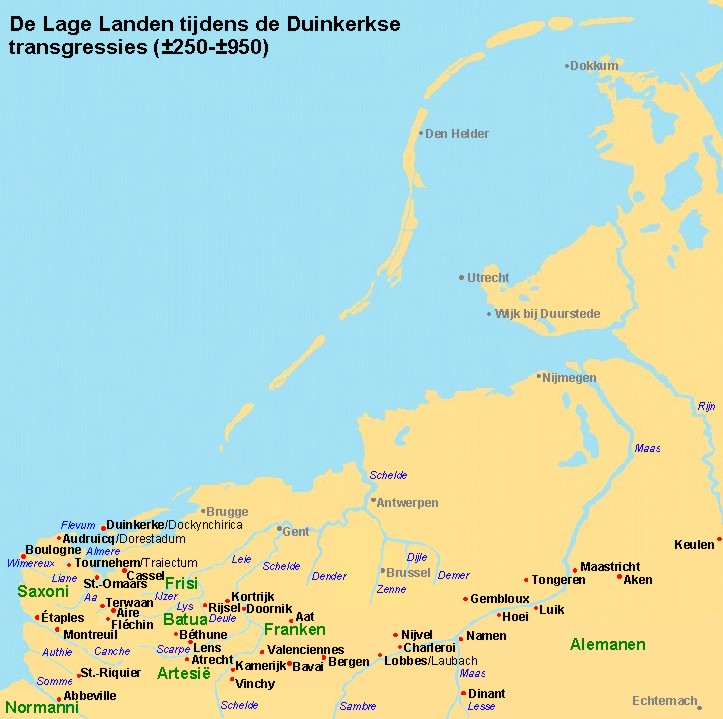
Duinkerke-transgression (250 -950)
Since the end of the last Ice Age the sea level has risen some 130 meters. With the ongoing weather and climate fluctuations this meant that the boader lines between land and water showed large variations. It wasn’t until the 11th century before serious efforts were made to keep the water out and the land dry, that more defined boarders started to occur. From the Medieval Warm Period (see next) onwards we start to get a bit better picture of climatological developments and their effect on social and economic conditions of the people.
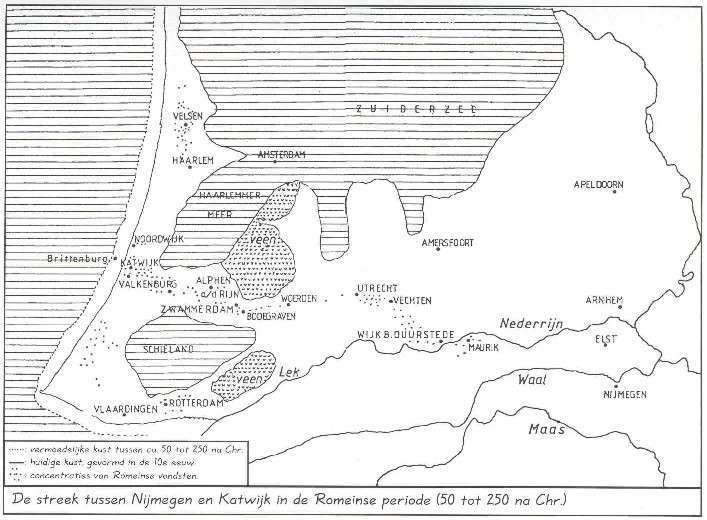
The situation in the preceding Roman and early Medieval period is far more unclear. However, it looks like that during Roman times some serious climate changes started to occur. Varies theories have been developed and abandoned (Duinkerkse-transgressie) but the effects of what happened are reasonable well agreed upon. There now seems to be consensus that the sea did n0t transgress but that surges, storms and climatological conditions resulted in the inundation of the land above the major rivers in the Low Countries.
Archaeological evidence from decades of excavations on the natural boarder line between the low lands of the river Maas and the higher sand grounds near the town of Oss in Brabant, Netherlands show that the farms that were situated in the river flats remained largely water free for a period of 2,000 years. Suddenly this ended at the time that coincided with the departure of the Romans in this region around 250AC. While there is no clear evidence that the rising water levels were the reason for their departure, there was no significant war activity talking place at that time either. Perhaps in a rapidly depopulated area the Roman boarder protection became less relevant.
The retreat from the Germanic Limes (along the river Rhine) also coincided with the start of this high water period whereby large parts of the Low Countries became uninhabitable, this included most of the coastal area except the dunes and most of the Rhine delta, not to far east of Oss the higher situated river clay areas retained occupation (near Nijmegen on the map below).
It is not until the late Middle Ages that evidence of new populations are starting to occur again in Oss. It could well be that at least some farmers moved to the higher grounds just 7 kms further to the north and that the population centre of this community became concentrated here this might also be related to the existence of a Medieval chapel linked to a legend of St Willibrord, however, there is no evidence to confirm this.
It is highly unlikely that the river flats were continuously inundated during all these centuries and names like ‘Frankenbeemd‘ could indicate that some of this land was used during that period by Franks. However, most likely this (fertile) area remained wet enough to not attract permanent settlements.
The start of the Medieval Warm Period ended this situation, perhaps that resulted in better growth opportunities that allowed swaps to change into moors. Further assisted by this favourable conditions the population grew and they started to built the dykes allowing for a more secure environment. From the start significant land reclamation occurred. However, remodelling nature also led to devastating floods in the following centuries all the way to modern time (see below).
Justinian Plague
It has been suggested that there was a cooling of temperature during the 530s, this could have been triggered by dust storms as a result of a volcanic eruption, some even suggest a comet instigated dust veil, whatever the source this might have led to the spread of pest infested fleas from the tropics into Europe.
It is the first know plague in the Middle Ages.
It arrived from Alexandria in Constantinople in 542. It has been estimated that within 2 years the plague killed 4 million of the possible 26 million subjects of Emperor Justinian. By the end of that century the total population had further declined to approx. 17 million.
The plague spread over large parts of Europe, including Gaul, but there are no indications that it reached the Low Countries.
It reoccurred here in 558 and 573 and in total it is estimated that 244,000 people out of a population of 508,000 perished. The main killer here was the pneumonic plague rather than the bubonic form.
The epidemic rapidly spread across Europe and in Clermont, France Bishop Gregory of Tours reported in 573 that on a Sunday alone 300 corpses were counted in its basilica . It even reached England and Ireland in the 7th century. Via Antioch it also spread into Persia and China. [3. Justinian’s Flea, William Rosen, 2007, p 201]
Together with the collapse of the Roman empire, the Barbarian invasions, the Justinian plague and subsequent outbreaks also devastated western Europe and were critical elements that lead to the ‘Dark Ages’. There was no longer the critical mass for new ideas and innovations, communications decline and trade largely disappeared. This lack of progress among people who again lived – as in the Bronze and Iron Ages – in small isolated communities rapidly reverted to paganism, superstition and magic.
Medieval Warm Period (800 – 1300)
The Medieval Warm Period (MWP) was a time of warm weather around 800-1300 AD. They were the warmest centuries of the past 8,000 years. There was a short so called “little Optimum” between 750 and 800 and ‘Maximum Optimum’ around 1300. The MWP was followed by the Little Ice Age, a period of cooling that lasted until the 19th century. A radiocarbon–dated box core in the Sargasso Sea (Raymond S. Bradley, Malcolm K. Hughes, Henry F. Diaz – 2003) shows that in comparison to today’s temperatures, the sea surface temperature was approximately 1°C cooler approximately 400 years ago (the Little Ice Age) and also 1700 years ago and approximately 1°C warmer 1000 years ago (the Medieval Warm Period).
Average summer land temperatures were 0.7 – 1.0C above the averages of the 20th century and in Central Europe even 1.4C higher. There was little or no frost in May and long warm and dry weather settled in in June and lasted till August.
With the melting of polar ice water levels increased and tribes along the coasts of north-western Europe struggled to survive and most likely this is one of the reasons why Saxons , Angles and to a lesser extend Frisians started to look for alternative places to live, which led to their migration to England.
A few centuries later the Vikings took advantage of ice-free seas to colonise Greenland. Wine grapes were grown as far north as southern Britain. Vineyards flourished 300-500 kms north of their 2oth century limits. But more importantly the warmer weather turned large tracks of marginal farmland into decent farmland, which supported the population explosion in Europe at that time. European farm yield were double of those as they stood at the end of the Roman period. Barren land such as mountainous areas such as in Scotland, Scandinavia and the Alps now became at least marginally productive.
Interestingly it was this warming of the planet that caused an economic and social boom that led to significant life style improvements and innovations. In many European regions life style conditions were higher during the Middle Ages than during the following 400 years, the next period of improvement didn’t start until after the Little Age Ice in the late 19th century.
Slowly the climate started to get cooler again, there was cold spell in the first two decennia of the 13th century, but then again a prolonged period of warm weather between 1284 and 1311. However, soon after that the Little Ace Age started to set in in all seriousness.
Malthusian deadlock
As a result of these favourable climate conditions we see across Europe a massive ‘internal’ colonisation of the forests, marshlands and other wilderness areas.
This also led to massive ecological disasters, land clearing and deforestation. This together and peat winning resulted in large floods which altered the northern part of the Low Countries forever. While there is no hard scientific evidence for a link between these human activities and these environmental disasters, soon after the MWP peaked the climate changed again.
More recently tectonic changes and its consequences in relation to natural disasters (volcanic eruptions, landslides) might have had an influence on changing weather patterns and also the effect of sun spots eruptions are a possible contributor to climate changes.
It has been argued that by 1300 population levels in Europe had reached unsustainable levels. Traditional population increases were followed by cutting down more forest land. By 1200 most arable land in Europe was now in use and only less fertile lands could be reclaimed by an ever expanding population. A rapidly urbanising environment brought of course a whole new level of problems with it; most importantly an imbalance between population growth and food resources. Already by 1280 wheat yields started to drop and food prices started to rise.
Quality of food intake
There was ongoing famine in Europe during the Middle Ages, if it was not in one part of the continent, it was somewhere else. Famine was often very deadly 10-15% death was not unusual, this was partly due to the very low resistance that people had against any health attacks. The low resistance had more to do with the quality of the food rather than the quantity. 80% of food intake was carbohydrates through the various grain based foodstuffs. Rye bread was unpopular so most of the bread was of the less nutritious white variety.
Perhaps one of the most difficult to understand is the total lack of hygiene. Animals roamed through the unpaved streets defecating wherever the felt fit. Human refuse was also thrown on the street as long as one three times had shouted for people to watch out. Cloths were hardly ever changed and butchers slaughtered cattle in the streets where the people lived and blood flowed freely wherever that happened. Tanners and vollers created enormous water and air pollution (and were amongst the first to be regulated to the outskirts of the towns, mainly because even medieval people could not handle that stench). What has often been said is that for modern man the most striking element of the medieval town would have been its terrible smell.
Before the arrival of the Black Death, leprosy (known to us as Hansen’s Disease) was the most feared illness. However, it is most likely that many skin diseases as well as syphilis were seen as leprosy by the people of the Middle Ages.
The period between 1350 and 1500 was a period of transition. While there was enormous poverty, death, illnesses and general misery on the one side at the same time we see the creation of enormous wealth and a large number of administrative, agriculture and commercial innovations.
Little Ice Age (1300- 1860)
The Little Ice Age was a period of cooling occurring after the medieval climate optimum. A shift in the North Atlantic Oscillator (NOA) has been mentioned as the major reason for the change. Climatologists and historians find it difficult to agree on either the start or end dates of this period and obviously also changes occurred within this period. Some confine the Little Ice Age to approximately the 16th to the mid-19th centuries. It is generally agreed that there were three minima, beginning about 1650, about 1770, and 1800/1850, each separated by slight warming intervals.
However, the climate started to change in the 13th century but it wasn’t until the 14th century before the change really started to settle in and had a devastated effect on Europe, it happened with earthquakes and devastating floods and as a result a ravaged population was by the mid 14th century extremely vulnerable to the plague and a range of other diseases. People were also spooked by increased meteor and comet activity. Interesting in recent times, these combined natural activities have been linked to climate change. Changes in the weather and an increase or decrease in ice caps can result in changes in the crust that leads to earthquakes, eruptions, land slides. Extensive solar flares also can lead to other natural reactions on earth.
During prolonged cold snaps between 1315 and 1330 most European rivers were frozen year after year, as was the Baltic Sea. In the Baltic countries snow stayed on the ground all year long.
The period continued with irregular patterns; no long term patterns as during the Medieval Warmth. Another period of severe weather occurred during the 1430s. This was followed by a period of a century of rather mild weather, with a few exceptions such as the winters of 1527-29. This was also a period of low solar activity, known as the Spörer Minimum. Periods on increased and decreased solar activity correlate rather exactly with the periods of higher and lower temperatures both during the Medieval Warmth and the Little Ice Age.
Some scientist are seeing these early disasters as a prelude to the Little Ice Age proper. The famous winter paintings from Pieter Breughel were painted during one of the most severe winters most probably in 1565. The next winter was equally devastating and certainly also assisted in getting starving people in the Low Countries to revolt against the Spanish occupation and their catholic religion (known as the beeldenstorm – iconoclasm).
Also this period saw an increase in suicides (familicides) – this peaked between 1565 and 1640. This period also recorded a large increase in plague and other epidemic outbreaks, starvation and witch burning. The latter of course directly related to finding people to blame for the bad weather. This is still a period with very little science and a strong belief in the ‘hand of God’. Some of this was also a vicious circle as often suicides were blamed for the bad weather as well.
Suicide broadside Leuven 1591
Broadsides
Printed on one side on a medium to large sheet of poor quality paper, in black-letter or gothic type and included multiple, eye-catching illustrations, a popular tune tile, as well as an alluring poem. They were performed and sung in pubs. They became popular in the late 16th century and peaked in popularity during the 17th century. It is estimated that millions of copies have been printed. They were sold by travelling chapmen (from the Dutch word koopman).
There remain quite a few broadsides from this period where the suicide stories were spelled out often in rhyme. The themes are also very similar. They describe a starving family, begging a wealthy relative, the Lord or a bishop for some food. They are rejected and consequently the family hang themselves. Next the ground opens under the feet of the wealthy person and the devil drags him to hell. There is one known from Brabant (Leuven) from 4 March 1591, it is in German and was printed in Cologne.
The heights of the Little Ice Age started to set in around 1590 and lasted until the 1850s. The glacial ‘high tide’ in the Alps lasted from around 1590 to around 1850. During the 2nd half of the 16th century storm activity increased by 85% , especially during the cold winters. The winters during the 1590s where the coldest of that century with severe famine in England between 1591 and 1597. The summer of 1600 was the coldest since the 1400s, this was a direct effect of the eruption of the Huanyaputina in Peru, ash fell as far as in Greenland, in Europe the sun was dimmed by a constant haze. More exceptionally cold winters were recorded in 1627/28 (perhaps the worst) in 1634, between 1641-43, in 1675 and 1698/99. [1. The Little Ice Age, Brian Fagan, 2002]
Low Countries prone to floods
By 3,000BC the ocean water levels had reach their current levels. The low laying countries were of course since times immemorial prone to flooding and the southern part of the North Sea was not much more than a marshy plain. Rising water levels in the 3rd century might have hastened a Roman retreat in the Low Countries and a depopulation of the of large parts of the river lands in this area. From that time until 1,000AD sea levels didn’t change much. The Medieval Warmth changed that when over a period of 250 years the rose by approx. 20 centimeters, to retreat to their previous levels when temperatures started to drop again.
The Medieval Warmth also led to a growth in population, in the Netherlands dikes were built to regulate the water management along the sea as well as along the rivers. This also allowed for large scale land reclamation which was used for agriculture. However, these alterations started to create a far more vulnerable natural environment. This in combination with the warmer weather resulted in several centuries of severe floods in the Low Countries.
Unlike floods in earlier periods it was no longer simply a matter of moving the farm a few kilometres further; villages could not be moved that easily.
One of the first recorded natural disasters occurred on December 26, 836: A large part of the northwest of Frisia was flooded by a storm. Lack of good dikes was an important cause of this flood disaster. Bishop Prudentius of Troyes describes this flood; he said there were 2437 victims.
While statistics recorded in the Middle Ages are not always very reliable, they certainly provide a good indication of the scale of the events.
On September 28 1014 the, by that time the again partially closed coast line of the Low Countries, was breached. In Zeeland the island of Walcheren suffered a particularly significant damage. It took years before people managed to get their lives back on track. The chronicle of the Quedlinburg Abbey in Saxony reports that thousands of people died.
A decade later on November 2 1024 a flood was mentioned in Annales Blandiniensis (Ghent), this one probably only affecting the Flemish coast and in particular the region of the Yser mouth.
Again, also in the next century several other major floods caused havoc again. First in 1134; the Zwin opened up as a channel connecting Bruges with the North Sea, the side effect of this was an economic benefit for the city. Thirty years later in 1163 the area further north experienced several floods. This caused dike breaches along the Maas. As a result the mouth of the Old Rhine (Oude Rijn) at Katwijk, which was already almost entirely silted up, was entirely closed of by sediment carried around by the flood. This greatly affected the land reclamations that had started in the 11th century. New dams were needed to stop further flooding and this in its turn than caused water problems elsewhere. This led to conflicts between the Bishop Godfried van Rhenen of Utrecht and Count Floris III of Holland. In 1165 the Emperor Frederick Barbarossa came to affected area and negotiated a regional agreement between Utrecht, Holland, Gelre, Cleve and Kuyc. Landlords such as van Amstel and van Woerden – situated in the middle of these new reclaimed lands – greatly profited from these new arrangements.
The First All Saints’ flood (Allerheiligenvloed) took place in 1170. Large parts of the north of the Netherlands and what became the Zuiderzee region were inundated. A channel from the North Sea was opened into the fresh water Lake Flavo (Almere lake), and it became the salt water Zuiderzee. This flood marked the beginning and spread of the North Sea, Zuiderzee and Waddenzee. Two factors causing this sea enlargement are important to mention here: first the sea area itself increased and second the presence of large peat areas, which easily washed away.
The St. Nicholas’ Flood (Sint-Nicolaasvloed) in 1196, again inundated large parts of the same region. Where the storm flood of 1170 made a beginning, this storm worsened it, washing away large peat areas. The result of this storm was the destruction of peat areas in West Friesland and enlarging the Waddenzee and the Almere Lake now officially becomes the Zuiderzee.
However, when the Little Ice Age started to set in, huge storm tides saw natural disaster on a scale never seen before. They are characteristic of the unsettled and changeable weather patterns in northern Europe at the beginning of the Little Ice Age. Without any dykes more more damage was done to life and property as the region had become more and more populated.
The veracious land reclamation that had started in all earnest in the 12th century started to have a negative effect on the land. With the peat gone, the land started to subside, which made it very vulnerable to the floods. While the coast was often protected by the dunes and the clay based lands, the water went into the lower laying lands behind it and created havoc among the many new farming communities that had settled there.
These series of floods started in North-Holland, this area suffered a large flood in 1212 which claimed approximately 60,000 victims. Two years later storm floods affected all parts of the Low Countries; again with lots of erosion in the peat areas.
The St. Marcellus’ Flood (Sint-Marcellusvloed) on the 16th of January 1219 again inundated large parts of the north of the Netherlands and the Zuiderzee region, killing an estimated 36,000 people. This was the 4th large flood in 50 years. It further shaped the Zuiderzee and Waddenzee.
Three major floods within 4 month created havoc in the coastal area of North Holland (with dune breaches most probably at Callantsoog). They took place on 20 November, 28 December 1248, and 4 February 1249. Also flooding occurred in Friesland and Groningen. Another flood hit this last province in 1277 and as in the previous one, drowned several villages here.
In 1280 the north of the Low Countries t again a major flood, this one created the Lauwerzee. Two years later a storm broke through the coastal dunes around Texel and let more sea water flood into in the by now well established Waddenzee and Zuiderzee.
St. Lucia’s flood was one of the most destructive floods ever and took place on December 14th 1287 (the day after St Lucia’s day) when the dunes of Texel were washed away during a storm, killing approximately 50,000 to 80,000 people. The salt sea swallowed sixty parishes in the Danish diocese of Schleswig as well as the town of Rungholt on the North Frisian island Strand.
It especially affected the north of the Netherlands, particularly Friesland. The island Griend disappeared almost completely under the waves. The name Zuiderzee – “Zuudzee” – dates from this event, as the water had merely been a shallow inland lake when the first dikes were being built, but rising North Sea levels created the “Southern Sea” when more floods including this one arrived. After this event several new parishes and villages started to appear, replacing those communities that had been washed away.
During the extensive rain periods between 1315-1317 most of the Low Countries were flooded again with hardly any farming being possible.
A good example of the problems as they arose was the damming of the Maas by Heusen and Maasdam in 1283. This created the Groote or Hollandse Waard. However, this area became now a target of flooding, in 1373, 1374, 1375, 1376, 1394, 1396 and finally wiped the whole area out during the 2nd St. Elizabeth’s flood in 1421 (see below).
The Grote Mandrenke Flood (Old Dutch: Great Drowning of Men) struck large parts of north-western Europe on January 16th 1362, causing the Hurricane-force winds drove enormous waves atop an incredible storm surge that greatly extended the huge inland sea.
The first St. Elizabeth’s flood of 1404 occurred on or around November 19, 1404, the namesake day of Saint Elisabeth of Hungary. The floods were especially catastrophic in Flanders, Zeeland and Holland. The area in Zeeland and Flanders had also been flooded twenty-nine years earlier, on October 8, 1375 when the Riederwaard disappeared in the waves.
Some areas untouched during a previous flood in 1375, such as the small towns of IJzendijke and Hugevliet were now totally destroyed. In the county of Flanders all the coast islands in the mouth of the Westerschelde were washed away. After this calamity John the Fearless, Duke of Burgundy (Jan zonder Vrees) gave the command to link all the dikes already existing into one large dike which ran from the north from the county to the south. This explains why the Belgian coast line is so straight. Since Jan zonder Vrees was also count of Flanders, this dike is still named Graaf Jansdijk (Duke John’s Dyke).
The first know polder mill started to operate near Alkmaar in 1407.
Detail from drawing “Bedroefde Watervloed”
The 2nd St. Elizabeth’s flood took place in 1421, during the night of November 18 and 19, a heavy storm in the North Sea surged up the rivers causing the dikes to overflow and break in a number of places and the lower lying polder land was flooded. Again a number of villages were swallowed by the flood and were lost, causing 2,000 casualties. The towers of some 20 churches was the only thing you could see here and because of that eerie view the casualties were exaggerated – even official documents talk about 100,000 casualties, however there never lived that many people here. The dike breaches and floods also caused widespread devastation in Zeeland and Holland. Also lands along the River Maas flooded, just north of Oss in Teeffelen 20 people dawned, 11 houses disappeared and also the St Elisabeth monastery was abandoned.
This flood also ended the ongoing fights between the cities of Geertruidenberg en Dordrecht (during the Hooks and Cods wars) as they were now separated by a broad new body of water.
Most of the area remained flooded for several decades. Reclaimed parts are the Island of Dordrecht, the Hoeksewaard island, and north-western North Brabant. Most of the Biesbosch area has been flooded ever since.
The 3rd St Elizabeth Flood took place on the 18th of November in 1424 flooding Zeealand, West Friesland, Friesland, Groningen and in creased the size of the Dollard.
In 1432/33 the riverlands flooded: Betuwe, Tielerwaard, Lopikerwaard, Land of Heused and Altena.
The Palm Sunday flood of 10th April 1446 flooded Zeeland, Ijsselmonde, Land of Heuden and Altena and Groningen. A storm surge in 1483 hit Zeeland and West Friesland. New river flooding took place in the Lower Betuwe in 1486 and again in 1496/97.
The storm surge of 1499 hit North-Holland, Zuiderzee and Groningen.
In 1477 the region suffered the ‘1st Cosmas and Damian (26 September) flood this hit Zeeland and Flanders but the most severe damage occurred in north Germany. The 2nd flood of this name took place in 1509 again devastating Zeeland and also Holland. In 1530 there was the St Felix ‘quade saterdach’ (bad Saturday) flood which created enormous havoc in the of the Westerschelde basin and created the Drowned Land of South Beveland.
Another All Saints flood in 1570, took the island of Bosch – situated in the Wadden Sea, between Shiermonnikoog and Rottumeroog. The devastation was in particular severe in Zeeland. This was probably the most devastating flood in the history of the Netherlands, with an estimated 20,000 death and at least 10,000 people homeless. Cattle, agriculture lands and and stored produce were all destroyed.
In all between 1134 and 1650 more than 45 large floods took place and Zeeland alone has 117 drawned parishes.
The island of Rottumeroog totally disappeared during the floods of 1717. By 2008 the island of Schiermonnikoog had moved westwards by 10 kms and medieval remnants from the old island a Bosch are now unearthed on Schiermonnikoog.
The Great Famine
In the Middle Ages, on average one in four harvests always failed. Famine was a reoccurring phenomenon in the Middle Ages, with struck the population of Europe on average one in every ten years – mostly in a rather localised way. Famine was mostly followed by plague and pestilence and they caused often more victims than famine. Famine often was also the result of poor farming techniques and difficulties with transportation and storage. The first recorded serious famines occurred in the 12thcentury (1124-6, 1140, 1195 and 1196). The 1124-6 one especially severe in Flanders with long snowy winters and cold rainy summers. In 1309 there was severe famine in Picardy (now northern France), the Low Countries and the Lowe Rhine region. However, while these certainly led to under nourishment they seldom led to large scale starvation.
The rather sudden change in climate started with a period of severe rain between 1314 and 1318; this led to catastrophic crop failures and this in turn led to massive famine at a time when more and more people had moved away from rural areas to the new towns and cities. The Great Famine – the largest ever recorded in NW European history – struck Europe north of the Alps and the Pyrenees, from Russia to Ireland.
The scale and the severity of the Great Famine at a time when – with the increased population after a prolonged period of very favourable climatological circumstances (MWP) there was little margin for failure and the results were devastating. The famines from 1315-1317 however, were very different.
During the months of May, July and August in 1315 it more or less rained non stop in most of north-western Europe followed by an unusual cold August and September. Spring rains in 1316 prevented proper sowing, harvests failed again and the rain simply continued. That year was the worst for cereals crops throughout the entire Middle Ages, this was also a year of death with many people dying of starvations. . Rain continued in 1317 and 1318. Weather started to improve in some parts in that year. However, extensive flooding in the Low Countries continued in 1320 and 1322. The NOA cycle finally ended that year. but the recovery didn’t start until 1325. Lack of communication aggravated these calamities as it could well be that only one or two districts further there was enough food that could have helped out their neighbours.
The prolonged rain also caused a heavy death toll amongst cattle and sheep, pigs survived best as they eat anything and the rain didn’t affect them. Over time up to 75% of sheep and cattle perished, this also of course very severely hit the wool trade.
It is estimated that the Great Famine killed approx. 10-25% of the population in north-western Europe. Hardest hit were England with half a million deaths and Flanders and Germany were between 10% and 15% of the urban population perished. Casualties in rural Europe were 95% of the population lived were even higher.
This was fertile ground for chiliastic prophesies; the end time was near and soon better times would arrive. Long processions of naked penitents cried to God for mercy. After decades of good harvests the population surely believed that this was a punishment of God.
Poverty and hunger are also ideal ingredients for popular uprisings and around these time we see many of them occurring, initially in England, France and Flanders. Already during the 1309 famine,armies of the poor had attacked the fortress of the Duke of Brabant. However, he had little time for these starving people and he merciless drove them away at heavy losses to the poor [2. Norman Cohn, The Pursuit of the Millennium, p 92].
There was already little room for error as in good years the agriculture yield in the Middle Ages was extremely low, with an archaic three field crop rotation system. Obviously the first lands that were cultivated where the most fertile areas, the rapid increase in population saw the need for more cultivation but this happened in far more marginally areas and was often not sufficient to feed the extra people.
As often happened in situations where the political rulers are confronted with (potential) social unrest they try to find ‘another enemy’. In order to deflect such situations kings proclaimed crusades which attracted large armies of the poor, as for example happened in 1320 when Philip V of France proclaimed the Shepard’s crusade.
Building up supplies for longer period of times was never possible, one could overcome one bad harvest but several in a row were simply unmanageable in these times. Storage in itself was a serious problem because of the large rat population in an age where hygiene hardly existed.
During the height of the killer famine grain prices in Hainault were between 25 to 30 times higher than during normal times, food prices in Paris rose by 800%, wheat prices increased by 320% in Lorraine, thus making it impossible for many of the common people to survive, rioting and theft became widespread. There was no social system in place to more equally distribute whatever food there was available.
The export of grain was also used as a political weapon. The French king used it as such in its struggle with the Flemish rebels.
The fairy tale Hansel and Gretel most probably has its origin in this period, where children were abandoned to fend for themselves. This in the fairy tale than gets linked to fantasies about food, especially cakes and sweets, to get the people’s mind away from hunger and deprivation.
However, the situation was often far more serious. Suicides during these periods increased, often involving whole families. The infallible medieval belief system also played a key role here. For example a father would kill his family and would be arrested. However, we would show repentence and as such he was saved from eternal damnation he would still be executed but his soul was saved.
The Great Famine killed fewer people than the Black Death 40 years later; however the last one was a rather quick killer while the Great Famine killed people of a prolonged period, also many people who lived during the period of the Black Death had gone through a period of malnutrition during their early childhood and might therefore have been more vulnerable to such aggressive diseases.
A similar situation occurred in north-western Europe in the 15th century. Cold weather started to appear in 1419. Northern France saw a severe famine in 1421. The winter of 1431/32 was particularly severe, most of France’s vineyards suffered from severe frost and storm damage. Storms also created havoc on the seas with many ships wrecked in Scandinavia, the Gulf of Biscay and in the Adriatic (Venice). The famine that occurred during the 1433-1438 period was almost as severe as the Great Famine from a century earlier. By 1440 most wine growing had disappeared from England, the last ones – in Ely – ceased operation in 1469.
Social, cultural and economic instability
The start of the 14th century brought lots of pressure on the European society; which created widespread instability socially, culturally and economically.
Interestingly at the same time we see an enormous growth in wealth, especially in the cities of Flanders, Brabant and northern Italy. There was a phenomenal growth in international trade and a great demand for money. Unlike the previous 800 years this was rapidly becoming a currency based economy. Financial institution to handle this effectively were limited and those who did operate within this environment found it extremely difficult to cope with these massive economic changes; adding further tension to the already volatile situation in Europe.
In the impoverished cities, famine and decease were fertile grounds for other to be exploited for their own cause. Mercenaries, crusaders, zealots, rough characters of any sort used these situations to their own advantage; this led to pillage, persecution, murder, rape for whatever reason these characters instigated amongst the poor.
Linked to eschatology phantasies, in the eyes of the people of the Middle Ages, murder and massacre was allowed in order to free the world of sin, and to pave the way for the arrival of the messiah.
The Plague broke out throughout Europe between 1347 and 1350 and was followed up by a range of waves over the following 50 years.
Most probably this devastating epidemic arrived in western Europe (Genoa) from the Crimea by mid or late 1347; caused by the bacteria Yersinia pestis (however, the cause has more recently been put up for debate), which is mainly carried by a flea hosted by the common rat. While it did reach the boarder of Brabant, in Doornik (Tournai) in the late summer of 1348, it did not ravage as bad though the Low Countries until 200 years later. One of the families covered in this publication – Henric Van Aemstel , canon at St Servaas in Maastricht – died in 1348, most probably as a result of this outbreak.
It has also been argued that because of the Great Famine – which in particular hit the youngest (and oldest) – there were therefore less vulnerable people when the Black Death arrived in the Low Countries, thirty years later.
The range of natural disasters in Europe, as mentioned above, coincided with the outbreak with the plague. The theory goes that these disasters resulted in unusual movements of rodents, who carry the bacterium. The bacteria causes bubonic plague in which black bumps develop (hence the name Black Death) an even more dangerous form of the plague was pneumonic in nature, spread by coughing and sneezing. In Medieval times it was thought that the plague was spread by foul air.
The devastation, human suffering and grief is beyond imagination. Apart from the people thousands if not millions of animals died during the Great Famine and the Black Death.
Some towns had mortality rates as high as between 50% and 80%. On average it has been estimated that Europe lost over a third of its population during the first wave.
Surprisingly the original epidemic did not have such a devastating effect on Flanders and Brabant where ‘only’ between 15% and 25% of the population became a victim of this epidemic. Some historians argue that because this region was far more severely hit by a series of famine between 1315 and 1317, where it lost a very large proportion of its children; there simply was a less vulnerable adult population by the time the pest arrived. In the highly urbanised Low Countries population levels were already at pre 1300 times, as a result of the famine and economic decline. In other areas, for example in Tuscany its pre-plague population level was not reached until well into the 19th century.
Apparently people from the blood group B were not or less effected, such as the people of Hungary.
Over the next hundred years so called ‘echo’ epidemics each saw a further 10-20% mortality rate in the regions it revenged. On a European scale the next wave of large scale epidemics occurred in 1361-62, 1366-67, 1373, 1374, 1390 and 1400. In the century following the Black Death another 30% to 40% of the total European population perished. In some the overall mortality during this century was a high as between 60% and 75%.
In the Netherlands there were epidemics in 1360-2, 1362-4 1368-9, 1371-2, 1382-4, 1409, 1420-1, 1438-9, 1450-4, 1456-9, 1466-72, 1481-2, 1487-90 and 1492-4. However, increasingly these outbreaks were smaller and less severe.
Brabant saw its populating decrease from 92,000 in 1438 to 75,000 in 1496; from here it increased again to 97,000 in 1526.
In Ootmarsum further outbreaks of the Black Death were reported in 1468, 1483,1488 and specially severe ones in 1565/66 and 1606.
In France, the English invasion (Hundred Year War), civil wars, deadly epidemics, famines and marauding mercenary armies turned to banditry reduced- between 1328 and 1470 – the population by two-thirds. The district of Caux in Normandy lost over two thirds of its villages, in all France lost over 3,000 villages. The situation in France only started to approve after the end of the Hundred Year War in 1453. Interestingly in Avignon, where Pope Clements VI resided during the height of the Black Death, some 400 people a day died. His court physician suggested they lit fires around the castle and indeed the pope survived.
At the same time a range of new epidemics started to cause havoc. In 1440 a major small pox (red plague) epidemic swept through Europe. In 1460 a flue epidemic swept through France, the Low Countries, Spain and eastern England. The sweating sickness (Picardy sweat) appeared six times between 1485 and 1551, mainly in the region around the English Channel, each time claiming around 10% of the effected population. Water pollution led to a range of other illnesses such as intestinal dysentery (bloody flux), infant diarrhoea. Added to this sorrow list were ‘modern’ diseases that arrived in the 15th century such as typhus, syphilis, gonorrhoea (French pox). The venereal diseases created severe havoc in the various armies.
The Black Death devastated Venice in 1348 and once again between 1575 and 1577. In three years the plague killed some 50,000 people. In 1630, the plague killed a third of Venice’s 150,000 citizens.
In the archives of Wietmarschen a plague epidemic was mentioned around 1400 and in 1564, 1577 and in 1630, when 50 people died, another epidemic six years later. During the Thirty Year War (1618-1648) a further a third of the German population was killed.
There were a further nine major pan-epidemics between 1521 and 1683.
Oss saw a particular devastating bout of this illness in 1599 which killed hundreds of people, perhaps as much as between a quarter to a third of the population at that time.
Infant mortality was around 50% during the Middle Ages.
Amazingly, very few people ever made a link between the appalling hygienic conditions and these epidemics.
These seemingly random ‘attacks’ had a profound effect on the population they were very heavily occupied with death; this is very noticeable in the way religion operated during these ages and in the art and literature of these times. Inevitable these disasters where blamed on God’s wrath on humans and their sinful behaviour.
Chevauchée – scorched earth warfare
Throughout history we see the most devastating military tactics used on the general population and north-western Europe received more than its fare share. Unprotected properties and fields were destroyed by bands of raiders.
Ever since tribal Europe, wars have been the norm rather than the exception. War was an annual event among the Germanic and Celtic tribes to obtain booty. This secured the tribal leaders prestige and wealth and also allowed them to keep control over the other ‘nobility’ within the clans. Homage was an important element in order to secure piece between wars. These raids were not aimed at conquering land or occupying other areas.
These warring activities got a far more devastating character during the Gallic Wars of the Romans, when Germanic and Celtic tribes were simply wiped of the map. They also allowed other tribes to do the dirty work for them by allowing them to settle in other tribal areas where they could plunder as a reward for services provided to the Roman Empire.
During the Carolingian period , war was still more along the lines of the tribal wars, and didn’t have a significant effect on the local population, outside these ‘war zones’. After the collapse of the Carolingian Empire however, it became a battle whereby every single lord started to create its own little territory, complete with fortifications. This period was more or less completed by the year 1000.
More lords meant more war. Initially these wars were fought between nobles and their relative small armies (knights), and while thousands could die they still had rather little effect on the local population. Their misery was more indirect. Increasingly however, mercenaries were hired in to fight with the warring nobilities and often in between jobs or otherwise roamed the land plundered the farms and ravaged relentless. The reality was that these war lords devastated farming lands and often forced local farmers to join in their battles.
These activities were scaled up during the Hundred Year War (see below) this saw the scorched earth technique being used as a tactic and was widely deployed by the English King Edward III. He deployed the scorch earth raids (chevauchée) in northern France – as an alternative to the usual siege warfare – instead concentrating on the unprotected population in order to create fear and havoc and sometimes also to force the French King into an attack. A significant goal was to use this raids to pay for the army that he needed. However, most of the proceeds of these raids ended up in the pocket of the officers (English nobles) there are still several castles in England that were built from this booty. Very little of the money ended up in the coffers of England, who continued to struggle to pay for the war effort. The conquered territories in France were severely impoverished and unable to provide any serious financial contributions to England. This “living off the land” began as simple freebooting, but quickly transformed into pâtis, or “ransoms of the country”.
Board and abandoned soldiers started to form their own rather well organised raiding bands (known as the routiers of the Free Companies) and committed some of the most atrocious crimes of war in France. Anybody who had not fled in time to a fortified place was slaughtered often in the most cruel and violent ways. Women were raped and than murdered, again often in the most unspeakable ways.
Later war lords continued this lowest form of warfare. The Duke of Gelre and his military leader Maarten van Rossum also used these tactics and Oss was raided and scorched in at least 7 campaigns between 1350 and 1550.
The Thirty Year War in Germany had a similar devastating effect, with close to a third of the population murdered or starved to death through the destruction of their fields.
Many of the war lord wars in Africa in the 21st century are exactly the same, shear plunder and devastation without any social, political or even religious cause.
Hundred Year War
The Hundred Years War was a conflict between France and England, lasting 116 years from 1337 to 1453, it was more of a series of campaigns rather than an continuous war; it finally ended in the expulsion of the Plantagenets from France.
The war was fought primarily over rival claims to the French throne. The history of that situation started in 1066 when William of Normandy conquered England, and as such forced England to accept overlord-ship of the king of France over its possessions in France. At that time, in feudal Europe, this was quite acceptable. However, over the next few hundred years feudal kingdoms started to grow into sovereign nations and the inevitable would lead to a conflict of English possession in France’s sphere of influence. Known as the Duchy of Guyenne, this territory had evolved from Aquitaine that had become an English possession in 1154
Another trigger for the Hundred Years war was when, after the Carpetian dynasty had died out, the House of Valois claimed the title of King of France. This was disputed by the Plantagenets from England, King Edward II claimed the French crown for the House of Plantagenet – trough his marriage with Isabel the sister of Charles IV. However, this was reacted by the Paris Parliament. The Plantagenet Kings in England, also known as the House of Anjou, had their roots in the French regions of Anjou and Normandy.
When, in 1334, King Philip VI of France provide refugee to the 10 year old son of the King of Scotland, England saw this as an act of war. When it was announced the France was considering sending troops to Scotland, King Edward III started to prepare for war against the French. He bought allies on the continent, the Counts of Gelre, Juliers and Limburg, the Duke of Brabant was promised the enormous amount of £60,000 over 4 years. Count Willem II of Holland and Hainaut also supported Edward – who was married to Phillipa, the daughter of the Count – and as such provided some useful relations to the king.
Holland and Flanders both depended on the wool trade with England. The Flemish refusal to support Edward led to to the move of the English Staple to Antwerp in Brabant. This led to a sharp economic decline in Flanders and resulted in a popular uprising that was started by the weavers led by the rich wool merchant Jacob van Artevelde. The Count of Flanders had to flee, Flanders joined the English cause the the Staple was restored in Bruges. The official starting date of the war is 24th May 1337 when King Philip declared that Guyenne had been forfeited by Edward, because of his disrespect for the rights of the French king.
The first phase of the war lasted from 1337-1360. This started with raids from both sides and finally England launched a full scale ground attack on France in 1339. For that occasion he had set up court in Antwerp where he stayed with his family during the winter of 1338/1339. His son John was born in Gent (John of Gaunt). The English were winning several key battles mainly because of their superior military techniques. In 1340 they destructed nearly the total French fleet in Sluis (Low Countries). The battle of Crécy in 1346 saw some very serious strategic military mistakes from France and as a result more than 1500 French lords and knights were killed, among them the Duke of Lorraine, the Counts of Alençon, Auxerre, Blamont, Blois, Flanders, Forez, Grandpré, Harcourt, Saint-Pol, Salm and Sancerre, overall casualties will have been well over 10,000. The following year the English took Calais and for 200 years this town would be the English gate into France. For those nobles who excelled in the was, Edward founded, in 1348, the Order of the Garter.
Most likely because of the devastation of the Great Death most military activities subsided until the next major battle, in 1356 at Poitiers, another incredible French military blunder against an English army many times smaller than the French force. The defeat and the consequent effects on the population led to the peasant uprising in 1359, known as the jacquerie. The English continued their devastating chevauchées, without any protection from their rulers, who in order to built up their armies again, increased the taxes. Their own Lords didn’t shy away from seizing crops and animals in order to raise money to either pay ransoms for family members captured by the English or in order to rebuild their armies.
A cease fire followed and the peace treaty of Bretigny was signed in 1360 where England was given sovereignty over Gascony. Interestingly – as a result of the feudal history – many French soldiers fought on both sides. Furthermore at times at least also Burgundy and Aquitaine providing notable support to the Plantagenet side. Changing alliances remained a continuous feature of the war.
For his brave behaviour during the battle of Poirtier – which France lost – Philip, the fourth son of the French King John II (born in 1342), received his nickname ‘the bold’ . As a 14 year old the prince had shown great courage during this battle and as a reward received at the peace treaty in 1360 the fiefdom of the duchy of Touraine (Loire Valley), which in 1363 he swapped for the more prestigious Burgundy. He would later marry the daughter of the Count of Flanders and as such extended his territory into the Low Countries. However, this bestowal enraged the King of Navarre, who also held claims on Burgundy and as a result even more havoc was created in France with Navarre often playing a deceiving role in the context of the Hundred Years War.
When France invaded Gascony the 2nd phase of the war started in 1369, this time the French were far more successful. By 1372, Aquitaine did no longer exist and Guyenne was diminished; the English could only just hang on to Calais and a small area around Bordeaux. A failed armada invasion of France ended to cost the British Treasury the phenomenal sum of £900,000. The enormous costs of the war – fought in foreign lands – resulted in ongoing financial problems; already before this period of the war started the English treasury was empty.
While an enormous amount of loot was generated that nearly always ended up, as mentioned above, in the hands of the nobility. Often very little, or no, money was available to pay for the troops. The devastation caused by the raids also resulted in a very low yields from the conqureed terretories, they were so impoverished that they were unable to contribute in any serious way to income generation for England. Because of the lucrative gains made by the nobility they were able to continue the war, basically through chevauchées. They also missed at this time the leadership of Edward III, who was old and frail and John of Gaunt who was basically in charge did not have the same strategic insights as his father.
The following decade is characterised by peace treaties, a truce was signed in 1374 at Périgueux, followed by a two year truce signed the following year, which covered all of France. A permanent peace conference was established at Bruges which was attended by John of Gaunt and Philip the Bold of Burgundy.
Despite possible good intentions the war started again in 1377 – the year Edward III died – he was succeeded by his grandson Richard II, who was still a minor at this time . Also the French King Charles VI was still a minor at this stage. Greedy uncles on both side were the real powers behind the scene, who were more than happy to keep the war going for their own gains. Philips the Bold had become the defacto ruler of France, which would last for six years. The other French power house Anjou and this duke was at this stage more interested in their Neapolitan interests. New taxes were levied in England that led to the Peasant Revolt of 1381/82. Similar taxes resulted in similar uprisings in France, Philip the Bold acted swiftly and crushed the farmers and the those involved in the popular revolt in Paris.
With the strength of the French at a peak they were ready to invade England, for which they had – in 1385 – assembled a mighty fleet in Sluys. Illness of Philip the Bald delayed the invasion and bad weather the following year led to the final called off .
In 1398 the English and the French reluctantly signed a truce for a period of 28 years.
During the war the trade between Flanders and England was often severely disrupted. Piracy on both sides was used to disrupt the trade. The truth signed in 1396 did see a restorations of this trade, however, piracy was often not so easy to stop.
King Richard II tried to stop the war by marrying Isabella of Valois. However soon after his death the war started again in 1415, with the landing in Normandy of 8,000 archers and 2,000 men of arms in 1500 ships . They had their famous victory later that year at Agincourt, when they conquered nearly all of northern France. The actual 4-hour long battle was – even by medieval criteria – more like a massacre with unspeakable atrocities conflicted on the disorganised and immobile coalition of French and allied troops. Constant rain had turned the battle field in a gigantic mud pool. The French had lost more than 10,00 men among them the Duke of Brabant and, in all, more than 120 nobles and 1,500 knights. At the Treaty of Troyes, King Henry V of England was appointed the regent and heir of the French King Charles VI. Soon after England also invaded southern France.
In 1421 the French (Armagnacs and Scotts) had their first victory, defeating an English at Bauge in Normandy. During a revenge campaign later that year King Henry fell ill and while the English were able to hold on to their power they were clearly reaching the end of their reign, a severely disgruntled army, a dying king and an empty treasury made it increasingly more difficult for the English to hold on to France. The English nobility continued to enrich themselves from their French properties and continued as there was no end in sight to their luxury and many built their own chateaux and hotels in the cities and in the countryside. In the meantime the French were subject to a ferocious taxation system. As the taxation was not enough to maintain the English presence in France, chevauchée were launched to compliment the money through raids. Surely not a good recipe to obtain the loyalty of the people. Henry V was succeeded by his six week old infant Henry VI (Henri II of France).
Duke Philip the Good was dutifully offered the regency of France but he declined. The Duke of Bedford became the regent of France. In 1423, he married Philip’s sister Anne of Burgundy.
Events in 1424 – which had nothing to do with the war – became a turning point. Duke Henry of Gloucester fell in love with Jacoba of Bavaria, Countess in her own right of Hainault, Holland and Zeeland. She was married to Jan II of Brabant was this was a very unsatisfactory marriage for her. In the following conflicts Jacoba positioned herself against Philip the Good, she fled to England married Henry and organised an invasion army to fight Phillip the Good. These events became the start of the souring of the relationship between Burgundy and England. The Duke of Gloucester proofed to be a first class intriguer, he also stirred the political pot in England what only increased the tension between the two allies. The invasion had failed but Gloucester organised a second invasion which was successfully stopped by the Regent and this saw the relationship between the allies restored. The marriage between Gloucester and Jacoba was nullified by the Pope and in 1428 Jacoba had to sign a peace agreement with Philip, the so called ‘Kiss of Delft’.
The final phase of the war started in 1428 when Jeanne d’Arc spurred on the French king to resist the English. While her heroic position only lasted a few year it revitalised the French. In 1430 she was captured by a Burgundian soldier, handed over to the English, she was tried for heresy and burned at the stake on the market place in Rouen the following year. This episode of the war saw again a massive devastation of the northern part of France. Philip of Burgundy was handsomely paid for his support during this campaign.
Jeanne d‘Arc – Joan of Arc
This one of the most remarkable persons of the Middle Ages and while there is a lot of myth surrounding her, there is also a lot of information available with historical facts. It is also important to put her in the context of the time. On the one side France was in the middle of a civil war, where two groups fought against each other for the leadership of the country. Furthermore, at this time everything religious was handled as serious as we now treat science. She indicated that she had a message from God (she was 13 at that time) and while that was not unusual, theologically it had to be established if this was indeed the case and if that message came indeed from God or if it was disguised and came for the devil. So after thorough investigation by the clergy it was agreed that the voices she had heard came from God. Now she still had to convince that she indeed could lead an army to defeat the English. At the age of 16 she received a rather small army of soldiers to try and break the English siege of Orléans. In the meantime however, her fame was spreading like wildfire and that in itself inspired the French soldiers and the French people to have faith in themselves, this faith had totally disappeared because of the weak leadership from the French King Charles VII. She indeed broke the siege and defeated the English and brought Charles through enemy territory to Reims where he was crowned. Charles indicated that the job was done but Jeanne wanted to continue the battle and drive the English out of all of France, she went on the Paris, however, without the military support she failed and with this her ‘magic’ disappeared.
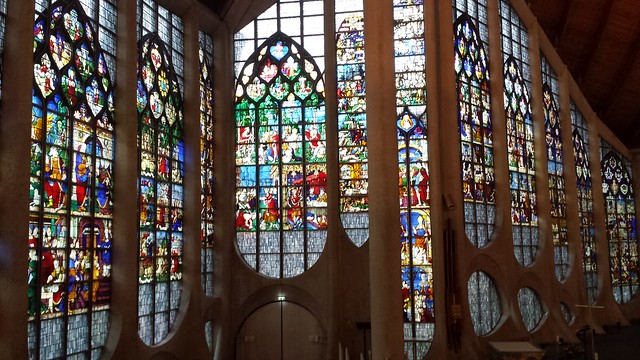
When she was captured by the Burgundians – who supported the English – she was imprisoned and ininterrogated in Rouen, Normandy by the (French) clergy but those on the side of the English and they concluded that the voices she had heard where from the devil. After the verdict she was handed over the English and as a heretic and in 1431 at the age of 19 she was burned at the stake. Twenty-five years after her execution Pope Callixtus III examined the trial, debunked the charges against her, pronounced her innocent, and declared her a martyr.She was beatified in 1909 and canonised in 1920. We visited Rouen, where next to the marketplace on the spot where she was burned a beautiful church was erected in honour Saint Jeanne.
Rouen – Church of St Joan of Arc
Finally in 1432 the French started to make progress, they were able to create havoc in several of the cities occupied by the English In that year also Anne of Burgundy died. Bedford remarried a year later with a daughter of one of Philip’s richest nobles, without his consent which – in the tradition of the Middle Ages – was yet another blow to the alliance. Philip started to distance himself from Bedford. He was worried that a weakened English power could look for a compromise with the Dauphinists, so instead he started diplomatic talks with them. In 1433 he tried to arrange – with the support of the Pope – a settlement between the three parties England, Burgundy and Dauphinists. The English were not enthusiastic and this undermined the position of the Regent. He was unable to raise enough money for the war effort, and English troops in France were close to starvation, which led to mutinies in Calais in 1431 and 1441, there were more chevauchées, massacres and peasant revolts.
Philip of Burgundy recognised that this situation had to change and again pressed for a peace conference in Arras. However, despite Philips utmost efforts the English couldn’t come to an agreement as they held on to their rights on the French Crown after 6 weeks of talks their delegation left for England. Just a week later the Regent died in Rouen.
Philip sensed that the end was near and he switched sides and signed while still in Arras a treaty with the French in 1435. Henry VI was shattered by this move. This new alliance became a turning point in the history of this war as there was now a united France and England had no longer military support on the continent. The political support of Burgundy had assisted England to get the assistance of those Frenchmen loyal to the Duke of Burgundy who opposed the rule of the Dauphin and the Armagnacs.
During the truce period between 1444 and 1450 under a the leadership of the matured French King Charles VII the country rebuild military power, he created a standing army with well trained soldiers and they used the latest military technology – the cannon.
The English unexpectedly broke the truth in 1449 and sacked the town of Fougères . Charles retaliated and send an of 30,000 into Normandy.
The following yea,r after the first decisive battle won by the French at Formigny, the English were kicked out of Normandy, they could hardly belief it and it took the reigning English nobility who had comfortably settled here in a false sense of security by surprise, many of them scrambled to get back to England. Still convinced of their superiority the firmly believed that they could recapture Normandy, however when they organised another invasion they not only were unable to recover Normandy, but during the battle of Castillon in 1453 also lost Guyenne. Finally, after an occupation by the Plantagenets of 300 years, its capital Bordeaux fell in 1457. The invincible English archers from 100 year ago were no longer a match against the modern army that France had brought together which was using the latest technology in fire weapons (cannons and a sort of handgun).
Still the English did not believe their defeat and tried unsuccessfully a few more times to invade France. Their Kings for centuries hang on to their title of King of France. The lost Calais in 1558 and it was not until 1802 that a final peace treaty was signed in Amiens.
The ongoing uneasy relationship between the two countries has its origins in this ugly war of plundering and murdering.
After the end of the war those plundering Englishmen with little else on their hand turned their weapons on to themselves and started the equally ugly and bloody War of the Roses between the Planagenets and the Lancastsrs for the throne of England, this – in 1485 – also brought an end to the Plantagenets in England.
Table – Climate events and their effects – North-western Europe
Time
Area
Climate event
Social effects
Other effects
13000BCE
Northern Hemisphere
End last Ice Age
11000-10000BCE
Northern Hemisphere
Younger Dryas
1000 yrs of cold weather
Reverse Gulf Stream
6000BCE
Europe
Warming
People arrive back to nw Europe
2180BCE
Egypt
El Niño draught
Near disintegration of civilisation
Govt unable to feed its people
145BCE
Greece (Santorini)
Volcano eruption
Atlantis legend?
500BCE
Scandinavia
Cooling
Migration into Europe
250 – 800
Low Countries
flooded
Depopulation
Romans abandon the Limes Germania
530s
Europe
cooling
Outbreak of the Justinian Plague
800
South America
draughts
Collapse Maya cities in Yucatán
Environmental disasters + war + exploitation by elite
800 – 1300
North western Europe
Start Medieval Warmth
Population growth
High agriculture yields, deforestation, Vikings
836
Northwest Frisia
Flood
2437 deaths
28/9/1024
West coast Low Countries + Walcheren
Flood
Thousands of deaths
Brugge connected to the sea
2/11/1024
Flanders-mouth Yser river
Flood
1125
North western Europe
Famine
No massive starvation
1134
Flanders (Zwin)
Flood
1140
North western Europe
Famine
No massive starvation
1163
Low Countries (Katwijk)
Floods
Totally silted up the Old Rhine. Seriously effected land reclamation,
Led to war between Utrecht and Holland in 1165
1170
Northern Low Countries
All Saints’ flood
Fresh water lake (Almere) became salt water Zuiderzee
Reclaimed (and peat) lands inundated by salt water
1195 and 1196
North western Europe
Famine
No massive starvation
1196
Northern Low Countries
St. Nicholas’ Flood
Enlarging Zuiderzee
Peat land West Friesland disappear
1203
Greenland, Iceland
Unusual cold winter
Shipping problems
1212
Northern Low Countries
Flood North-Holland
60,000 victims
1215
Russia, Poland
Unusual cold winter
Famine
1219
Northern Low Countries and Zuiderzee region
St. Marcellus’ Flood
36,000 killed
Further shaped Zuiderzee + Waddenzee.
20/11/, 28/12 1248, and 4/2 1249
Coastal area North Holland
Floods
Drowning villages in Friesland + Groningen
Dune breaches Callantsoog
1277
Friesland and Groningen
Flood
Drowning villages
1280
Northern Low Countries
Flood
Created the Lauwerzee
1282
Texel
Flood
Enlarging Zuiderzee and Waddenzee
1284-1311
North western Europe
Unusual warm weather
Vineyards England
End of Medieval Warmth
1285
?
Volcanic eruption
Food shortages
Cooling nw Europe
14/12 1287
Northern coast
St. Lucia’s flood
50,000 -80,000 victims on Texel. Name Zuiderzee – “Zuudzee” – dates from this event.
60 parishes Danish diocese Schleswig ; town of Rungholt on island Strand.; island Griend disappeared
1300
Start Little Ice Age
Cooling
Depopulation
Famine, epedemics
1309
Picardy, Low Countries, Lowe Rhine region
Famine
No large scale starvation
Armies of the poor attacked fortress of Duke of Brabant. He merciless drove them away at heavy losses to the poor.
1315/17
North-western Europe
Heavy rain fall
Great Famine 1317-1325
1315 French army bogged down lost battle with England. Philip V of France proclaimed Shepard’s crusade (1320)
1347-1350
Europe
Black Death
16/1/1356
North-western Europe
Grote Mandrenke Flood (Great Drowning of Men)
1360-1364
Low Countries
Epidemic
Severe casualties (10%)
1366-67
Europe
Epidemic
Severe casualties (10%)
1373
Groote Hollandse Waard
Flood
1373-74
Europe
Epidemic
Severe casualties (10%)
8/10/1375
Zeeland and Flanders
Flood
1376
Groote Hollandse Waard
Flood
1382-1384
Low Countries
Epidemic
Severe casualties
1390
Europe
Epidemic
Severe casualties (10%)
1394
Zeeland, Groote Waard, West Friesland
Storm surge/flood
1396
Riverlands, Groote Hollandse Waard
Flood
1400
Europe
Epidemic
Severe casualties (10%)
Wietmarschen reports epidemic
19/11/1404
Flanders, Zeeland and Holland
St. Elizabeth’s flood
Ijzendijke, Hugevliet destroyed., coast islands in mouth Westerschelde washed away.
Duke of Burgundy orders to link all dikes already existing into one large dyke (Duke John’s Dyke).Explains straight Belgian coast line .