During the Merovingian period wealth was still based on plunder but increasingly war lords were paid in land. This led to the emergence of a range of landowner estates, especially in the heartland of their realm Austrasia.
They soon had properties exceeding the size of their kings, they were running out of options to pay their war lords and this became a critical part of the demise of the Mervingoian Empire. The kings still had a symbolic function but in reality since around 650 they didn’t have any real power anymore.
The most powerful landowners became the mayors of the palace, comparable with the function of prime minister or minister of defense. It were they major of the palaces who became the effective powers, they continued the strong alliance with the wandering Irish and British monks and that would in the end help them to get the legitimacy to replace the kings by their own dynasty that of the Carolingians.
Many of these estates grew into important domains and allowed these new elites to built their power base around their own court (curtis), often from the remnants of the positions of the ‘comes civiatates’ – the military district commanders of the late Roman cities- these rulers became known as counts. But when they received greater autonomy the moved their power bases to the rural areas such as the fertile valleys of the rivers Maas and Mosel, where they owned many farming estates and mixed with the large indigenous landowners. The Pippinides are one of the most famous of these rural elites, with Charlemagne born probably at one of these rural castles in Herstal. It is interesting to note that there was already during the late Roman times a network of large landowners in the old Germani cisrhenani region which included parts of modern Brabant, it was with such groups that the Pippinides and others started to mix. While there are certain reference to this , so far no firm evidence of exact locations or estate names are known.
With the arrival of the Carolingians a change to the land payments system was introduced. Charles Martel, didn’t want to fall in the same trap the Merovingian kings fell into, who saw their wealth basis (landownership) rapidly eroding through heritage divisions, land donations and immunities. Charles changed the system in one of fiefdom. In order to not loose ownership, land and privileges were given in fief and at least initially was only for a certain duration (lifetime) slowly unavoidably however, hereditary crept into this system. It wasn’t until trade started to create a monetary economic system that money started to replace land as the basis of wealth.
During the 6th and early 7th century we also see a more defined split among the Germanic tribes. The Frisii occupied the coastal areas above the main rivers all the way to river Elbe in the east. The Franks were situated below the main rivers with Nijmegen the boarder town, further to the east the Saxons held power. All three groups formed through etnogeneses (combining different tribes into new ethnic groups). Over time these different groups were further combined into what would become the Low Countries.
There is very little archaeological evidence from this period in most of north western Europe. But slowly the population starts to increase again around the new domain system and increasingly also supported by an improvement in climatological conditions. In Oss there is some evidence of occupation on the Heuvel and also to the south where the iron age and Roman farmlands were, we do see some occupational evidence again (The Mun).
The organisation was still very much along the lines of the Germanic tribal arrangements. Decisions were taken by the ‘freemen’ (vicini, ceorls, liberi homines) within the tribes during their regular assemblies (ding/mallus/campus) where the freemen decided about the upcoming raids as well as all other major decisions that needed to be made as a community. All freemen were also obliged to provide fyrd (heervaart, leidang) their participation in a sort of short term militia.
Later on under Charlemagne the assemblies were limited to three per year and the most important annual campus meetings was moved to May (campus maii). All freemen were now obliged to participate in these meetings and increasingly the freemen had to make room for the edhilingui (edelingen- nobles). In an increasingly more Christianised society these events were- especially from 788 onward – also used to issue new canons and law. Under Charlemagne the freemen started to take on juridical positions as scabini (schepenen, sheriffs, bailiffs, officials). When villages started to emerge these scabini – at a local level – were chosen from among the local freemen. The freemen combined were also allowed to use and manage the commons. Once feudalism started to set in, the power of the freeman diminished and was taken over by the (lower) nobility, who became – as we will see below – powerful vassals under Charlemagne.
Secular or religious powers?
The origin of the power struggle between church and state (Investiture) is closely linked to Roman Emperor Constantine I. He warmed to Christendom, influenced by Bishop Eusebius who held the carrot in front of him that the Emperor was ‘the Expected One’ the ‘David’ of Christian prophecy and his Empire, the Messianic Kingdom. Constantine liked this war-like leadership and while the populace was rather reluctant to give up their pagan Gods, the leadership certainly saw the advantages of this new cult – as it was still seen at that time. Constantine wanted to establish Rome as the centre for the new imperial cult of Christ, however, fierce opposition from this city forced him to establish this centre in the new eastern capital of his empire, Constantinople.
He became the first catholic emperor (being it at only at the very end of his life, on his deathbed in 336).
Forged document (known as the Donatio Constantini) were a few hundred years later used to prove that he donated his palace in Rome, his imperial insignia and all of his authority over the western part of his Empire, including the city of Rome and all of Italy and the islands to the West to the Pope. Constantine would keep the eastern Empire for himself (Byzantium).
According to this forged document special secular powers were given to the pope. He saw himself as the custodian of what was left of the Western Roman Empire. He used the power vacuum that was created after the death of Emperor Justinian in 565 (he reconquered, for a short while, most of the old Western Empire). It was the church who, at least in Rome and parts of what is now Italy, was able to step into this vacuum and thus obtaining that dual role. However, the Lombards, a Germanic tribe originating from the middle Elbe region, conquered northern Italy in 568 and they didn’t accept papal authority over these papal lands.
Since the reconquest Rome had been part of the Byzantium Empire, however the difference in culture and at occasion religious interpretations as well as the distance did not create a strong relationship between Constantinople and Rome. At the same time the Langobards started to put their stamp on the region and claimed more and more secular powers also in areas which previous fell under the papal jurisdictions. Only after 600, when the Langobards converted from Arianism to Catholicism were they more inclined to treat the popes more favourable, but like the Franks in the north they did see a clear distinction between religious and secular powers.
Ever since the baptism of Clovis, the Frankish kingdom had identified itself with Catholicism. Thanks to Boniface, pope Gregory II had heard of the Franks and their success in the north and was very impressed by Charles Martel’s defeat of the Moors in Tour. Increasingly he started to look at ways to get the Franks military support to protect the Papal States.
The question is how much these alliances had to do with power and wealth and how much with with true religion. There certainly was piety especially among the Merovingian women at the court, they were the leading force behind the early conversions between 550 and 750. They were staunch supporters of the missionaries. These missionaries increasingly also received the support of the rulers, especially between the the reigns of Pippin II (700) and Louis the Pious (840). However, on the male side the alliances had perhaps more to do with a good excuse to extend their territories into ‘pagan’ areas. At the Concilium Germanicum in 743 it was established that bishops and priests had to be supported by secular powers in their battle against pagan beliefs and traditions. The foundation of mission-episcopacy in the new territories such as Osnabrück (783), Paderborn (785), Münster (802 ) and Hamburg (832) have to be looked at from a perspective of conquest. More than a century later Holy Emperor Otto I was also able to establish the episcopate of Magdeburg (968), in charge of christening the region east of the Elbe, again further strengthening his secular powers of this region.
On a more positive note, as the crowning of kings was a sacrament, the laws and institutions under which the king had to operate were treated as very serious issues. Kings had to be just and protect the people (and the church of course). Over time these laws became more complex and from here the royal and later state institutions started to evolve.
Especially during the reigns of Charlemagne and Louis the Pious, we see very dedicated religious kings, who felt the full responsibility, not only for political and military security but also of the spiritual well being of their people. This was a sacred kingship and this was taken very serious also by counts and dukes, even when they challenged the powers of the kings they at a minimum accepted his sacred powers as their overlord.
The Frankish-Papal alliances established during this period were continued during the Holy Roman Empire – this names says it all.
Unquestionable faith in the Catholic religion, is one of the most remarkable aspects of the Middle Ages and this started to become widespread during the Carolingian period; violence and piety went hand in hand during most of this period.
Perhaps the key differentiator between the Merovingians and the Carolingians is that Frankish-Papal alliance, which will create different history going forward.
The Arnulfings
Arnulf of Metz (August 13, 582 – August 16, 640) was a Frankish noble who, as a bishop, had great influence in the Merovingian kingdoms and was later canonized as a saint. Legend has it that he was the grandson of Ansbertus, a member of a senatorial family of southern Gaul.
He was born near Nancy. Arnulf stood out for his distinguished service at the Austrasian court under Theudebert II. At the age of thirty he wanted to retire from public life. Instead, in 614, he was made bishop of Metz, even though he was still a layman at the time. In 613, Arnulf and Pippin I of Landen, led the opposition of Frankish nobles to Queen Brunhilda of Austrasia. The revolt led to her overthrow, torture, and eventual execution, and the subsequent reunification of Frankish lands under Chlothar II, the dowager queen’s nephew.
From 623 (with Pippin of Landen, then the Mayor of the Palace), Arnulf was an adviser to Dagobert I. He finally retired in 627 to a mountain site in the Vosges, to implement his lifelong resolution to become a hermit. His friend Romaric had preceded him to the mountains and had already established the monastery of Remiremont there. Arnulf settled there, and remained there until his death twelve years later.
Before he was consecrated, he married Doda and had the following children:
Ansegisel, married Begga, and their child was Pippin the Middle.
Chlodulf, like his father, became bishop of Metz.
Before his ordination Chlodulf had married an unknown woman and had begotten a son also called Arnulf.
In 657, he became bishop of Metz, the third successor of his father, and held that office for 40 years. During this time he richly decorated the cathedral St. Stephen. He also was in close contact with his sister-in-law Saint Gertrude of Nivelles and with Remaclus (see both below).
Through Remaclus, Chlodulf also became the tutor of Trudo, a young nobleman from Hebaye, who founded the monastery of Sarchinum (St. Trond) between Landen and Tongeren.
He died on 8 June 696 or 697 in Metz and was buried in the church of St. Arnulf. In Nivelles he was locally venerated as Saint Clou, especially because of his connection to Saint Getrude.
Through Ansegisel the Arnulfings continued their dynasty through the Pippins.
Pippines
Pippin (Pepin) I – Founder of the Carolingians
The Pippin family under the leadership of Pippin I (Pippin of Landen) started in the early 7th century, they played a key role in the power struggles which took place in the dying days of the regime of Brunhilda. After her death in 613, Pippin took a leading role in reshaping the Merovingian structures in the period after this. He was able to reunite the many fractions and in the meantime carve out a leading position for himself. Through marriages he was also able to influence the various important functions throughout the kingdom. The new king Chlothar II appointed Pippin as the mayor of the palace.
Grimoald I – first attempt to overthrow the Merovingians
After Pippin’s death his wife Itta and daughter moved to Nivelles and played key roles in the religious development of the region. His son Grimoald had to earn his position as mayor, and he proofed his qualities in that respect. He inherited the above mentioned immense properties from his father in Frisia all the way down to the Meuse and Rhine valleys. His main seat of power was the palace in Metz.
He also worked very closely with the female members of the family to further expand religious works of the monks and bishops that went through the region founding new monasteries and churches.
After the death of the young king Sigebert III in 656, Grimoald felt himself strong enough to undertake the first Carolingian coup d’etat. This event had more to do with family intrigue rather than a military intervention. However, in the end it failed. He did not have the legitimacy needed to take over the royal crown.
Pippin II – strengthening catholicism in the region
After Grimoald death in 662, the Pippin line went on through his nephew Pippin II, he represents a direct link with the Arnulfings through his sister Begga, who was married to the Arnulfing Ansegisel.
He had to fight the Neustrian mayor Ebroin in order to regain his family’s prominence as mayors. Finally in 687 at the battle of Tertry, along the old Roman highway near Saint Quentin, he decisively defeated the Neustrians. He became the first of the Pippins mayors to rule the whole Frankish kingdom: Neustria, Austrasia and Burgundy. The kingdom enjoyed a long period of peace under Pippin II, who used the title ‘Prince of the Franks’. He also continued the tradition to support monasteries and churches and as he was the key supporter of Willibrord.
As a youngster he stayed in Pavia at the court of the Langobards, here he learned about the Roman organisation and once in power he laid the foundation for royal administration and court systems. It is interesting to note here that the political ideas of the Roman Empire remained of great importance during the Middle Ages, eventually resulting in the proclamation of the Holy Roman Empire.
He resided most of the time at his properties in the Meuse valley (Herstal, Jupille and Chevremont – near Liège).
Herstal
Around the end of the Roman era this hamlet had become a fortified stronghold, and then known as Héristal. The major road that linked Tongeren to Aachen crossed the Meuse here, where a ferry likely carried travellers to Jupille.
In the 7th century, Héristal gave its name to the founder of the family that established the Carolingian dynasty, Pippin, lord of Héristal. He probably chose this location as his main residence because of its proximity to the major cities of Aachen, Tongeren, Maastricht, and Liège.
Charlemagne is also supposedly born in Herstal, where he lived for at least fifteen years. Charlemagne later established his capital in Aachen, ending Herstal’s period of medieval glory as capital of the empire.
However, he went back to his castle in Herstal in 788 when he assembled here the nobility and bishops to launch his new set of laws, another groundbreaking event in the history of Europe.
Pippin died in 714 which led to a complex succession. His wife Plectrude had influenced Pippin to not appoint one of his bastard sons, but the son of their murdered son, grandson Theudoald as his successor. However, the Nuestrian nobility seized the opportunity to overthrow the Pippins and again a power struggle between the two groups of nobility raged for several years. Plectrude had to flee to her ancestral home in Cologne and most of the Pippin treasure was seized by the Neustrians.
Charles Martel – stopped Islamic spread in Europe
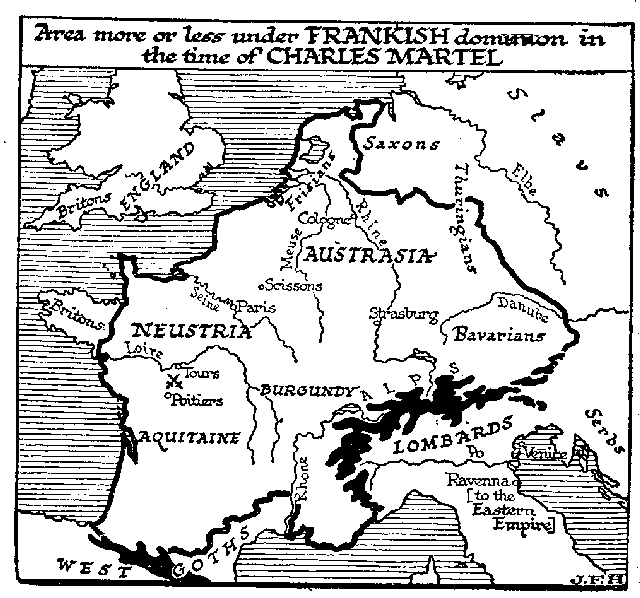
Merovingian Empire – Charles Martel
However, yet again a strong Pippinide Charles, one of Pippin’s illegitimate children was able to regain control over the kingdom. He won a decisive battle with the Neustrians in 717 at Vinchy. He made himself mayor of the Austrasian palace. Two years later he also successfully reclaimed the title of mayor of Neustria.
In 719 he defeated the Frisian after the death of the famous King Radbod. Frisian territory from the Scheldt to the Vlie (the seaway between Holland and the island of Vlieland) were lost to the Franks.
It was also Charles after whom the Carolingians were named (and not after Charles the Great).
He most probably received the nickname ‘Martel’ (the hammer) because of his successful campaigns the most important one (for Europe) was the Battle of Tours in 732, where he stopped the Islamic expansion into Europe. This gave him the legitimacy, prestige and credibility on which he and his successors were able to found the Carolingian Empire. In order to be able to face this massive army he convinced the Church to pay for a standing army. This enabled him to also introduced heavy cavalry to complement the still dominating foot based armies of soldiers. Cavalry became feasible with the introduction of the stirrup by the Avars around 550. However, it wasn’t until the year 1000 that a more serious advance was made with this form of fighting.
He also established and officially formalised the system of vassalage, with clear terms and conditions of such arrangements; which in some parts of Europe lasted until the 19th century .
While still very supportive of monasteries, missionaries and the Church in general, he also clearly established his authority over the bishops. Over the previous century substantial parts of the Pippin properties had been donated to the church. Charles put an end to this by secularising some of the church properties
When the Merovingian king Theuderic IV died in 737, Charles did not replace him with a new king, but he also didn’t claim the title for himself. Instead he used charters in the name of the deceased king and made new appointments in his name.
The next family succession crisis started after the death of Charles in 741. His son Carloman received Austrasia, Alemannia and Thuringia, Pippin received Burgundy, Neustria and Provence. Grifo a son of his 2nd (Bavarian) wife received a number of lands scattered across the kingdom.
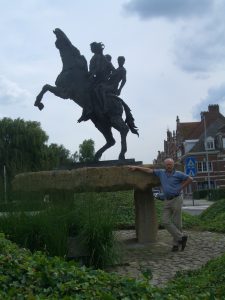
Ros Beiaard
Ros Beiaard – Dendermonde – 2007
Interesting folklore in relation to the feuds of the Franks can be found in the Belgium town of Dendermonde. Every ten year the town has the famous warhorse Ros Beiaard procession, featuring a huge wooden horse that gets paraded around town, together with other ancient symbols.
It is a story about four brave boys who take on the many intrigues in and around the court of Charles (either Charlemagne or Charles Martel).
At primary school I learned the famous song that describes the adventures of these four Heemskinderen (Aymon’s children) and their invincible horse. In the legend their father Aymon was the count of Dendermonde, and their mother a niece of Charles.
‘t Ros Beiaard maakt zijn ronde
In de stad van Dendermonde
Die van Aalst die zijn zo kwaad
Omdat hier ’t Ros Beiaard gaat.
In 2007 we visited Dendermonde and of course also the statue of the four heroes and their horse.
King Pippin III (the Short) – dynastic change
The new feud started off with his brother Grifo claiming a more equal share of the inheritance, supported by the Bavarian nobility. While Grifo was imprisoned many of these nobles especially in the south of the kingdom kept his other brother Carloman and Pippin himself busy for the next few years. In order to reinforce the legitimacy of their position they placed a new Merovingian king on the throne, Childeric III son of the already deceased Chilperic II.
Carloman and Pippin also worked closely together to reform the Frankish church, restoring statuary rule. Pippin also appointed many of the clergy in administrative positions.
It has been argued the his name ‘The Short’ was a nickname as there is evidence that the Carolingian kings were tall people. His wives included: Rotrude (Chotrud), Swanahilde (Sonichilde), Bertrada de Laon (also known as Big Foot and the Younger) . The later was the mother of Charlemagne and Carloman. She was a very pious lady but also had strong political preferences and several times opposed her husband.
In regions where pagan religion and culture still survived and with a lack of communication across the land, many priests and bishops had used their own interpretations of Catholicism and there was widespread misuse and corruption. The Frankish mayors took a leading role in these reforms. Interestingly also the pope was inspired by these Frankish actions and convoked a synod at the Lateran where he also condemned clerical immorality, greed and the misuse of religious powers, a clear sign of the increased importance of the lands above the Alps.
In 747 Carloman abdicated and left for Rome where he received the tonsure and retired in a monastery. But the family feud didn’t end here, Carloman’s son Drogo claimed his inheritance and also Grifo’s claims had not gone away, after he had been able to escape from his prison and his move to the Franks arch enemy the Saxons and later on to Bavaria. Pippin action was swift and inflicted military defeats to these challengers; he again captured Grifo, who was later pardoned.
With these victories under his belt Pippin prepared for his next move. The biggest tool he used was public relations and propaganda. Talking up his family and the achievements of his forebears especially Charles Martel.
Without any legitimate power left to him, Pippin decided in 751 to dispose of what would be the last Merovingian King Childeric. His hair and beard was cut – symbolically taking away his royal powers – and he was put in a monastery.
This became a decisive moment in history. Kingship was a divine institution and to desolve that in a legitimate way required the authority of the ruling pope Zacharias. The good relationships that the Carolingians had with the wandering monks played a key role in this process. Bishop Boniface went to Rome and established the contact between Pippin and the Pope. To authenticate this move, Boniface successfully argued that it was better to have a king that had power and the authority rather than one without it. This approval arrived and it was Bishop Boniface who in the following year in Soissons crowned Pippin King of the Franks. The following year the Pope traveled to Paris to ask Pippin for military assistance against the Lombards as his previous protector the Byzantine Emperor had refused to give him his assistance. This led to the Frankish expansion into Italy and to the foundation of what later would turn into the Holy Roman Empire which lasted for more than a millennium.
With the Coup of 751 we also see the arrival of a different concept of government. The Carolingians were hands-on kings both in secular and religious affairs. The role of the king was modelled on the kings of the Old Testament, who instituted God’s law under God’s grace (gratia Dei). Pippin arranged that he received the holy anointment from the pope when inaugurated as king. The Carolingians became an integral part of the Church.
The later emperors would claim their legitimacy at least partly on Charles the Great, who became in 800 the first emperor. Frederick I Barbarossa (approx 1122 – 1190) even claimed the ‘sainthood’ for the Empire. During his reign also Charles the Great was canonised (but never sainted)..
As mentioned in the Merovingian chapter, the immunities that had been handed out under the Merovingians became now ‘protections’. This basically took the power away from the monasteries and made the kings the rulers who did have the obligation to protect the monasteries, without distinguishing ownership. They claimed their credibility by stating that they themselves had arisen from monasteries and churches (Bishop Arnulf and the saintly Abbess Gertrude of Nivelles).
The change of guards also saw the start of change of power within the Church, until know it were the monasteries that had played the leading role but slowly bishops and their bureaucratic structures would take over the lead. With the state and the church now being one, powerful bishops from the aristocracy and closely linked to the royal family would run the church like a state.
This coincided with a church driven reformation also aimed at ensuring control of the church through the Episcopal system as advocated by Boniface, however, his aim was to unify religious control over the various institutions. He very seriously warned against layman control of the church, be it the emperor, kings or counts.
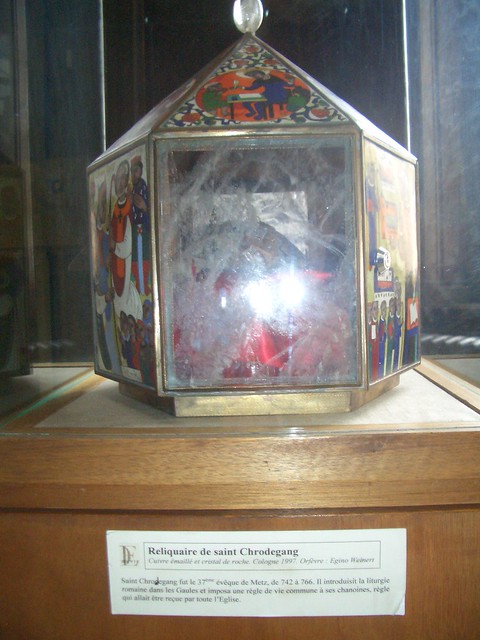
Sarcophagi relics of Bishop Chrodegang of Metz
A key role here played Chrodegang of Metz, a cousin of Charles Martel and a member of the nobles of Hesbay. His Rules for Canons, fostered a quasi-monastic regime of communal life amongst the urban clergy, his rule was implemented in virtual all bishoprics. He was appointed Bishop of Metz by Pippin III in 742. After the death of Boniface in 754 he received his archiepiscopal position.
Emergence of the new European Power
The first campaign against the Langobards
In Italy the power balance between the Langobards, the pope and the Byzantium empire with its stronghold in Ravenna was maintained for nearly 200 years. But by than the pope desperately needed new alliances to withstand the new threat of the Langobards.
However, the Langobards and Franks were united in an alliance to fight the Muslims and Pippin III was, in 734, send to the court of Lombard king Liutprand in Pavia, where he was adopted by the king. So the Franks were not in a hurry to fight the Langobards on behalf of the pope.
Pavia rapidly became Italy’s largest urban centre and remained so for a long time.
In 751 Pippin III took over the rains. As mentioned above, to proof not just his power but also the legitimacy of the coup he secured papal blessing when he was crowned king.
Along the secular and ecclesiastical entanglements as mentioned above, the pope of course didn’t shy away from asking a favour back and when pope Stephan II visited Pippin in 754 he asked for his assistance to rid Italy of the Langobards and restore the Papal State. Pippin promises under oath to do so and he was for the 2nd time crowned king, this time by the pope himself. At the same time his two sons Charles and Carloman were also anointed.
Two years later Pippin indeed forced the Longobards out of Ravenna. Pippin donates certain lands as well as administration over it to the pope; this donation still forms the foundation of the current Papal State (Donatio Pippini).
Towards the end of the century it has been estimated that the Carolingians had the capability of to mobilise up to 100,000 free men to military services, which easily made them the most powerful military force in Europe.
Collapse of Byzantium influence in Europe
The Byzantine Emperor Justinian I, who assumed the throne in 527, oversaw a period of recovery of former West Roman territories.
In 535, a small Byzantine expedition as sent to Sicily and met with easy success, but the Goths – who had invaded the island a century earlier – soon stiffened their resistance, and victory did not come until 540, when his military leader Belisarius captured Ravenna, after successful sieges of Naples and Rome.
After the death of Emperor Justinian in 565 the old Roman Empire disintegrated to be never united again. The Lombards, a Germanic tribe originating from the middle Elbe region, conquered northern Italy in 568 and they didn’t accept papal authority over these papal lands.
Sicily was in 652 invaded by the Arabs, however their influence remained weak until more serious attempts were made in the 9th century to capture the island. However, Arab tolerance secured an ongoing influence of Byzantium religion and culture. The Cathedral in Monreale with its most beautiful mosaics is evidence of this (see video clip). Byzantium was able to hold on to their powers in the Southern Italy and Ravenna for another 200 years.
However the difference in culture and at occasion religious interpretations as well as the distance did not create a strong relationship between Constantinople and Rome.
In 753 the Lombard king Aistulf conquered Ravenna and thus ended the last remnant of the Byzantium empire in Northern Italy (however, the bishop of Ravenna did hold on for a bit longer to the Byzantium flavour of Catholicism). The lack of a strong military power that had kept the balance in place since the fall of Rome, was a major set back for the new Pope Stephen II. The Langobards followed Arius’ version of the catholic faith and were seen as heretics, they in turn had little respect for the pope and his version of that same catholic religion.
With the Langobard threat the pope had to turn to the new upcoming power in the west of Europe and this would result in a total shift in European politics.
The battles that followed also brought the Byzantine emperor into southern Italy, where he encroached on the papal states, thus widening the rift between the original inheritors of the Roman empire. Over the years that rift would only increase in size. Eventually the issue of iconoclasm singled out by an ever increasing number of arch conservative Byzantine Emperors would lead to a formal schism in 1054.
However, it were not just ecclesiastical issues that strained the relationship between east and west. Venice was desired by both emperors, it was a clearing house of goods from the east and since the opening of the region by Charlemagne increasingly also from the west, however he was unable to increase Frankish power in Venice nor in the lucrative trade to the east. Furthermore long distance trade and commerce was still very much under-developed in the west, where trade was still very much organised around the individual domains. Perhaps with one serious exemption was the production and trade in weaponry. Frankish swords were so much in demand that Charlemagne ordered they they couldn’t be exported without his consent.
Longer-term however, Byzantium saw its fortunes in the west decline. In 1025 the Byzantine Emperor planned for another invasion into Sicily to rid the island of the Arabs, however his sudden death stopped this campaign in its tracks. In the end it were Norman mercenary who exploited the intra-dynastic quarrels of the Arab occupation and landed in 1068 and started the reconquest of the island.
Charlemagne
As mentioned, in late 753 the pope left Rome in a hurry and crossed the Alps. Charles was send out as a welcoming party as was Chrodegang of Metz and both accompanied Pope Stephen II to his meeting with Pippin III in St Denis where the pope asked for the military assistance of the Franks.
The pope reconfirmed the coronation by Boniface by placing coronets on the heads of Pippin and his two sons, thus also legitimising the Carolingian dynasty.
However, only after consultations with his war lords did Pippin form an army and defeated the Longobards. After the peace broke down several months later the pope again asked Pippin for assistance this time the king refused as he had other wars to fight this time in Aquitaine (which after years and years of campaigning was finally subdued in 768). After this victory the sick Pippin could only just make it back to St Denis were he died and was buried next to his ancestors.
After his death the Empire was split between his two sons. Carloman received the centre with Soissons as the capital. However, this only lasted for a short time as he died in 771. While Carloman had two sons, Charles claimed the whole empire. Carloman’s widow Gerberga and her two young sons went to the Court of Desiderius in Pavia, to make it more difficult for them to claim their inheritance.
Under Charlemagne the Carolingian Empire would reach its zenith and his achievements are still reverberating through Europe. However, at this stage he simply followed in the footsteps of his forebears and went on campaign wherever he saw fit, without any particular larger vision in mind. He expanded south into Italy, east into the land of the Saxons and even beyond and in the west he secured Aquitaine. Nearly all his life he was on campaign. During the 33 year war against the Saxons, he only twice directly faced his enemy, both in the same year – 783 – once near Detmold and once at the River Haase near Osnabrück.
It wasn’t until after 778 when – in good Frankish fashion – he faced internal rebellion simultaneously from a range of the regional nobility across his empire, that he must have come to the conclusion that he had to put better internal systems in place and the capitulary from that time onward clearly reflect that situation. The period between 778 and 791 clearly is the central governance period of his reign, from this time onward his military vision becomes also strategically much more aligned with the sense of a Christian mission.
When he arrived on the European scene, Europe was largely an empty continent, seriously depopulated after the collapse of the Roman Empire, the invasions of the Barbarians and the effects of the Justinian plaque and consequent outbreaks. The old Roman infrastructure had largely collapsed, trade had all but disappeared. At that time a quarter of the all the children born died at birth and another quarter died before the age of 10. One of the children parents would have died before that child entered adulthood.
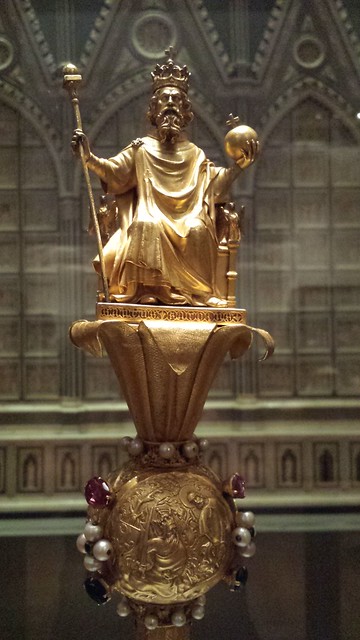
Statuette of Charlemagne on the scepter of the French king Charles V – Louvre
The 2nd campaign against the Longobards
It was not until 773 before the Franks again responded to a call from Rome this time from Pope Hadrian I. The new king Charles took his troops over the Alps, outside the normal campaigning season, established a winter camp near Pavia and starved the Langobards into a peace agreement that he didn’t get until the summer of 774. He exiled the Lombard king Desiderius and his family to France, demanded homage from the local nobility and installed a strong Frankish garrison in Pavia. By doing so he established clearly that it was him who held the secular power and not the pope, he was now not only the King of the Franks but also the King of the Langobards; the kingdom comprised northern and central Italy down to the March of Spoleto.
While the king moved back to Aachen, many Frankish settlers moved into Lombardy. A whole outside ruling class took over religious, bureaucratic and merchant structures.
Key Frankish families that moved into the region included”
Unrouchings – the family’s main landholdings, were in modern France, north of the River Seine, and southern Belgium. The family monastery, the centre of their power, was at Cysoing, near Tournai. They settled in Friuli (where they became Berengar’s ancestors).
Widonen at Spoleto (ancestors of King Wido (Guido or Guy) and Lambertus – rivals of the Berengars). Their ancestors came from Nantes.
Supponids at Parma ( family of Berengar’s first wife, Bertilla)
In 888 Berengar, a grandson of Louise the Pious become King of Italy. A member of his rival family Wido had been King of Italy in 798.
Papal feuds
However, the dramas with the various popes continued, there were assassinations, competing families who claimed the papal throne, double popes and so on. Charles despised these activities and tried to make changes by implementing new laws (they included canon laws).
Another drama unfolded in 799 when an assassination attempt on Pope Leo III failed, the gravely harmed pope was bandaged up and escorted to Paderborn for safety. The Byzantine emperor, the first female to reign in her own right in Constantinople, Irene, was bypassed, she had murdered her son and above all as women she was unworthy of being asked for assistance. So again it was Charles who was asked to assist, however he didn’t want to take part in the feud. In the end he travelled back with Leo III to Rome and had him officially under oath declared that he was not part of the family feud that had resulted in the attack. For Charles that was the end of the affair.
Paderborn
In 772, at the caste of Eresburg (near Paderborn) Charlemagne crushed the Saxons and demolished their sacred ‘Irminsul’, it was a large tree trunk that was venerated as one of the pillars of the heaven.
Already in 776 he started to build an impressive stronghold here, this was a totally new town and not based on a previous Roman town or military settlement. The focus point of the building activities was a church-palace, aimed to impress the recently overrun Saxons in the region.
Charlemagne held his first Frankish Imperial Assembly in 777 on recently conquered Saxon ground.
In 799 the meeting between Charlemagne and Pope Leo III takes place here. This also led to the foundation of the bishopric. It has also been suggested that during this meeting, preliminary talks were started regarding the on crowning Charlemagne Emperor.
While he had very ambitious plans for Paderborn, soon after he had conquered the Saxons the urge to use this city to proof his authority was gone and the grand plans never fully eventuated.
We visited the remnants of his palace (pfalz) and the Dom in 2001.
It looks that rather unexpectedly the opportunity was used to, on Christmas Day 800, officially crown Charles Emperor of the Western Roman Empire (included Rome). In various statements Charles had clearly indicated that he was king and emperor and he named the pope ‘father’ making a distinct difference between secular and religious powers. It has also been argued that Charles’ was indeed, as he indicated, surprised perhaps not to show humility but that he had problems that by this crowing he excepted the superiority of the pope. It was for that reason that a thousand years later Napoleon crowned himself.
This uneasiness is also shown in a long Frankish tradition, already Clothar II had made it clear to Pope Gregory I at the time, that the bishops were his subjects.
Nevertheless in Rome the pope kept his secular powers (until today).
The crowning of Charles is a momentous event in the history of Europe, as this was a total rebuke of the official Roman Empress residing in Constantinople. There were now rather suddenly two Roman emperors one in the west and one in the east. Obviously the ‘official’ Roman emperor in Constantinople was furious about this decision. However, the reign of Irene had ruined the country and the internal iconoclast battles had weakened the empire and Irene was in no position to challenge the decision.
Charles, aware of the situation, wanted to use his crowning as an opportunity to reunite the two parts of the empire and suggested a marriage between him and Empress Irene. She was interested as she saw this as an opportunity to strengthen her position, her rivals in Constantinople however, saw this as a further insult and disposed of her and imprisoned her; this ended the attempts the unite the empire.
Kings ask popes for missionaries
As indicated above the pope also claimed secular powers and wanted them to extend them to the Frankish realm as well. However, both Pepin III and Charlemagne ignored this and saw themselves as the secular powers and Charlemagne even considered to challenge the emperor of the East Roman Empire, but this never eventuated.
This power struggle between church and state was at least for the time being won by Charles the Great who was able to establish his independence from the pope but at the same time as a devout Christian placed the spiritual powers of the pope above the secular ones. Nevertheless he would not accept direct papal interference in his realm but everything he did was also in the name of God. So in other words if somebody would attack the church he would see that as an attack on his empire, if somebody trespassed the catholic rules it was at the same time an offence under secular law.
The strong spiritual powers also provided certain safeguards regarding governance, these kings were obliged under the catholic faith to protect the poor, women and children, they had to be just and were to uphold morality as was laid down in catholic rules and regulations such as the Ten Commandments. Canon Law continued to be further developed for religious interpretation and fine-tuning of the laws.
As mentioned above, their strong believe in the scriptures, especially in relation to their eternal life, led many of the rulers to donate large sums of money to monasteries and the clergy; often with the aim to secure ongoing prayers for their souls. Monasteries, chapels, churches as well as their staffing were paid for in this way. The clergy were given property which allowed them to long term income and stability. Monasteries and chapels were built on the lands of the nobility and these landlords were keen to be buried here. These became the first churches, known as ‘proprietary’ churches (Adelskirches – churches of the nobles). The concept of parish churches followed later. It was not until the 9th century before a more cohesive network of parish churches was established.
These religious organisations in turn became important advisers, diplomats and bureaucrats and the monasteries also allowed for the spread of knowledge, they were paid to also look after the poor and the sick and as such played a critical role in the political, social and economic development of Europe throughout the Middle Ages and well into the modern era.
The Carolingians were greatly influenced by the Catholic religion and was stirred by missionaries such as Willibrord and Boniface. He combined the age old Germanic tradition as the warrior chief in charge of the annual campaigns to grab land and booty for himself and his allies, with the divine commission he felt he had to convert the pagans. Charlemagne was still very much a barbarian, however he also appreciated the sophisticated organisation, culture and learning that were brought to him and his regions by the men of the faith. This mixing pot of activities had a profound impact on the shape and future of Europe.
Charlemagne crushed the Saxons
The relationship between the Franks and the Saxons had always been one of conflict. During Roman times the boarder had been set by the river Rhine but since that time the Saxons had taken another 20 kilometres on the other side of the river and had established strongholds also along the river Diemel. In an act of defiance they had established an important pagan shrine at Eresburg castle in the name of Irminsul, it was a large tree trunk that was venerated as one of the pillars of the heaven.
Irminsul
The Germanic god, Irmin, inferred from the name Irminsul (sul = zuil = pillar) and the tribal name Herminones, is sometimes postulated as the war god of the Saxons. The Old Norse form of Irmin was Jörmunr and interestingly, just like Yggr, it was one of the names of Odin. “Yggr’s horse”, Yggdrasil, was the yew or ash tree from which Odin sacrificed himself, and which connected heaven and earth. It appears, thus, that Irminsul may have represented a World tree corresponding to Yggdrasil among the Saxon tribes of Germany.
Furthermore in 747 the Saxons had provided refuge to Grifo, a son of Charles Martel but exposed of by Pippin and his brother Carloman.
The Frankish wars started increasingly to look like crusades. Weapons were blessed by priests, victories were victories of the Lord and defeats were seen as a punishment for a sinning nation. No longer were these campaigns aimed at grabbing booty to return home and split the spoils between the war lords, instead they became more of a colonasation, the newly conquered areas were integrated into the empire, new secular and religious laws were enforced and many new dukes and counts were appointed.
In 754 Boniface was killed by the Frisii in Dokkum, this apparently had a serious impact on Charlemagne and the life and death of Boniface became an example for his own fundamentalist way of life.
The Saxon campaign – which started in 772 – became the first known Christian crusade. Charles not simply raided the Saxons but destroyed Irminsul, the first time a political leader became involved in religious affairs, until that time bishops and missionaries had been engaged in such practices but not the secular leaders. New campaigns were launched in 773, 775 and 776.
After an other successful campaign in 779, there was another one three year later in 782 where Charles encountered a rare defeat, his response was one of desperation and led to a terrible massacre of the beheading of 4,500 Saxons in Veden on the banks of the river Aller.
In order to underline the progress of his campaigns he started to use the newly conquered lands of the Saxons. As mentioned above in 776 he started to build an impressive stronghold in Paderborn, aimed to impress the recently overrun Saxons in the region.
The leader of the Saxons Widukind fled to Denmark and continued guerrilla warfare during the following years. Again Charles response was merciless killing men, women, children and cattle and burning villages and farms, the region was totally devastated. Rather than killing Widukind, that would have made him an hero, he offered him safe passage to his villa in the Ardennes and offered him gifts in return for his baptism. The strategy worked and many Saxons followed Windukind and were ‘peacefully’ converted. Finally at the end of the 784/785 campaign he had subjugated the Saxons.
There are indications that the border was established along the river Vechte and at Nordhorn, most probably as elsewhere strongholds were established with bailiffs (schutzen) to guard the border and to ensure that the inhabitants would no longer practice their pagan religion (See: Barbarians rule). As a consequence Nordhorn started to grow and by 900 had become an independent town.
Frankish control over the Saxons (and for that matter their neighbouring Frisii) remained patchy for at least another century. One of the main problems for the Franks was the fact that these lands were not ruled by dukes or princes but instead contained a network of warlords – Widukind was only one of many of them – on which the Franks never maintained a firm grip.
Some major internal trouble started in 792 with terrible weather and severe famine, the following year saw the start of widespread revolts throughout the empire (Saxony, Italy, Spain and even in heartland Francia). Between 793 and 799 most of the newly built (wooden) churches were burnt down and the people reverted back to their pagan believes. However, through massacres and deportations (7,000 in 794 and every third household in 797) Charles gradually did win these territories back and by 804 he considered the job done – the period between the revolts and Charles coronation is known as the period of consolidation. He also started to take greater control over the region through his capitulari and force all Frankish men 12 years and over to take a personal oath of fealty.
What did secure long last stability was that after these revolts he codified Saxon law and appointed leading Saxons as counts and local officials.
Under the Lex Saxonum, the rigid Saxon structured was altered, taking away the power of the frillingi (freemen) and increasing the power of the edhilingui (edelingen- nobels). In their hatred for the edhilingui, who had deprived of them of their rights, the frillingi refused to accept Catholicism, which led to more bloodshed in the following decades.
After he defeated the Saxons he moved onto Bavaria, where his cousin Tassilo had been supporting the Saxons and Lombards. He rather easily deposed of him and received the full support of the local nobility From here on he also started to venture beyond the land of the Saxons and battles were fought with people further to the east, the Abotrites, the Wiltzes, the Sorbs, the Avars, the Wends and further to the south the Slavs. In the south he defeated the Basks and in 801 his son Louis captured Barcelona and drove the Muslims from this city.
The victory over the Avars was especially lucrative as the booty from this war financed Charles’ economy for the next 20 years.
In all it estimated that in the end Charles had brought together anywhere between 200 and 600 territories. [1. Middeleeuwen – D.E.H.de Boer, J.van Heerwaarden, J.Scheurkogel p.77] With little central ruling power, arrangements were made with the occupied territories which allowed these regions a large level of autonomy and – similar to Roman times – we see a multicultural development with many of the emperor’s closest advisers coming from concurred lands and beyond. He divided his empire in 350 counties each with their own count. However, this structure did not work very well without central power, and when that collapsed many of the regions eventually fragmented again.
Charlemagne and his successors established special counties, with special powers along the boarder, these frontier counties were known as marks (maerch – old Frankish for border) or in English marches. They were basically military districts in which the chief official, the Markgraf, or count of the march (Markgrafschaft) exercised palatine (independent) jurisdiction (normally only available to the king). He was responsible for the defense of the frontier against the attack of Normans, Avars, Saxons in short the barbarians. In the north western part of the Frankish Empire the following marks were established: Mark Antwerpen, Markiezaat Bergen op Zoom, Mark Ename Mark Valencijn (Valenciennes). The Ost Mark became Österreich (Austria). In the north Denmark reveals its position in history and also Mercia in Britain has its origin in the word maerch.
In the south in the Spanish Marches against the Muslims.
The Spanish Marches
The Moors – who had conquered most of the Iberian Peninsula – made the same mistake as the Visigoths has done before – in one of the feuds they sought outside assistance in this case it was the Muslim ruler of Barcelona who in 777 asked Charlemagne for assistance. Charlemagne’s son Louis (the Pious) made great advances into Spain and conquered Barcelona. However, he had to retreat as he needed his army back in the north because the Saxons had used the opportunity to attack Cologne. The rear force of the Carolingian army was cut off and slaughtered by the Basques on the way back, among the dead was Hruodland, who later on became the hero in the famous Chanson de Roland. Charlemagne established three marches on the boarder of Spain: Mach of Gascony, March of Toulouse and the March of Gothia. In 801 Louis came back and was able to drive the Muslims out of Barcelona. A fourth March was established that of Hispanica, centred around the County of Barcelona and covering the central and eastern Pyrenees, this march had no less than 16 counties, each with their own military leader. While it would take over 200 years, from here finally the reconquesta took hold.
The Capital Aachen
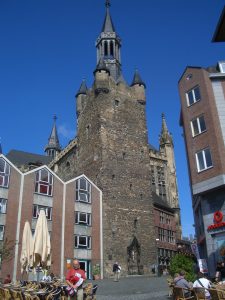
Grannus Tower – Aachen – 2007
Charles loved Aachen Aquis grani (Grannus was the Celtic god of water), he had regularly visited the old Roman bath here in which he enjoyed swimming. When we visited Aachen in 2007 we saw the remnants of Roman columns marking the place of the old baths. However in Charles time the town was run down and there wouldn’t have been more than a few hundred inhabitants; a far cry from the 6,000 roman soldiers the ‘resort’ could cater for.
In the first year of his ascension to the throne in 768 he spent his first Christmas in Aachen. While he had very ambitious plans for Paderborn, soon after he had conquered the Saxons the urge to use this city to proof his authority was gone and the grand plans never fully eventuated. It was Aachen that he made his capital.
He built here an impressive complex he started with the royal hall on top of the hill with living quarters and administrative offices on both side of an elongated square forming ‘a bridge’ to the other side on the complex, the lower side, where he built a magnificent basilica in the Byzantium style which he most probably copied from Ravenna. Stretching further was another court yard with buildings that housed a monastery. The way the complex was designed, also reflects Charles vision on the division of powers between the secular and the religious, his palace was situated higher and from there he could overlook the basilica!
He saw Aachen as his new Rome a continuation of the Roman Empire (renovation imperii Romanorum). This also had a tremendous impact on the belief system of the Middle Ages. Church history spoke of the four monarchies before the arrival of the end times (see: Christianity steps into power vacuum). After the collapse of the 4th empire – the Romans Empire – the Church authorities were at a loss and the new Frankish Empire was rapidly accepted as a continuation of the Roman Empire pushing the theological problem of the ‘end times’ further towards the future.
From 794 onwards Charlemagne resided often in this palace (pfalz). He employed artists, theologians, scientists, writers and other academics. He founded a court school on the top floor of the palace (pfalz) buildings with housing for the garrison underneath. One of the ivory diptychs from the school is on display in the museum. Charles and his family attended the school an the school traveled with Charles on their wandering throughout his empire.
From the original palace only one Grannus tower (788) still exists as well as some of the walling of the royal living quarters, along the current Katshof, which still reflects the original lay out of the inner court.
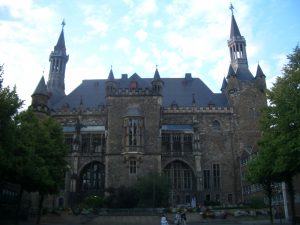
City Hall – Aula Regia Aachen – 2007
The royal hall has since been replaced by the current town hall and this building on the top floor still holds the new royal hall, where later other Holy Roman Emperors have been inaugurated and now every year the European Charlemagne price is awarded in this hall, to people who are advancing the European course. Louise and I had dinner in the cellars of the southern side of the building which still holds the remnant of the old cellars, a very special place indeed.
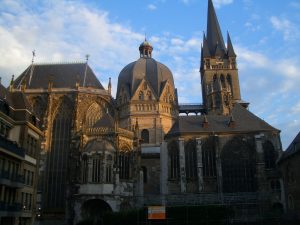
Basilica Aachen – 2007
The original sixteen side rotunda basilica (St Mary’s Church) is still there for anybody to admire. Charlemagne also had a foundry build that produced the impressive bronze ‘Wolf Doors’ from 800, still preserved in the basilica. Its magnificent marble and mosaic interior was aimed to serve as the throne hall, similar to the Chrysotriklinios (golden audience hall) in Byzantium.
While the church complex has since been extended the original basilica ( in the ancient Roman sense) still forms the core of the complex. The basilica was concentrated in 805 by Pope Leo III.
On the upper ‘emperor’s’ walkway is Charles throne situated, from where he could look upon the altar below. All German and later Holy Roman Emperors between 936 and 1531 were crowned on this throne.
The Aachen basilica inspired a range of other church buildings and extensions in the region such as the first cathedrals in Rheims and Cologne and in Nivelles I also saw the remnants of the Carolingian church that was built there around 800. This architecture became known as the Carolingian style.
After Charles death on 28th January 814 he was buried in this church.
In the museum we saw the Roman Proserpina sarcophagus, which Charlemagne had brought over from Rome and where his remains rested for most probably 400 years.
The museum has lots of treasures, some attributed to Charlemagne, however most are dating from a later period. Charlemagne’s statue grew enormously over the following centuries and kings and emperors fell over each other claiming their links with Charles and in the process donated many treasures to the church. The imperial crown jewels (at least a copy of them) are on display in the town hall. The museum also holds a so called Reichenau evangelary containing the ‘Apotheosis of Otto III’ a printing on gold leaf that seems to represent Otto I flanked by his two successors.
The Charlemagne treasures have over the centuries been very powerful symbols. Some were passed on the Emperors of the Holy Roman Emperor. From the 11th till the 15th century the Imperial Regalia (Reichskleinodien) were held by the Salian and Hohenstaufen emperors at the Trifles fortress near the small town of Annweiler, in the Palatinate, Germany we visited the caste in 2009 and also saw the replicas of the jewels; the most important ones are the Imperial Crown, the Holy Lance and the Imperial Sword. From here they ended up at the treasury (Schatzkammer) of the Hofburg, the palace of the Habsburgers in Vienna, here we had seen the real treasury during our visit in 2003.
After the partition of the Carolingian Empire in 843, Lothar I and Lothar II remained at Aachen.
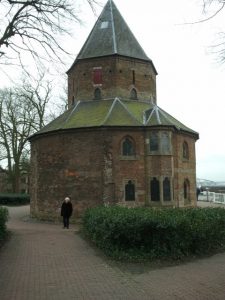
St Nicolas Chapel Valkhof Nijmegen ca 1000
Apart from the civil works in Aachen and Paderborn he also built a bridge over the river Rhine at Mainz (however, this burnt down in 810). In Ingelheim, close to Mainz he started to built built another palace. In 776 he also built one in the old Roman city Nijmegen, near the River Waal. He also insisted in building and rebuilding churches throughout his empire. The site is currently known as the Valkhof and there are ruined remnants of the church of the castle as well as the St Nicolas chapel either built under the reign of Emperor Otto III (around 996) or Emperor Koenraad (around 1030). There is also some evidence that the foundation was based on the initiative of Theophanu of Essen in remembrance of her grandmother Theophanu who died in Nijmegen.
Charlemagne’s wives and children
Charlemagne had twenty children over the course of his life with eight of his ten known wives or concubines. Nonetheless, he only had four legitimate grandsons, the four sons of his third son Louis, plus a grandson who was born illegitimate, but included in the line of inheritance in any case (Bernard of Italy, only son of Charlemagne’s third son Pippin of Italy), so that the claimants to his inheritance remained few.
His first relationship was with Himiltrude. The union with Himiltrude produced two children:
Amaudru, a daughter. she later on married the Count of Paris.
Pippin the Hunchback (c. 769-811) – after a conspiracy he ended up in the Monastery of Prüm.
In Nijvel we saw what most probably was the grave of Himiltrude. Perhaps she was disposed when Charlemagne’s mother Bertrade arranged the next marriage for her son.
Foundations Carolingian church Nijvel
This was with Desiderata, daughter of Desiderius, king of the Longobards. In 770 he was persuaded by his mother to marry her – despite strong opposition of Pope Stephen III – however, for unknown reasons the relationship was annulled in 771.
His second wife was the Swabian Hildegard (757 or 758-783), married 771, died 783. By her he had nine children:
Charles the Younger (c.772-4 December 811), Duke of Maine, and crowned King of the Franks on 25 December 800
Carloman, renamed Pippin (April 773-8 July 810), King of Italy
Adalhaid (774), who was born whilst her parents were on campaign in Italy. She was sent back to Francia, but died before reaching Lyons
Rotrude (or Hruodrud) (775-6 June 810). She was earmarked to mary Constantine VI, the son of the Byzantine Empress Irene. However, negotiations broke down in 787.
Louis (778-20 June 840), twin of Lothair, King of Aquitaine since 781, crowned Holy Roman Emperor in 813, senior Emperor from 814
Lothair (778-6 February 779/780), twin of Louis, he died in infancy
Bertha (779-826)
Gisela (781-808)
Hildegarde (782-783)
His third wife was an Eastern Frank princess Fastrada, married 784, died 794. By her he had:
Theodrada (b.784), abbess of Argenteuil
Hiltrude (b.787)
His fourth wife was the Allamanni princess Luitgard, married 794, died childless
According to Einhard, after the death of Luitgard, Charlemagne had another four concubines:
Madelgard, who bore him a daughter Ruothilde
Gersvinda, a Saxon, who bore him another daughter Adaltrude
Regina with who he had two sons: Drogo (who became the bishop of Metz) and Hugo
Adallinda, the mother of Theodoric
Interestingly, again according to Einhard, he loved his daughters so much that he kept them within his household and against the tradition of the day didn’t give them in marriage, some married after their father’s death. This might have been a too rosy picture, this has also been interpreted more or less as the ‘imprisonment’ of his daughters.
Charlemagne’s legacy
A very important legacy of Charlemagne is the large volume of legislation, with repeated instructions on all matter secular and ecclesiastical. Also impressive are – as we saw above – the widespread contacts he established as far afield as Cord0ba, Constantinople and Baghdad as well as international trade with Britain, the Baltic and the key trading ports of those days Birka (Sweden) and Dorestad (Low Countries).
Dorestad was the first city in the Netherlands. Stretched out over 3 kms along the river with hundreds of houses and thousands of inhabitants. Archaeological research of the people buried here indicate that it was a wealthy community, people were tall and healthy. The Dorestad brioche also indicated that there was a top layer of elites living here.
He also reformed his army. Landowners had to train and held ready for service -during set periods of time – military troops based on the size of their land.
While a more successful central structure was established under Charles the Great. We still can’t really speak about a central government, what he established was more like central governance. He issued hundreds of edicts and employed a large number of royal commissioners to observe if the edicts were tried by the local law-courts. Each commission had one high ranking churchmen and one layman.
However, while on the one hand he created – mostly through brutal force – great political and administrative integration he at the same time knew that according the Frankish law, eventually his realm would be divided.
In 806 he issued a total carve-up of his lands, known as the ‘Divisio regnorum’. At that stage all of his three senior sons were still alive:
Louis was to receive the lands south of the plateau of Langres down to the Mediterranean.
Pippin the Italian kingdom, Bavaria, Carinthia and half of Allemannia
Charles, everything else.
He even did not make any provision for the title of emperor in this document. But his Testament from 8o6 does include other inter sting information, it list all of the 21 metropolitan cities of his empire, part of his treasure had to be used for alms to the poor in these cities. They are: Rome, Ravenna, Milan, Cividale, Grado, Cologne, Mainz, Juvavum (Salzburg), Trier, Sens, Besançon, Lyons, Rouen, Rheims, Arles, Vienne, Moutiers-en-Tarantaise, Embrun, Bordeaux, Tours and Bourges.
The situation changed when before his own death his sons Pippin and Charles died and in 813 – a few months before his own death – he crowned his son Louis as joint-emperor. By doing so he tried to establish a dynasty; very much in line with the old Frankish tradition of personal honour. He however, failed to establish a long lasted structure for centralised Frankish succession. He created a personal empire, held together by his strong personality and a common ideology (Christianity). Rather than investing in the future of the empire he ‘invested’ in his own soul by donating two thirds of his ‘portable’ wealth to the church. The rest he kept for his own use, while moving to a monastery to die.
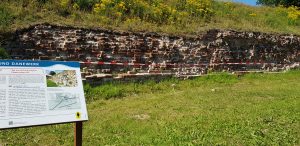
Danevirke – 2018
Towards the end of his reign, when he had largely restored central control over most of his Empire, the majority of his efforts were aimed at stopping the Norsemen from what is now Denmark where he build the Danevirke (see: Viking raids.) For Europe this couldn’t have come at a worse time as this pressure required a very strong and sustained response and Charlemagne was now too old to provide that level of leadership. At the same time as he had subdued the Frisians and their fleets so there was no local structure of resistance in the northern part of his empire and the local nobility was basically left on their own to find ways to defend themselves against the raiders.
This was a major set back especially for the developments in north western Europe as the region after a brief period of ‘light’ fell back into the Dark Ages during the plunder and devastation caused by the raiding Danes.
As the name ‘Louis the Pious’ implies his successor had different qualities and was unable to maintain his father’s strong leadership against the Danes. With rapidly declining central power Louis and his successors provided more and more immunity and privileges to secular rulers under their promise to defend their regions against the invaders.
However, this only further undermined the central authority of the Emperor and didn’t do anything to create a better ‘national’ defense.
We also saw this happening in Italy, under the reign of Berengar, which had a long lasting effect on the integrity of Italy. But also elsewhere in the collapsing empire we increasingly see privileges handed out to local lords and often they were not used to assist in the defense of the empire but simply to increase their own influence and power aimed against neigbouring lords rather than the common enemy, not much different from the old tribal raids.
The Nine Heroes
Charlemagne was named as one of the Nine Worthies or Nine Heroes, they are nine historical, scriptural and legendary personages who personify the ideals of chivalry and virtue. The study of the life of each would thus form a good education for the aspirant to chivalric status. The Nine include three good pagans: Hector, Alexander the Great and Julius Caesar, three good Jews: Joshua, David and Judas Maccabeus, and three good Christians: King Arthur, Charlemagne and Godfrey of Bouillon.
In 2012 I saw the tapestries of these Nine Heroes in The Cloisters in New York City. These tapestries were most likely designed in Paris and produced in Brussels between 1400 and 1410. See videoclip.
The Carolingians relevant to Brabant (years of death)
Charles the Great +814
Louise the Pious +840
Lotharus I +855 (Emperor Carolingian Middle Kingdom)
Lotharus II +869 King of Lower Lotharingia –Boundaries: Eifel, Rhine, North Sea,
Charles the Bald +877
Zwentibold +900
Carolingian Renaissance
The Carolingian Renaissance differs from the Italian one, which started some 600 years later, in that the first one was a state-initiated intellectual, scientific and cultural event. The Italian Renaissance was spontaneous and not state-driven, however it was sponsored by patrons, which included both state and ecclesiastical rulers.
It followed on from the military successes of Carolingian (Charlemagne’s) politics. This required political, cultural and social integration. As mentioned above, this led among other things to more organised administrative systems. This in turn required more and more people to become involved in these new political, juridical and administrative systems.
During the assemblies of the king and his nobles (ding/mallus/campus) scabini (scribes/secretaries) were elected among the freemen, some of whom also started to take up juridical tasks throughout the empire.In 789 Charlemagne ordered in his ‘ Admonitio Generalis’ edict that every monastery and cathedral should establish a school. The curriculum included: reading, writing, stenography, singing, reckoning and grammar. The aim was to ensure that church service and legal and administrative rules would be standardised across the Empire. For that purpose he assembled at his court in Aachen Europe’s best intellectuals, where they advised him on a large range of topics, from literature to science and religion, music and other forms of art. Among them the English monk Alcuin from York, Paul the Deacon (Pavia), Peter of Pisa and Paulinus of Aquileia and Einhard a Frank born in Maingau (see below). Under Alcuin the Latin spelling was standardised including the spelling of the letters as we still use them today. While there was a clear focus on the education of the clerics, lay people also attended these schools.
At school we learned that it had been Charlemagne who had laid the foundation for our education. Indeed he was the first to institutionalise education. However, perhaps not for the same motives we currently attribute to education. The purpose was not to develop new ideas, innovation, economic advantages, it was much more to standardise the present based on orthodox principles. Where innovation and entrepreneurship did occur was in the writings about the saints, relics and miracles.
Of course education was also well established during Greek and Roman times and actually at the Council of Orange in 529 – attended by fourteen bishops – mainly from the newly converted Gaul and Merovingian (Burgundy) area it was decreed that priests should educate boys to read the bible in Latin as well as religious prayers. For this purpose cathedrals and monasteries started ecclesiastical schools for the study of the Holy Script. Charles also built on the success story of his cousin Tassilo in Bavaria, who had also attached schools to churches as from 772. Charlemagne’s father, Pippin III opened his court to ‘men of letters’ and his episcopal appointees were educated.
He built on these earlier initiatives, and further institutionalised these developments. He brought the most learned men from his time to his court in Aachen.
Christian morals and teachings were also used to enforce the conversion of the pagan Saxons. He therefore needed to educate his aristocracy – who were still largely war lords – that learning and piety were admirable attributes for them to be used.
For that purpose Charlemagne also needed the official ancient teachings and missions were send out all over Europe to collect these documents and many books where in this way saved from the wreckage that followed the collapse of the Roman Empire. If the Carolingians had not collected and copy the Roman books of Cicero, Virgil, Ovid, Julius Caesar, Tacitus, Seneca and others these works might have been lost forever. Of course these activities also required educated people and this was of course linked in with the above mentioned ‘ Admonitio Generalis’. Charlemagne didn’t just want copiests, he also needed people who could apply the texts. He also continued the process of the earlier Church Fathers, who used the ancient Greek and Roman texts to assist them in explaining elements of the Bible.
The Carolingian cultural renaissance continued after the collapse of a unified empire at the courts of the new kings and their vassal counts and bishops. In our region, under the patronage of Lothar I and his wife Ermengard learned men such as: Hrbanus Maurus, Angelomus of Luxeuil, and Sedulius Scottus wrote poems and exegetical treatises on the Bible. In Liège, Irishman Sedulius, a man encyclopedic in his learning, settles at the court of Bishop Franco.
However, that was all relatively short lived and it would take another hundred and fifty years after the death of Charlemagne before we start seeing the next revival of cultural and literary activities. The full effect of the secularisation of writing only started to proliferate during the 11th and 12th centuries. By that time the centre of study and culture north of the Alps started to move from the Rhineland to Paris.
Charlemagne also maintained a large diplomatic network that reached as far as Baghdad in the east and Mercia and Northumbria on the British Isles. In 808 Eardulf, King of Northumbria – as a fugitive – visited the Emperor in Nijmegen.
During the last ten years of his reign the Carolingian Empire was at its zenith. By 802 he had ended his military campaign and this period of peace allowed him to concentrate on consolidating his empire and he made a range of important political, administrative and cultural decisions that greatly improved the overall welfare of the Empire. He put a lot of effort on stamping out corruption and asked all his citizens to pledge allegiance to him and as such clearly submitting the nobles to his reign. He also stressed his spiritual obligations to his people and his responsibility for that to God. These developments also need to be contrasted by the reality that imperial unity was hard to establish, counts in the outer areas often acted independently and used their powers to extract extra taxes or keep taxes midden from the emperor, also invasions from the Vikings and Magyars started to occur, with hindsight the cracks were already starting to appear.
But no real sign of a decline at that time. During the course of one year – in 810 – Charlemagne concluded peace treaties with the new Byzantine Emperor Nicephorus I, El Hakem the Cruel, Emir of Cordova and with the Danish King Hemming. Some of the gifts Charlemagne received during his reign included a Marmarican (Libyan) lion from the king of Numidia, purple dye-cloth from Spain, the dye of the murex snail of Tyre. He also provided foreign-aid to the King of Africa and his Libyan subjects because these people were constantly oppressed by poverty.
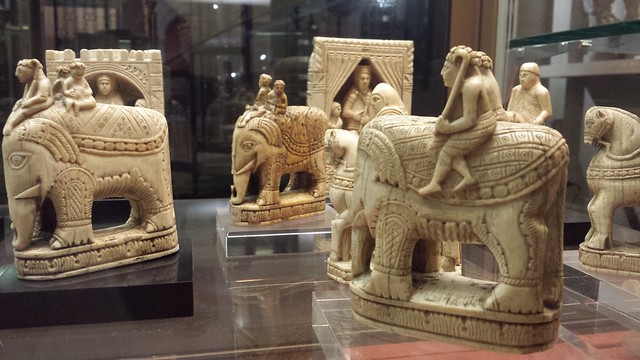
Charlemagne’s chess set
According to Notker the Stammerer, monk of Saint Gall, in his book Charlemagne, written a few decades after the death of the Emperor mentioned that he also send gifts to foreign rulers, Spanish horses and mules to the ruler of the Persians. He also send some cloaks from Frisia white, grey, crimson and sapphire blue, for these as he discovered, were in short supply in those parts and extremely expensive.
Interestingly Notker also mentions that when Charlemagne’s enemies saw the cloths the Franks wore they also wanted them however, they wore short cloaks rather than the long ones the Franks used. When Charlemagne noticed that the Frisian were selling the short ones for the same price as the long ones, he ordered that no one should pay that price other than for those long cloaks.
Key intellectuals of the Carolingian Renaissance
With thanks to Wikipedia
Alcuin of York (730s or 740s – 804)
Nicknamed Albinus or Flaccus was an English scholar, ecclesiastic, poet and teacher from York, Northumbria. He was born around 735 and became the student of Archbishop Ecgbert at York. He probably was the most learned European of this time. At the invitation of Charlemagne, he became a leading scholar and teacher at the Carolingian court, where he stayed from 782 till 796, after this he still provided his advice to Charles as Abbot of the abbey Saint Martin in Tours, where Alcuin stayed for the rest of his life. He wrote many theological and dogmatic treatises, as well as a few grammatical works and a number of poems.
He organised the palace school and built an impressive imperial library, Latin was restored as a literary language. Perhaps even more importantly he also introduced a new simplified script known as the Carolingian minuscule, ‘Caroline’ or Carolingian; this was used throughout the ninth century.
This new Carolingian script was also of immense importance for the development of Europe, as texts could now be copied for more quickly. In his 789 capitulary, Charlemagne also ordered to correct the catholic books, often copied, in so called scriptoria or copying rooms, from original writing, by monks with little or no understanding of the actual language. Some 8,000 manuscripts from this time survived into modern times. At the same he forbade the monks from conducting business transaction and this greatly contributed to the secularisation of writing; a new class of non religious scribes started to emerge. This linked to the revival of Roman Law (Justians’ Code) saw the start of the administrative bureaucracy.
Alcuin was ahead of his time, several of his ideas and thoughts – eg the ones written down in his work Rhetorica – were only taking up several centuries later. Interestingly he goes back in this work to the work of Cicero.
He was the most important intellectual of the group known as the Carolingians – gathered together by Charles the Great. Perhaps his most importance legacy was his influence on this group as well as on the generations of writers and thinkers after him.
Paul the Deacon (c. 720s – 799)
He was a Benedictine monk and historian of the Lombards. He received an exceptionally good education, probably at the court of the Lombard king Ratchis in Pavia, learning from a teacher named Flavian the rudiments of Greek. Soon he entered a monastery on Lake Como, and before 782 he had become a resident at the Abby of Monte Cassino, where he made the acquaintance of Charlemagne. He became a potent factor in the Carolingian Renaissance.
His chief work is his Historia Langobardorum. He also wrote at the request of Angilram, bishop of Metz a history of the bishops of Metz to 766, the first work of its kind north of the Alps (he lived in Metz for a while. close to the court of Charlemagne). He also wrote many letters, verses and epitaphs, including those of Duke/Prince Arichis II of Benevento and of many members of the Carolingian family. One epitome was dedicated to Charlemagne: Sextus Pompeius Festus’ De significatu verborum.
While in Francia, Paul was requested by Charlemagne to compile a collection of homilies. He executed this after his return to Monte Cassino, and it was largely used in the Frankish churches.
Theodulf of Orléans (c. 750/60 –821)
Born in Spain, probably Saragossa and of Visigothic descent he was inspired by the centres of learning in Rome and from here sent letters to a large number of abbots and bishops of the Frankish empire, encouraging them to establish public schools.
Charlemagne recognized Theodulf’s importance within his court and simultaneously named him Bishop of Orléans and abbot of many monasteries. He then went on to establish public schools outside the monastic areas which he oversaw. He quickly became one of Charlemagne’s favoured theologians alongside Alcuin and was deeply involved in many facets of Charlemagne’s desire to reform the church.
He was also involved in editing numerous translated texts that Charlemagne believed to be inaccurate and in translating sacred texts directly from the classical Greek and Hebrew languages.
He is almost certainly the author of the Libri Carolini, the most comprehensive surviving statement of the Middle Ages on the Western attitude to representational art.
He continued his work under Louis the Pious, but had a falling out with him which led to his exile.
Agobard of Lyon (ca. 779-840)
He was a Spanish-born priest and archbishop of Lyon. The author of multiple treatises, ranging in subject matter from the iconoclast controversy to Spanish Adoptionism (theological issue in respect to his human nature of Jesus Christ in which it was argued that he was an adoptive Son of God) to critiques of the Carolingian royal family, Agobard is notorious for his critiques of Jewish religious practices and he also wrote on the political power in the Frankish realm.
Louis the Pious ensured Jewish legal protection, and did not force Jews to allow baptism for their slaves. Agobard found this last provision particularly galling, and wrote his first anti-Jewish tract on the matter: De Baptismo Judaicorum Mancipiorum. For the rest of the decade he campaigned against what he saw as the dangerous growth in power and influence of Jews in the kingdom that was contrary to canon law.
He also continued to confront the emperor, particularly on the issues of royal succession and the matter of land ownership. Eventually he was suspended from his episcopate, exiled and replaced by the lower ranked bishop Amalarius of Metz.
Amalarius of Metz (775- ca. 850)
He was a liturgist and wrote extensively on the Mass and was involved in the great Medieval debates regarding predestination, it is believed that he died around 850.
During his tenure as bishop of Lyon, he worked to impose liturgical reforms upon the archdiocese. These reforms were characterized by a heavy reliance upon allegorical and symbolic representations within the Mass.
Agobard (see above) disdained Amalarius’ reforms as “theatrical” and “showy” and favoured a more plain liturgy. His reforms were also opposed by Agobard’s disciple Florus of Lyon; Amalarius was deposed and accused of heresy in 838.
Einhard (c. 775 –840)
He was from the eastern German-speaking part of the Frank Kingdom, into a family of relatively low status, his parents sent him to be educated by the monks of Fulda – one of the most impressive centres of learning in the Frankish Empire. He concentrated his energies towards scholarship and especially to the mastering of Latin.
Despite his humble origins, he was accepted into court of Charlemagne. He evidently was a talented builder and construction manager, because Charlemagne put him in charge of the completion of several palace complexes including Aachen and Ingelheim, Louis the Pious made him his private secretary.
He was a very pious person and made numerous references to himself as a “sinner. To assuage such feelings of guilt he erected churches at both of his estates in Michelstadt and Mulinheim. He sent a servant, Ratleic, to Rome with an end to find relics for the new building. Once in Rome, Ratleic robbed a catacomb of the bones of the Martyrs Marcellinus and Peter and had them translated (brought them) to Michelstadt. Once there, the relics made it known they were unhappy with their new tomb and thus had to be moved again to Mulinheim. Once established there, they proved to be miracle workers. Although unsure as to why these saints should choose such a “sinner” as their patron, Einhard nonetheless set about ensuring they continued to receive a resting place fitting of their honour. Between 831 and 834 he founded a Benedictine Monastery and, after the death of his powerful wife and co-worker Emma, served as its Abbot until his own death in 840.
The most famous of Einhard’s works is his biography of Charlemagne, the Vita Karoli Magni, “The Life of Charlemagne” which provides much direct information about Charlemagne’s life and character. He is also responsible for three other extant works: a collection of letters, On the Translations and the Miracles of SS. Marcellinus and Petrus, and On the Adoration of the Cross.
Lupus Servatus (ca. 805 – ca. 862)
He was born into an influential family within the Archdiocese of Sens His father was Bavarian and his mother Frankish. He began his education at the Abbey of Saints Peter and Paul in Ferrières-en-Gâtinais, where he was educated in the trivium and quadrivium, he showed a passion for Classical studies. He was send to the Abbey of Fulda to deepen his theological education. Here he became an intimate friend and disciple of the learned Einhard.
His opinion was that education should be esteemed and intended not for a certain purpose, but as a good of its own value. He was interested therefore not only in Christian but also in pagan classical authors and even those who not belonged to the reading canon of the Carolingian schools like Suetonius, of whom he was one of very few readers in the early Middle Ages, and Cicero, whose nearly entire work he seems to know, not only as usual his rhetorical writings, and whom he mentions and cites very often.
He had become favourably known at court and was especially esteemed by the Empress Judith, the second wife of Louis the Pious. During the turbulent succession conflicts after the death of Louis, Lupus was appointed as Abbott of Ferrières by Charles the Bald.
In 844 Lupus was sent to Burgundy to carry out the monastic reforms decreed by the Synod of Germigny and attended the Synod of Verneuil on the Oise, whose resulting canons had been written by him. He was also present at several other Church councils, notably that of Soissons in 853, and played an important part in the contemporary controversy regarding predestination. He believed in a twofold predestination, not indeed in the sense that God predestined some men to damnation, but that he foreknew the sins of men and foreordained consequent punishment. Lupus not only took part in the most lively ecclesiastical controversy of his age, but also, by the method of his treatment, showed himself a skilled dialectician at the time when dialectics were still very imperfectly developed.
In 847 Lupus accompanied Charles the Bald to a conference at Meerssen, whereby the three brothers again swore peace with one other.
The closing years of the life of Lupus were saddened by the threatened devastation of his monastery by the invading Normans.
During the reign of Charles the Bald an enormous amount of written material was produced. Lupus’ letters, of which 132 remain, are distinguished for literary elegance and valuable historical information. Most of these letters were written to church officials, monks in neighbouring monasteries, clergymen, Popes Benedict III and Nicholas I, Charles the Bald and Lothair. His own writings show him as a classicist and admirer of the Ciceronian style. He made his vast translation of Cicero’s letters serve as a code of communicating with other well-read individuals.
Lupus is sometimes regarded as the first humanist of the Early Middle Ages because of the quality of his literary style, his love of learning, and his work as a scribe and textual critic.
Johannes Scotus Eriugena (c. 815 – c. 877)
This name translates to ‘the Irish-born Gael’ is regarded as Europe’s greatest philosopher of the early Middle Ages was highly proficient in Greek, which, though rare at that time in West Europe, was to be found used in the learning tradition of Early and Medieval Ireland, as evidenced by the use of Greek script in medieval Irish manuscripts. Thus, with an Irish education, he was well equipped for Western society, and his linguistic competences allowed for intellectual exchanges.
He moved to France (about 845) and took over the Palatine Academy at the invitation of Carolingian King Charles the Bald. He succeeded Alcuin of York as head of the Palace School. Whereas Alcuin was a schoolmaster rather than a philosopher, Eriugena was a noted Greek scholar. He was one of the most original thinkers of the entire Middle Ages.
He remained in France for at least thirty years. At the request of the Byzantine emperor Michael III, he undertook some translation into Latin of the works of Pseudo-Dionysius and added his own commentary. He was thus the first since Saint Augustine to introduce the ideas of Neoplatonism from the Greek into the Western European intellectual tradition, where they were to have a strong influence on Christian theology.
His work is largely based upon Saint Augustine, Pseudo-Dionysius, Maximus the Confessor, and the Cappadocian Fathers, and is clearly Neoplatonist. He revived the transcendentalist standpoint of Neoplatonism with its “graded hierarchy” approach.
Sedulius Scottus (the Younger)
Another Irish teacher, Latin grammarian and Scriptural commentator, who lived in the ninth century.
It appears from the manuscript records of the ninth century that there was a teacher at St. Lambert, Liège, who was known as Sedulius Scotus, and was a scribe and a poet. He was a student of Greek and copied the Greek Psalter
It is quite probable that, towards the end of his days, he went to Milan, following the example of his countryman, Dungal, who established a school at Pavia. When and where he died is unknown.
His most important works are his treatise De Rectoribus Christianis, a commentary on Porphyry’s Isagoge, or introduction to the logic of Aristotle, and a scriptural commentary Collectanea in omnes beati Pauli Epistolas.
Isaak the Jew and Abul-Abbas the elephant.
In order to make contact and learn more about the Abbasid Empire, in 797, Charlemagne send a delegation to the famous Harun al-Rashid (the righteous) the Caliph of Baghdad; led by Isaac the Jew and two other persons Lenterfrid and Sigimund. The Jews were key in east west communications, diplomatic missions and scientific links.
Isaak was the only one who returned and in 802 brought with him a present from the Caliph an elephant called Abul-Abbas. The two travelled back via Egypt and North Africa to Geneva and from here to Aachen.
Charlemagne was very proud of his elephant and took him everywhere, the animal died when, in 802, he took him with him on a campaign to the Frisian, where Abas died on the bank of the river Rhine.
Louis the Pious
As mentioned, by default the empire was not divided because two of Charles sons Charles and Pippin predeceased their father. His other son Louis (king of Aquitaine) was crowned emperor in 813, a few month before Charlemagne’s death. In Aquitaine Louis was living the good life of a grand-seigneur, he had been involved only in a few of his father’s campaigns, nevertheless had had proven to be a good military leader, especially during the battle in Spain where he conquered Barcelona.
However, he inherited an extremely fragile, corrupt and almost bankrupt empire. After years of wars many regions experienced extreme poverty and famine, many regions were still only relatively recently been conquered and there were plenty of disgruntled nobles willing to rebel again and according to good Frankish tradition there were still plenty of family feuds and infighting. For a while the veneer stayed.
Louis had three sons: Lothar, born in 795, Pippin (797) and Louis (806). His reign started of rather well with a range of improvements to the royal administration. He was seen as an intellectual, refined and energetic leader.
Louis saw himself foremost as the emperor of the Christians, not so much as over the Franks, Romans, etc. He continued with more rigorous church reforms, stamping out flagrant ecclesiastic abuses and regulations. He was also the first to send missionaries into Scandinavia. This was organised from the newly established frontier archbishopric of Hamburg/Bremen.
He certainly was a pious person, especially in the beginning of his reign, even more so as his father. Similar to his father he not only saw himself as the political and military leader of his people, but also as their spiritual leader, for this he saw himself accountable to God. This led sometimes to rather emotional situation of penitence, where he very publicly and humbly confessed some of his wrongdoings. This undermined his credibility as a leader and further weakened the unity of the Empire. This was also seized upon by the Church. The Pope started to talk about the superiority of spirituality over material and as such started to indicate ecclesiastical powers over secular ones. Charlemagne had clearly drawn the line and as had rescued popes at several occasions, his superiority was well established. Under Louis we start seeing the making of a conflict between these two powers that would last for many centuries to come.
That is not to say that he didn’t try to keep the empire together. In the ‘Ordinatio Imperii’ from 817 he appointed Lothar as his successor with the title of emperor; this title was heredity to his sons. Pippin was appointed king of Aquitaine and Louis king of Bavaria, both subject to the authority of their elder brother.
After the death of his wife Ermengard in 817 he married Judith daughter of the Bavarian Count Welf. She was beautiful and intelligent and soon all-powerful. She arranged privileges and titles for her family and arranged a range of marriages, creating a web of intrigues and jalousies. After the birth of their daughter, a son -Charles (the Bald) – was born in 823. Judith immediately showed ambitions to wriggle her child into the ‘Ordinato’.
Soon the situation deteriorated where – in good old Frankish tradition – sons fought their father; sons were taken prison and exiled or tonsured; sons take their father prison; the mother gets exiled; and so on. There were numerous fractions which also fought; got exiled; reappointed; etc. Finally an assembly was convened in Nijmegen in 830 that led to nullification of the ‘Ordinato’ this was replaced by ‘Divisio Regni’; three equal parts between three brothers. After yet another revolt Charles was given the territory that had been given to Pippin.
In the meantime all these internal struggles had weakened the Empire. The Vikings used the opportunities and pillaged the coastal regions of the empire, they were able to progress as far as Dorestad. There was no effective response from the Empire to these invasions. The empire started to crumble assisted by these invasions not just from the Vikings but also from the Magyars in the east and the Arabs in the south. There was yet another Saxon revolt this time led by the frilingi and the lazzi (a slave revolt against their overlords). This revolt was brutally surprised by Louis, with all the leaders and many others massacred. According to Notker, after this massacre Louis could never condemn anyone to death.
After a successful start Louis died with little glory in 840.
The collapse of the Carolingian Empire
While Louise had been able to keep the empire together, it was already clear within his reign that there was little interest from those around them to put the effort in it to maintain a cohesive. Events that happened were viewed in the light of ‘God’s will’ rather than through good or bad governance and management.
Looking at the conflicts with his sons already during his reign it came as little surprise that immediately after the death of Louis civil war broke out once again between the heirs. The division that followed reflects the pressures within the empire the east (Saxons led by the Liudolfings) the south (Barcelona, Aquitaine, Provence), Flanders in the west and Italy (Rome).
In the east we see the conflict the lower classes of the Saxon society, who were deprived of their pagan rights after the conquering of the Saxons by Charlemagne, took the side Lothar I. His brother Louis the German however, marched against the Saxons and ruthlessly crushed their revolt. The Saxon nobility finished the rest.
These developments led to a total collapse of central power, the local counts and dukes no longer received support from a central government. The success of the Carolingian Empire had been to short to establish a strong central system and when it came to the crunch it proofed to be not much more than a Frankish tribal monarchy. The State was unable to muster central troops to face the various invasions and the individual war lords simply had to fight themselves. They started to fortify their houses, arranged their own small armies (knights) and the more powerful soon started a land grab and war and devastation became the order of the day.
This situation further exasperated especially in the outer areas of the empires were people with different cultures and languages showed more allegiance with the local rulers, these developments were led by the counts of Barcelona, Aquitaine and Flanders. Similar pressure came from Italy and in particular the old aristocratic senators often linked to intrigues within the Curia surrounding the Pope.
In order for the new kings to ‘buy’ support of these local rulers, the system of benefices and immunities as it had started to develop in Merovingian times, now also started now to include: toll concessions, market dues, digging moats, building defence walls, building castles and the right to punish and the fines and revenues associated with it. However, in order to not loose ownership, these privileges were given in fief and at least initially was only for a certain duration (lifetime) slowly hereditary elements were added.
This developed into the military feudal system that now started to emerge. In order to operate as a count or duke under the king military services had to be provided and in exchange land was given in fief.
Similar to the fall of other empires such of that of the Roman, the Persians and the Caliphate and much later the British also the Carolingian Empire suffered from overstretch, however, none of the other Empires died as quickly. The reasons for this are as usual manifold. First of all military mainly cased by the invasions; but also critical, administrative, social and economic structures in the Frankish Empire were still at its infancy.While both Charlemagne and Louis the Pious should be recommended for their visionary approach the overall reign was too short to establish lasting structures. All that good work got undone once the family feud started under Louis the Pious. This allowed invaders to enter the lands and local lords either out of necessity or simply by being opportunistic started to carve out their own all but in name independent territories.
It is rather interesting that the ones who started to bring back some cohesion and structure were from Saxon stock – the people who for decades had been able to resist the military might of Charlemagne. The Liudolfngs (Ottonians) – who equally interestingly claimed direct ascendancy from Charlemagne -were the leading nobility in East Saxony and they were able to restore order especially after they successfully defeated the Magyars.
In the Carolingian period the population density of the Low Countries (as that of Germany and England) is estimated at around 2 to 5 people per square kilometre.