Bronze and Iron Age Northwestern Europe 2,500 – 250 BCE
Copper Age 4,500 – 2,500 BCE
It was during the Eneolithic (Copper Age) – this period coincided with the Corded Ware pottery cultures – when we are starting to see structural changes to the way the people live together; the diversification of humanity had now well and truly started. No longer will there be that large unity that existed during the hunter-gathers period and the start of the agrarian cultures. While humanity will still largely follow a similar agriculture-based social development path forwards we now start to the developments of distinctly different cultures across the globe.These societies are known as the classic civilisations and in Europe we are talking about the still agriculture based Greco-Roman civilisation. The end of the Roman Empire showed the maximum capacity of an agriculture civilisation.
With the scratch plough agriculture based societies could produced more food and therefore could sustain more people, this led to population explosions. This needs to be seen in a relative way, as Europe remained largely unpopulated and settlements remained small and scattered thought a rather insulated environment of dense forests.
As mentioned, in the Mesolithic, the combination of more people and permanent settlements had already led to need for protection and the first fortified settlements had already started to appear in Eastern Europe around 6000BCE.
While copper was known as early as 9000 BCE, the real production of it started to emerge in what became known as the Copper Age. In the Middle East people figured out that the newly discovered copper could be used to make not only jewelry and attractive other artifacts but also powerful tools, as a matter of fact, it allowed them the produce the first weapon of mass destruction. The sites were copper was found were rare and these mines became rapidly under the control of the emerging warrior elite. Beersheva in the Jordan valley became a production centre and Teleilat Ghassul (southern Jordan) became probably one of the first cities to be based on trade. What most likely are tokens have been found indicating that this was also linked to some sort of an administration or bureaucratic system. Interesting this place also had an elaborate irrigation system, a thousand year before the famous irrigation systems along the Nile started to emerge.
More wealth could now be created by conquering than by agriculture. Power became more and more important and as a result of this – now also in north-western Europe – stratified societies started to emerge. However, copper played here an unimportant role in this process, basically they skipped the Copper Age and went straight from the Neolithic into the Bronze Age. However, the social and economic effects of these developments in the Middle East also reached the non-copper parts of Europe.
Back in the Middle East, in the beginning those who could produce copper products were seen as magicians and held a very powerful position within their communities. We see this back later in the Greek mythology.
Copper became a prestige product that was often buried with warriors and leaders; indicating their importance in their communities, further indicating a more competitive society, which would lead to less cohesion. More diversification, different roles and new social opportunities all were a result of these changes.
In north-western Europe, elaborate cooperative religious manifestations such as the ones that can be found in the megalithic culture were rather suddenly replaced by a more individualistic culture, based on personal and portable wealth. The focus shifted from places to people and their personal possessions.
This also led to the growth of trade. Small-scale opportunistic movements of people stimulated the exchange and transfer of new technologies. A key route for our region was along the Danube all the way from southeast Europe and than over time further along the Rhine and Seine rivers.
It was mobility that allowed the people to break away from their rather small and isolated communities and they started to establish wider networks of social interaction. In order to progress, goods and livestock were exchanged and a more complex relationship required leadership, negotiations, new concepts of hospitality and other organisational values and sometimes people were forced to face the threat of aggression.
Control of men, animals and nature became the new ways to progress society. Those who were able to manage these processes were able to attain power.
Copper was needed – and later tin to make bronze tools – in the case of western Europe most of these products had to be obtained from distant places and bartered with other produce such as amber, salt, gold, silver and so on. Because of bronze, long-distance trade chains started to emerge. In all it took nearly 2,000 years for copper and bronze to become a more commonly used commodity. However, because of its rarity it remained largely an elite article and didn’t make it to mass market deployment. Apart from its ‘price’, its technical limitations didn’t allow for the flexibility needed in for example farming.
While long-distance trade only had a limited effect on this outlaying part of Europe, this ‘Age’ had an unstoppable effect on the exchange of ideas, innovations and thoughts between peoples and would from now on become a permanent feature of the newly emerging Europeans. A very rare and beautiful copper ax was found in Escharen (near Grave, Brabant) because of its unusual format (a very small hole for the handle) it is believed it was use for ceremonial purposes. As mentioned there never has been a ‘Copper Age’ period in the north western part of Europe. However, copper artifacts were used by the Bell Beaker people who lived in these regions (see below).
International communication and trade patterns, which are now so well established, were first – in any serious way – experimented in this Copper Age.
Bronze Age 2,300 – 800BCE
Broader European context
We now start to see some sharp differences in pre-historic European developments. In general it is characterised with a better use of materials.
While in northwestern Europe the agricultural and technological advances remained rather slow paced, during the Bronze Age, close to the advanced society in Egypt and the Middle East, it was in Crete where finally more sophisticated and complex palace-state cultures started to make an inroad into Europe. Minoan Crete and later Mycenaean Greece were leading this development in Europe.
The Mycenaean’s also belonged to the Bronze Age warrior societies, be it with a more sophisticated material culture than most of the other Bronze Age people.
There was also active communications among the Bronze Age Palace Cultures in the regions: the Hittites, Assyriansm Babyloniers, Caannites, Minoans, Myceneans and Egyptians. Though trade there was a true globalised society at least at a top level highly interconnected also through treaties, marriages, war and gift giving.
This all came to a crushing end at the end of the 12th C BC. In the Egyptian anales in 1177BC the Sea People are mentioned as invaders and destroyers. Most likely other calamaties also played a role such as climate changes, earthquakes, famine, displacement, migration and refugees.
However, before that happened these cultures most likely also interacted on the fringes of their area of influence, with for example the Celts along the river Danube and the Etruscans in Italy. As mentioned above it was via the Danube that the northwestern area of Europe – roughly at that same time – started to see its own Bronze Age revolution.
Following the collapse of the Bronze Age in the Middle East we see another interesting Mediterranean culture emerging, that of the Phoenicians, they also had far reaching consequences on the development of European history, at least some of the tin produced in Britain at the time was traded via the Phoenicians, however their impact on northern Europe was limited. Interestingly they were the first thalassocracy (maritime based empire), it would take another 2,000 years before other similar thalassocracies evolved that of the Portuguese and the Dutch.
Greek Civilisation
It was via Greece and the Balkans that, at the beginning in the 7th millennium BC, that the agriculture reached Europe. By 3,000 – 4,000 BCE heavily fortified settlements started to emerge, indicating increased warfare. In about 1900 BCE, the Indo-Europeans Mycenaeans overran the Greek peninsula from the north and east and they introduced the Greek language to present-day Greece.
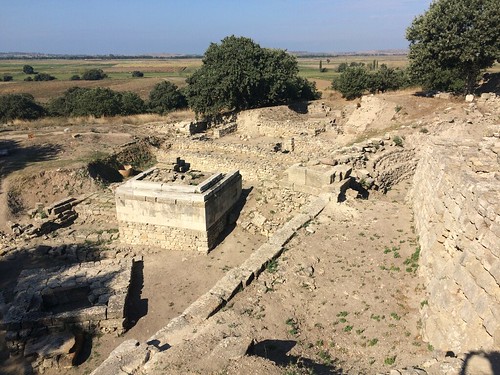
One of the most well known battles of the Bronze Age was the Troyan War, this most likely took place in the 12th century BCE (according to Erathostanus from 1194-1184). Legend has it that it was all about the beautiful Queen Helena who was kidnapped from Greece (Sparta) and taken to Troy (modern Turkey). The independent Greek cities formed a coalition and fought the far more sophisticated Troyans, but in the end they succeeded.
We visited Troy in June 2015
Extensive archaeological evidence from graves from around 800BCE indicate that the society was egalitarian and this has been brought forward as the right environment that might have led to the development of the first democracy.
Before the famous Greek philosophers arrived on the scene there were the ‘poets’ they were seen as the messengers of the Gods. Homerus was one of the most well known. Through oral and later written tradition they passed on the knowledge from the past to the future. They could recite the mythological stories which contained the ‘knowledge’ of that time and they also could recite the laws of the gods and the people and they were often required to attend the tribal assemblies where the kings held court. Their mythological knowledge was widely accepted as the truth.
The father of the Greek democracy was such a poet, Solon (c. 638 – 558 BC). From him onward, this situation started to change with learned people starting to arrive. With a booming Greek ‘economy’ it became possible for the well off to spend time on learning and at that early stage that was largely self-taught.
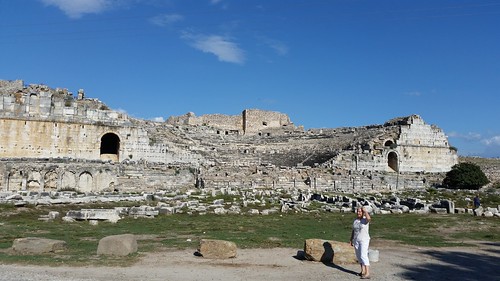
One of the first self-taught pioneers was Thales who lived around 600BCE. He was more interested in the natural philosophy (what we now call science). He invoked the concept of theory: ‘that what can be tested’, through reasoning, argumentation and observations. Together with his followers Anaximander and Anaximenes (known collectively, to modern scholars, as the Milesian School) they began to speculate about the material constitution of the world, and to propose speculative naturalistic (as opposed to traditional, supernatural) explanations for various natural phenomena.
Theatre Miletus 2015
Heraclitus is the first known person that started to investigate the concept of ‘knowledge’. His most famous saying is “No man ever steps in the same river twice”. He unified his thoughts on knowledge under the concept of ’Logos’ that can be interpreted as reason.
Socrates was one of the greatest as he continually put a mirror in front of Athenians with considerations of justice and the pursuit of goodness while he wondered around time. He saw himself as a gadfly, but his stinginess in the end also costed his life. He was found guilty of both corrupting the minds of the youth of Athens and of impiety (“not believing in the gods of the state”), and subsequently sentenced to death by drinking a mixture containing poison hemlock.
Others great minds followed the principle of reasoning and the most famous ancient philosophers are Plato and Aristotle.
Plato (400BCE) established the concept of dualism between the natural phenomenon of space and time, which continuously in flux and the Forms (ideas) which are eternal. This concept was carried forward into Christianity and is still with us today. All great thinkers of the next millennium basically used Plato as the starting point of their learnings: Luke, Paul, Augustine, Boethius, Anselm, Ockham and many others. They were assisted in this with the works of Plotinus who revived the works of Plato and started Neo-Platonism (this term only arrived in the 19th century).
Aristotle (350BCE) accepted Plato’s views but wanted to take them further to the test by questions where these ‘Forms’ are and what proof there was that they existed and where did they came from. He defines metaphysics as “the knowledge of immaterial being,” or of “being in the highest degree of abstraction.” He refers to metaphysics as “first philosophy”, as well as “the theological science.
Aristotle also went much further into natural physics: physics, metaphysics, poetry, theatre, music, logic, rhetoric, linguistics, politics, government, ethics, biology, and zoology.
The Ancient Philosophers they can be categorised as follow:
Platonism – dualism, the distinction between reality and what is perceptible.
Empiricism – experience based
Sceptics – answers to metaphysic questions are simply impossible – is knowledge achievable?
Stoicism – accept dualism but live in accordance to nature
Epicurism – (hedonism) perusal of happiness (intellectually pleasure) is most important in life
At times the combined Greek cities – within the concept of a ‘national’ identity – showed unity. They twice beat the far more powerful Persian armies. However, more often they also fought each other (e.g. the Peloponnesian wars) and in the end it was their disunity – each city was a totally self governing unit – that led to the fall of Greece. In 336BCE King Philip II of Macedonia took control over heartland Greece. His son Alexander the Great established the largest empire of ancient times. After Alexander’s death, during the so called Hellenistic period, Greek culture was spread through the remnant of Alexander’s empire, as far away as India and Kazakhstan. It has even been suggested that Greek knowledge and philosophy made it into Sanskrit literature.
In the meantime the famous Greek colonies around the Mediterranean were conquered by the Romans and Greece itself was incorporated in the Roman Empire in 146BCE. Greek culture however, remained popular among the Roman elite. While Greece as a country never developed into an empire, during its millennium of existence the Greek created a culture that was in many aspects unrivaled until very recently.
Phoenicean Maritime Empire
This successful culture developed in the north of the ancient Canaan in what is nowadays Palestine, Israel, Lebanon and Syria. Its part of the linguistic Semitic culture, while there is no conclusive evidence there are strong theories linking the origin of the language group to the Levant. The earliest archaeology linked to the (proto)Phoenicians dates from 5000BCE. It is unclear if Canaanites and the Phoenicians are one and the same people, however, common ancestry is well accepted. (see also video clip Israel Prehistory).
Culture and religion are closely linked to Mesopotamia. Political influence from this region also became clear when in the 3rd millennium BCE Mesopotamian King Sargon the Great conquers lands including the cedar forests of the Lebanon. Sargon was the first king in ancient times to start the conquering raids that soon would become a trade mark of all evolving dynasties after him. He established what is believed the first empire: Akkadia.
The names Phoenician comes from the Egyptian word Fenku (purple). They were famed as ‘traders in purple’, referring to their monopoly on the precious purple dye of the Murex snail, used, among other things, for the dying of royal clothing. Phoenicia was also highly attractive because of its cedar, pine and ash mountain forests (1300-1500 meters above sea level) in the two ranges of the Lebanon mountains. This provided them with a unique economic advantage because of a general lack if timber in the Middle East. They also used it for their own famous navy ships. According to the Bible, King Hiram I of Tyre sent engineers with Cedar wood to build the Temple of Jerusalem.The Phoenicians and successor rulers replanted and restocked the range so that even as late as the 16th century, its forested area was considerable, by now – 400 years later – only a few isolated reserves exist.
Glass was another key trading product from this region, the earliest glassware dates to 1900BCE.
Now more distinct as Phoenicians they established their early city states around 1550BC, they were independent maritime cities.. These were rather small cities of a few thousand people each and the bigger ones at their peak not more than 10,000 people each. They included, Byblos (Gebal), Tyre , Sidon and Akkã (Akko, Acre) (see video clip port of Acre).They occupied a strip of the coastal Levant approx 280 in length and 50 km wide (Lebanon currently occupies 250km of this coastal strip). In all they dominated maritime trade in and around the Mediterranean for more than a thousand years. As mentioned above they were also the first people to use the alphabet (Byblos is the Greek word for books, the city claims to be the oldest continuously-inhabited city in the world).
For most of the time Phoenicia had to accept overlords (Hitities, Assyrians, Egyptians, Babylonians, Persians, Romans, Arabs, Crusaders). As we see with so many city state developments their internal rivalry made it always easier for others to use divide and conquer techniques to exercise their control. In the 14th century BCE the border between Hittite controlled and Egyptian controlled Phoenicia was established at the Dog River ( Nahr al-Kalb), a famous strategic point to well into modern times. The territory north of the river was controlled by the Hittites, with the Phoenicians required to pay tribute to their overlords. However, this situation rarely remained stable; overlordship changed throughout the next 1000 years on a regular basis.
Around 1180 BCE their civilisation was severely disrupted. There was a mass migration from Mycenea and the Aegean Sea islands, probably because of earthquakes and or climate change.It is at this time that the Canaanites are being mentioned separate from the Phoenicians. The Canaanites are now mentioned as living live south of the river Dog. It is also in this area – according to the Bible – that the Israelites settled.
The Hellenic migration (known by the Egyptians as the Sea People) was brutally stopped during an 8 year war by Ramses III the migrants now known as Philistines (Philistine could indeed stand for the word ‘immigrant’) were allowed by the Egyptians to settle in what is now Gaza and southern Israel. The Israelites lived to the north of them bordering Phoenicia to their north, they saw the Philistines as their major enemy Goliath, etc).
During and following the disruptive period the Phoenicians experienced a rare moment of full independence. The upheaval did cut off the Phoenicians from their tin supplies (needed to produce bronze for their weapons) and out of necessity they now landed into the Iron Age. This can be called the true Phoenician period. We see Tyre now taking the leading role in the maritime trade, exploration and settlements around the Mediterranean. Hugging the Middle East and African coast line most of the settlements they established were simple trading ports only at a few places did they actually occupy territories (southern Hispania – Cadiz, Sicily, Malta, Carthage). From Tyre the Phoenicians also operated an extensive trade system into the east as far as Afghanistan (Lapis lazuli). There are indications that the circumnavigated Africa in the 6th century BCE and also maintained trading links with Britain (they operated the largest tin mines in the world between 2000-600BCE).
Hispania
When the Phoenicians landed in what is now Spain they came across a small rodent. As it looked like the one they were familiar with in their homeland they named the land after it: I-saphan-im. The Romans latinised this to Hispania. However, what the Phoenicians thought they saw was not the Hyrax as it occurs in their land but the rabbit. Originally native to Spain but since Roman time, spread all over Europe and currently of course far beyond that.
They established trading posts in Sicily around 900BC and founded in North Africa Carthage in 814BC. In 538 BC the Persians – with the assistance of the coastal people – overthrew the Assyrians. However, they immediately conquered the territories along the Levant, the ruling class of Israel was exiled to Babylon and the centre of Phoenician power now moved to Carthage.
The Greek started to establish their trading posts around the Mediterranean from around 750BC. For more than a century the two Mediterranean super powers lived peacefully next to each other. However from around 600BC they started to clash in Sicily this initially simply led to a division of the island, the Phoenicians in the east (Palermo) and the Greek in the west (Syracuse – see clip).
The Punics (Carthagineans)
The Phoenicians who founded Carthage in 814BCE slowly integrated with the local Berber population and developed their own unique Punic culture, language and religion and soon established their own independent political system independent from the Phoenicians. This started to flourish during the Hellenistic period.They controlled the western part of the Mediterranean: Hispania, Malta (where they had several heavily fortified inland settlements) and what are now the Tunisian and Libyan coastal areas.
When the Greeks started to challenge the Phoenicians the cities in Sicily often used the Greek and Phoenicians in their home lands to assist them on a as needed basis, this led to a waring situation for nearly 350 years, known as the Sicilian Wars or more correctly the Greek-Punic Wars. Initially these wars were between the Greek and the Punics and later between the Romans and the Punics. The first clash occurred in 580BC on the island of Motya (Mozia) of the Sicilian coast of Trapani (see video clip).
The Greek city of Segesta was assisted by the Carthagineans in 540 to defeat a Greek expedition. Their maritime technology was far superior to that of the Greek. The first serious war started in 480BC. Greek power had increased with two competing Greek powers in Sicily, the Ionians (Palermo)and the Doric (stronghold Syracuse), the Carthagineans dominated the west. The Phoenicean fleet stranded (bad weather?) and lost the war.
The second Punic War started in 415BC when Segesta asked for the assistance of Athens and when their expedition failed they asked for the the Phoenicians to help them, this led to the total destruction of the city (see video clip). In another raid the Carthaginians destroyed the Greek city of Akragas (Agrigento) in 406BC (see video clip). A peace treaty was signed which enforced the supremacy of the Phoenicians on the island.
The Persian Empire collapsed more or less overnight during Alexander’s campaign in 332/333. Tyre put up a fight and stopped Alexander for 8 months, the reprisals were severe. Sidon befriended Alexander and became the most important city during the Hellenistic period.
During the Third Punic War the Sicilian city Selinunte, remained loyal to the Punics and was destroyed by the Greek in 307BC (see video clip). In the meantime the Carthagineans had built a new stronghold in Marsala in the Province of Tarpani. However, the overall power of the Carthegineans was severely reduced.
Pyrrhic Victory
Between 280-275BC King Pyrrhus of Epirus (the Greek state facing Italy)interfered in a range of complex local conflicts in the region, including the ones linked to the Punic Wars. He amazingly defeated the Romans in Italy and the Carthagineans in Sicily, however the costs of these victories was so high that he had to withdraw to his homeland and as such lost all of his won territories. This event has gone into history as the saying ‘a Pyrrhic Victory’.
A new series of wars – known as the Roman – Punic Wars started in 264 also in Sicily – as a local conflict. However, the Romans used this event to become involved with the purpose to undermine the Carthagineans. The Romans wanted to expand their regional hegemony into Sicily. They also used new naval technology to attack – until that time – the Mediterranean had seen a nearly totally undefeated Punic navy. At the end of the war in 214BC Sicily was under the control of Rome.
Interestingly the Punics conquered a large part of Hispania and from here – during the second Punic War (218-210BC) – one of the most celebrated military leaders of all times – Hannibal – crossed the Alps with elephants into what is now southern France and entered Italy. Some of the military defeats were among the heaviest Rome encountered during the 800 years of its existence (at Cannae in Italy some 70,000 Romans were killed – 90% of its total force) . However, a lack of supply support from Carthage forced Hannibal to stop short of actually conquering Italy through this back-door. This was for the first time that the Mediterranean powers started to reach into Europe above the Alps – at this stage however – just passing through. They did receive the support here from the local Celtic tribes, many of them even joined Hannibal in his expedition into Italy.
Initially Rome was devastated and demoralised, the country was in disarray and even resorted back to human sacrifices to appease the gods. However, the Carthagineans were unable to built on this success and resorted to a range of internal conflicts; severely weakening its political position. Rome felt strong enough to renege on its peace treated and started to attack the Carthagineans in North Africa which ended with the conquering of Carthage in 146BC which led to the demise of the Punic maritime empire, with all of their territories as well as the mother country in the Levant now all under the control of the Romans. However, the influence of their culture was still felt in the 3rd century AC as the Punic language was still spoken in North Africa.
Some 500 year later German tribes started to arrive in this area with the Vandals conquering Carthage.
It is amazing to see the similarities between the sarcophagi of the kings of Sidon from ca. 350BCE with those of the the Dukes of Burgundy in Dyon from the 15th century. They have similar funeral processions, but Claus Sluter the designer of the Burgundian sarcophagi can’t have seen the tombs from Sidon as these were only unearthed in the 20th century. The sarcophagus of Abdalonymus, how was made the king of Sidon by Alexander the Great is the most magnificent sarcophagus of the ancient world.
Mediterranean influences on northern Europe
Apart from a few brush strokes none of these Mediterranean developments had yet reached northern Europe. However, shortly after the end of the Punic Ware, Romans interest started to move northwards. It was only at that time that the Mediterranean culture started to reach north-western Europe but even than it didn’t have a transforming effect on the north-western region of the continent. Only in Medieval times did we start to see the arrival of state building activities; the arrival of palaces and cities and in general the arrival of more complex societal structures. It is no wonder that these southern cultures soon started to characterise their northern neighbours as Barbarians.
However, what did influence our region – at the time the Minoan culture arrived in Crete – were Bronze Age developments, which originated – again – on the eastern Steppes (4500BCE). This together with their skills in horse rearing and their new vehicle the chariot had a great influence on the developments in the rest of Europe.
A key region for the development of metallurgy was Central Germany and Czech especially the Únětice region in this latter country. Initially the spread of bronze was stimulated by the mobility of the steppe people, with their horses they reached both east into Asia and west into central Europe where bronze was produced. One of the most famous artefacts of these people is the beautiful so called bronze sky disk found in the German town of Nebra. It is portable observatory dating back to 1600BCE.
As mentioned, there is a strong esoteric link with metallurgy; smiths were seen as very important people, we see similar roles of smiths in the many religious stories both in Nordic and the Mediterranean versions.
Late Neolithic Revolution in the Low Countries
Three thousand years after it started in the Eastern Mediterranean, with the arrival of Corded Ware people, the Neolithic and Copper Revolution finally came to a grand finale in the Low Countries.
While in other parts of Europe the changes over the previous 3000 years occurred more gradual in the Low Countries when all of these innovations finally came together this resulted in a sharp break between the old archaic and static structures.
As is the case in modern times, also than, such abrupt changes open up ways for innovations, new structures and cultural developments. As this development happened rather late in this remote region, we might want to talk about a rather rapid ‘revolution’ and as is often the case revolutions lead to tension and disruption.
This period can be seen as a final end of the megalithic stone mortuary shrines as they started to be replaced by smaller burial places, reflecting a more mobile society. It was in these regions of north-western Europe where the old native structure lasted the longest, but finally also the people here were brought into modern times.
The changes might have invigorated the local people, or at least some people within their society, and led to a series of rapid changes, most probably overthrowing old archaic structures, this propelled these ‘modernists’ to the forefront of a range of new innovations.
This upheaval might even have led to the development of some small local dynasties of competing (young) chiefs, some graves known as chieftain graves could be an indication of that. However, it is important to put this in the context of still rather primitive farming communities.
Living along the coast and rivers, these people had become seasoned seafarers. They also might have been stimulated to look beyond their marginal agriculture lands, limited by the environments situation of this dynamic region between land and water. Add to this population increases and you have the right mix for a Dutch revolution.
These people established a complex networks of alliances to secure the material symbols of success. Raiding must also have had his origin in this period a development that would continue well into the early Middle Ages. However, at this early stage this did not yet lead to enforced territorial boundaries or asserted territorial control.
The Bell Beaker Culture 2,800 – 1,900 BC
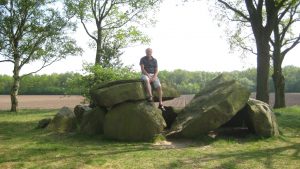
Hunebed Drenthe 2011
The Corded Ware culture arrived in the Rhine Delta around 3100 BCE most probably from the east and this culture was adopted by the native Hunebed-builders, Stein Group, Enkelgraf Culture and Vlaardingen Culture people. They brought with them knowledge and materials of the Neolithic Revolution. It took a few centuries for these cultures to mix and to form the local variant known as the Bell Beaker (Klokbeker) culture, they also continued the tradition of single grave burials. They also settled and became farmers.
These Bell Beakers are very important cultural markers and they are representing the people living in the Rhine Delta and along the rivers including the Rhineland.
Occupying an area of maritime cross roads, they traded with Britain and Scotland and along the Atlantic coast, their bell beakers and other elements of their culture, ended up all the way in Portugal, southern Spain and Sicily. Via the inland river systems they reached well into Germany and France. This might well be the earliest evidence of the seafaring and trading nature of these people; a characteristic still closely linked with the Low Countries These characteristics have been maintained by these people ever since.
The travel and trading activities also brought these people in contact with other Bronze Age cultures, in particular the Únětice culture (Central Europe ca. 2,300-1,600BCE) and Nordic Bronze Age, a culture of Scandinavia and northernmost Germany-Poland, 1,700-500 BC.
We also now see the first European products arriving in the Mediterranean; amber from the Baltic ended up all the way in Egypt.
These contacts also assisted in the opening up trading routes with the metallurgic people in Central Europe. Bell Beaker people were instrumental in the spread the use of bronze products and most probably also horses and chariots (the wheel) throughout their trading areas. They rapidly became a main competitor to the older-established steppe based groups.
Many people they came in contact with rather rapidly took over their new individual material way of life and the Bell Beaker people had a long lasting effect on several of the other, especially the more marginally, Neolithic people along the fringes of what in many cases was still very much a communal oriented megalithic Europe. It also caused in these place a very distinct break with the past. This new form of individualism also created a more materialistic culture, where the nouveau rich started to show off, we also see the arrival of the so called elite graves (see below). Interestingly most of the bronze weapons produced for the elite hardly ever show signs of violence, it is believed that they were mainly ceremonial.
Bell Beaker people didn’t reach Scandinavia and this region kept living in a retarded Stone Age.
The importance of the Bell Beaker culture is further highlighted as it is seen as a local flavour of the Proto Celtic Indo Europeans.
We also see that these traders – on their maritime trips in these cold climates – also started to use woolen garments.
Drinking beakers
The bell beakers, which are the most characteristic elements of the culture the people representing this culture left behind, were – based on pollen research – definitely also used for weak alcohol drinks like mead with herbs and wild fruits – all rare substances and thus prestigious – perhaps they were also used to assist them in preparation for their dangerous travels. While it is more likely that this was used for hospitality rather than large-scale community ceremonies, there has been a persistent image of alcohol loving people during Germanic and medieval Dutch times, it is only since rather recent has this image has started to recede.
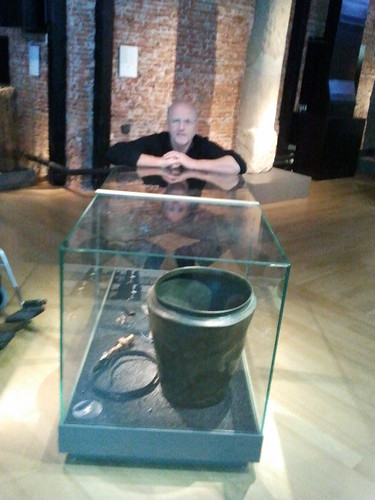
At the burial ground in Oss (see below) , there were at least two graves with bell beaker findings, dating back to between 2,200 and 2,000BCE. The first one, beautifully decorated, of the ‘Veluwe’ type was found in the urn field close to the Hallstatt chieftain grave this one was at that time (1935) the first of such find in Brabant. The beaker was buried next to a cremation, this is a rather unusual find from the late Neolithic. A second Bell Beaker, or better describes as a plate was found around the same time in a tumulus a few kilometres to the west, in Schaijk, they also discovered the silhouette of a skull in the sandy grounds of the tumulus.
Other evidence of these people in this region include a beaker in a single grave as well as an (empty) 2nd grave near Cuijk and another grave a few kilometers further near the village of Haps. In nearby Beers-Gassel another bell beaker was recovered together with some golden jewellery.
At Mander near Ootmarsum the grave of the (feet-less) famous ‘ De Man van Mander’ (the Man of Mander) also indicates a Bell Beaker burial in this area. He was buried in a stone coffin under a tumulus. Also this area is rich with tumuli (approx. 20) and as at the tumuli in Oss, also here one of them was used to put gallows on top. Further more a large urnfield (300 graves) and the remnants of two older hunebeds and this site goes even further back with a flint stones find that dates back to the Neanderthal man (80,000BCE). Also similar to Oss is the positioning of the settlement this time on the slopes of sandy hill of the 15 km long push moraines between Ootmarsum Uelsen (Germany), its highest point was 89 meters, there are plenty of springs and streams in the area. In this area the urnfields at Rossum are another example of early settlement covering a period from approx 3000BCE till 800BCE.
Of the approx 1,000 tumuli in the Low Countries, nearly two thirds are found on the slopes of the sandhills formed by the moraines in Drenthe, the Veluwe, Gelre hills (between Nijmegen and Rhenen) and the Maashorst. There are many similarities between the burial sites in these areas.
The Bronze Age in the Low Countries
There was not that a sharp divide between the Bell Beaker period (Copper Age) and Bronze Age in the Low Countries, more of a gradual inclusion of bronze objects within the existing cultures. The first finds date back to 2,100 BCE (Wageningen) and 1,900 BCE (Barger-Oosterveld). The Hilversum Culture (1,800 – 1,100 BCE) is also linked to this period, this is a rather misnomer while indeed a rare find of this pottery was found near Hilversum, the centre of this culture however, is further south in Brabant and Belgium.
Similar to copper, bronze largely remained a prestigious good to be used for gift exchange and most regularly found in burial sites and at religious sites where it was used to obtain goodwill from their gods. Bronze however, was far more easier to work with for jewelery, arrow heads and daggers. The number of weapons produced indicates that man-to-man fights had become a far more serious activity by now.
Again Escharen delivers some great finds from the middle period – along the river Raam – two swords, a big arrow point and a bracelet. In Oss a very rare (the only one in the Low Countries) and large mold was discovered, it could be used for the production of three totally different products a so called heel axe (farming), an arrowhead (hunting) and a so called radnaald (round needle used for fibula for ladies from the higher classes). Other Bronze Age finding sites include: Cuijk, Escharen and Gassel the same place names as we came across in the previous period. A rare find further south is near Nijnsel.
As in the proceeding Stein group period also during the Bronze Age it is this north eastern corner of Brabant – in and around Oss – that saw an explosion in human activity. However, these people started to use more robust building materials for their farms and they have left better traces behind for the archeologists to study. These people started to travel further west and south.
Vegetation samples also indicate that large parts of the original forests disappeared indicating an increase in population and more land cultivation. The farms were both occupied by people and their cattle, deforestation also saw an increase in heath that proofed to be excellent grazing lands for sheep. A practice that in many parts of Europe continued to well into the 20th century. The change in culture also indicates that cattle started to play a more prominent role in their societies; perhaps cattle and its produce became part of the new trading activities that had started to emerge. It doesn’t look like that arrival of bronze had any significant impact on societal or economic changes. In some areas bronze however, did play a role in their (burial) ceremonies and in their contacts between people outside their own settlement.
From now on settlements also started to become permanent. After farm houses started to deteriorate new ones were build between 25 and 200 meters further on, as we will see below in the chapter on the settlement of Oss. Other farm settlements in Brabant include: Loon op Zand, Geldrop, Boxmeer and perhaps also Rosmalen and Breda. Most of these settlements were very small, only one or two (large) farm houses were in use at any given time, indicating an ongoing tradition of family clans.
Cultural progress certainly occurred amongst the northern Bronze Age people, as high quality bronze sculptures, drinking vessels and jewellery that included gold, silver and amber was produced locally across the region. While less in number their artistic skills were certainly not less than their more famous southern cousins around the Mediterranean. Chariots became more widespread used and textiles become more elaborate. All clear indications that the new culture of individualism, which had started in the late Neolithic and Copper Ages, continued and further developed during the Bronze Ages.
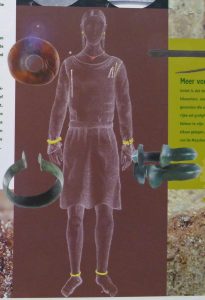
One of the most famous finds of the Bronze Age has been the necklace of Exloo (Drenthe) dating back to around 1,800BCE. It consists of 25 tin beads, 14 amber beads and 4 faience (glass paste) beads.
Drenthe seems to have been the centre for bronze casting in the Low Countries, perhaps this was because there was a trading route over the hill crest that runs through this province this might have been used for amber trade with the Baltics.
While the Copper Ages saw a wide diversity, especially in its pottery, the Bronze Age shows a far more uniform cultural pattern.
An increase in bronze production required an increase in trade. This was needed to obtain the commodities required for the production of bronze. This required a higher level of organisation from the earlier developed trading systems of the Copper Age. Local trading goods had to be produced to obtain these commodities. This will have included hides, cattle, salt, wool and possible fur from animals trapped in the forests.
Late Bronze Age revolutions around 1300BCE
The innovative Bronze Age people also led to the spread of more advanced bronze inventions such as the lost-wax technology and the use of the above mentioned multiple-piece moulds. This saw the introduction of many new objects. They also invented an easier way of transporting the commodity, done in sheets (igots).
There are also indications that the most south-eastern groups of the Bronze Age Tumuli Culture traded with Mycenae. There are a few rare finds of products based on innovations from the south; as mentioned above; northern Europe remained uninfluenced by the developments around the Mediterranean.
That is not to say that also the northern regions saw a range of remarkable developments. As far as Denmark fertile lands were tiled and in the country some 4,000 burial mounds are still visible in the landscape, indicating a large group of rather wealthy people/families. Further north there was very little farmland and developments here were slower than further south.
Towards the end of the Bronze Age, we also see a very noticeable increase in high-quality gold objects. This must have had a significant effect on the economy and in particular on the personal wealth of the local chieftains. Bronze artifacts played a very important role in social life with complex gift giving traditions involved over long distances, this tradition most likely dates back to well before the Bronze Age period and continued well into historic times .
The gift giving culture
The gift giving culture is still very much alive amongst tribal of semi-tribal societies. I remember visiting people in a village in Zambia in the 1970s together with my sister and her husband who lived there at the time and she told us that we had to bring some gifts with us. We brought salt, sugar and some clothes and in exchange we received a live chicken. Fortunately my brother-in-law was an expert in killing and preparing it, what he did on our arrival back home.
In relation to this gift giving culture back in tribal times in north-western Europe, it is interesting to look at the situation in Iceland. The island was settled in the 870s from Norway. The tribal tradition they brought with them continued here in relative unchanged conditions till the end of what is known of the Golden Age of Iceland in 1262/4 when it was integrated into Norway.
Its population grew from around 10,000 in 930 to 50,000 when it lost its independence. During that period they had approx 50-60 tribal chiefs. This changed after 1262 to 6 or 7.
Thanks to the early 13th century sagas from Snorri Sturluson we get great insights in tribal life of that time. During a lecture at the University of Sydney, Professor Jòn Sigurðsson from the University of Oslo provided a good insight in the gift giving culture at that time, indicating that this would have been characteristic of the Germanic tribal systems through north-western Europe and indeed beyond.
Friendship was the key to this system and the friendship relations were expressed in many different words for ‘friend’ based on relationships. These friendships existed between the chief and his subjects, between subjects and between chiefs. These friendship relationships were essential in the functioning of the tribal society. Gifts played a key role in this, they could be physical gifts, including property and title, feasts and protection. Gifts were important to establish friendship, feats to maintain that friendship
In exchange support was expected. Support by subjects to the chief and support of friends from friends. In all between 15-20% of the population played an active role in this gift giving system, they were mainly men but women were not excluded, eg. widows and queens.
With this limited number of players the friends-of-friends also played a key role as they were supposed to support their friend who supported the chief.
Sometimes somebody could be a friend of two chiefs and when it came to a conflict between the chiefs, they played a key role in mediation. The Golden Age in Iceland was a peaceful time and showed that this system of friendship worked well.
In the tribal structure friendship was more important than blood relationships. These ties were extremely strong, friends were prepared to die for each other and this also happened regularly as we know from Viking stories.
A further revolution in agriculture occurred around 1300BCE. Broad beans started to appear as well as the more regular appearance of millet and rye. Oil-bearing plans became cultivated such as flax, poppy and gold-of-pleasure (false flax). These agriculture innovations started to reach the northern regions in the early Iron Age. Some of these innovations would not reach their full potential until the Middle Ages, when millet became the main staple for the populations and a key ingredient for the production of fermented drinks and porridges.
xxx
Celtic Fields
Celtic fields are an innovation of the early Bronze Age (c.1800BCE) they are a popular name for the traces of early agricultural field systems, but have nothing to do with the Celts. They can date from any time between the Early Bronze Age and the early medieval period, when they were still used.
These are characterised by their proximity to other ancient features such as enclosures, sunken lanes and farmsteads and are divided into a patchwork quilt of square plots rarely more than 2,000 m² in area although larger examples are known. Their small size implies that each was cultivated by one individual or family. There are some good examples of these fields In Friesland, especially the one in Hijkerveld (Drenthe) is well known. It is estimated that to feed a family of six, 100 of these patches were needed, in any given year only 25 of them could be cultivated, and the rest had to be left fallow. The Celtic fields known from this period could not sustain more than five or seven farms.
An archaeological site in Bovenkarspel (North Holland) provides evidence for the systematic breeding and herding of cattle on a rather large scale.
Tumulus and urnfield cultures 1,600 – 1,200BCE – late Bronze Age
The late Bronze Age saw also a rapid change in burials; cremation became the dominant funeral tradition, perhaps indicating a change in religious beliefs, brought with the invaders and migrants coming from the steppes (tumuli = kurgans in Russian). The spread of the above-mentioned Czech Únětice culture within the dynamic Bell Beaker culture period might have be the catalyst for the spread of tumuli in our region. The new trend arrived from the east via the Danube. In north and central Italy the related culture is known as Villanovan. These cultures also form the basis of important follow up cultures such as Hallstatt, Celtic and Etruscan.
In north western Europe it had such an impact that it the period became known as the Tumulus culture.
It is thought that these burrows were seen as houses of the dead, with their inhabitants looking after the living, welcoming new people, sometimes feasts and processions were organises at the tumulus. Several of these tumuli have a south-east entrance and the ditches sometimes have a little dam here. This looks very much like a midwinter solstice alignment and looks similar to the positioning of many other tumuli and megalithic passage graves and throughout Europe. It has also been argued that there is a cosmology relationship with the burrow for the dead being ‘underground’ representing the underworld and the mound the cosmos, often a tree or a stake was put on top of it as a link with the upper world. While there is some evidence for such decorations in Britain and Ireland there is no indication of this also happening in the Low Countries, but there is no reason to believe that also here, this has not been the case. As we will see sometimes these barrows were used for secondary burials as well, but as there are relative few people buried in these tumuli, clearly not everybody was buried in tumuli.
These tumuli were often built on higher grounds (sand hills as in the case near Oss – see below) and sometimes small hills and remained a prominent feature in the landscape for centuries even millennia and would also inspire the living and this would assist them in providing wise council to them. The higher laying Maashorst – as mentioned above – was also a popular area for burials. Over time many of these sites accumulated larger number of tumuli. The one on the Maashorst – Slabroek – counts 38 circle ditches (see video clip). Another famous urn field is Toterfout, near Veldhoven, where some 34 burial mounds have been located dating back to 1,600 and 1,000 BCE. There are also a significant number of them in the area near Ootmarsum and in 2007 we visited some of them in an area north of the town, known as Springendal. Two other ones in Brabant will be discussed in more detail below: Haps and Oss.
An important group of tumuli people became established in and around the Lüneburger Heide in north west Germany, they rapidly occupied the niche left open by the Beaker people to the west and opened trade routes to the north, in particular into Jutland and to the mineral rich areas to the south.
After a period were it was the tradition to bury their dead individually or later collectively in rather large tumuli the rituals changed again and somewhere around 1300 BCE tumuli burials started to become replaced by urnfield burials.
People now started to cremate their dead and buried them individually under a small barrow, sometimes surrounded by a small ditch or more of them depending on the status of the deceased. Graves were put closer together and that’s how the urnfields formed, sometimes they were next to the old larger tumuli. As mentioned before the higher sand dunes in the Low Countries formed during the ice ages, became favorable spots for these burial grounds, as well as for the first settlements here.
Most urn fields are dating from 1,300 – 950BCE and will stay in use until well into Roman times. However, it was not until around 1050BCE before this trend started in Brabant where these burial grounds became especially prominent (some 135 of them). The largest urnfield in the Low Countries is near Weert. Another one is the burial site Someren-Waterdael where there are 185 graves. These urnfields are similar to those in neighbouring Germany (Rhineland) and Belgium.
In the (southern) Low Countries the date – 1050BCE – is used as the starting date for the late Bronze Age period.
Above the rivers this period had started here slightly earlier
Based on the analyses of these burial sites also during the Bronze and Iron Ages most settlements again remained not much larger than one or two families
As mentioned often these new urnfields were in close proximity of the earlier tumuli and sometimes as we will see in Oss, an old tumulus was reused for an urn burial. Towards the end of the urn-field period we see the arrive of pole circles.
The end of the urn field burials finished as abrupt as it started. From 500BCE onward they totally disappear, to the great despair of archaeologists.
One of the most interesting Bronze Age burial grounds has been found in Haps, this is the village where my wife’s father’s family came from; van Daal. Their farming history in Haps goes back to around 1650.
The tumuli and urnfield in Haps have been used between 1800BCA and 150AC. The tumuli were placed in a long row, perhaps along a road. There are long shaped and round shaped tumuli and one is a combination of the two. As usual in the Bronze Age the tumuli were circled by poles (paalgraven – pole graves), the function of which still eludes archaeologists, however ceremonial reasons are expected.
The dead were cremated and their remains either buried in urns or in small holes in the ground. During the 7thcentury BCE a small urnfield was added to the site, containing 80 burials. The theme continues here with some burials in urns, others in small holes, some have some simple grave gifts; some of the holes have a pottery fragment on top to close it off. These themes are continued throughout the tumuli and urnfields right across Europe.
Around 500BCE there was also a small settlement of 2 or 3 farms, this settlement remained in use Roman times. It has been suggested that earlier settlement must have been elsewhere in the vicinity of the tumuli.
Not everybody was buried within these urnfields, to the contrary often there are only indications of one of such burials with a one, two or even three generation, highlighting the importance of the person.
The settlements of Oss
Oss is one of the early settlements that were established on the border between higher and lower grounds. The effects of the above mentioned geological peel fault had created a perfect environment for this settlement. The higher grounds towards what is now Oss also created a barrier for the water flowing (mainly underground) from the peel morasses and thus surfaced in little streams that created further opportunities for settlements (wijsten). Furthermore the area was close enough to the river Maas to also take part in the trade and gift exchange networks.
The fact that we know so much about this is that the University of Leiden became involved in this project back in the 1970s and in all three generation of archeologist from this university have been studying these sites over some 35 years and their work is in 2012 still continuing. Most of the information in this section is thanks to the work of these people and the various publications that they have produced.
Early farmers were using the higher sand dunes perhaps as early as 3000BCE and the river flats, from around 2000BCE. The sandy hills also show remnant of hunter gathers campsites dating back another 3000 to 4000 years.
We already saw above that the people in this region at that time were influenced by the Bell Beaker culture. There is a strong indication that it were these people who finally became the first farmers in north-western Europe.
At the southern settlement of Oss, on the higher ground, archeologists also found evidence of a hunter-gatherers camp from the Mesolithic. Under one of the tumuli they also found evidence of two poles dating back from the late Neolithic (2900-2600BCE). [15. Archeologisch Onderzoek Leiden (Archol) bv – Project Oss Zevenbergen] The archaeologists suggest that the area occupied by these farmers was perhaps a few hundred meters wide and a kilometer long, it was mainly used for pastoral activities. It is impossible that all these cultural changes that occurred throughout this period did not effect the local population, however, there is very little evidence that these resulted in large scale changes to their societies. Throughout these periods it is generally suggested that farming communities of maximum 5 or 6 farmhouses and a population of between 25 and 40 people would be the norm.
There is also no evidence of invasion or large scale migration, the conclusion more likely is that the local people adopted some of the new innovations, but only those that fitted into their local pattern.
From the north-western European Neolithic period onwards there is remarkable little evidence of hunting so it looks like from that time farming has been the main activity.
The social development of the later village economy had its origin in these very small Neolithic, Bronze Age and Iron Age communities. Interestingly these settlements continued into modern times. Some of these settlements didn’t really start to change at all until the Middle Ages and even many an iron age person walking around in some the more isolated part of this region as recent as the first half of the 20th century would have recognised significant elements of the ways of life they had lived here a few thousand years earlier.
The social and economic developments in northwestern Europe have been the most stable of those in the whole of Europe, isolated from the consumer market developments in the Mediterranean and the more disruptive developments in the eastern parts of the continent. For several millennia there is little evidence of status or of any significant social and economic differences between the farmers who lived here.
Forest settlements
The current centre of Oss – as well as the older Neolithic river flat communities are situated 7km north of the forest settlement. So in the end with technological innovations in agriculture practices the gravity of the farming and pastoral activities ended up closer to the more productive river flats.
What happened was that initially the clearing of land took place on easier to till, lighter, higher laying, grounds such as the sandy soils in the area where also the burial grounds are – and in which vicinity also, most likely, the original settlement of this community.
A result of this form of farming was that after a while the soil got exhausted and significant sand drifts occurred threatening farms and even communities. There are still several sand drifts on the heath lands around Oss, Uden and Herpen.
Sand Drift Osse Hei
The whole area was a cleared area in the forest that existed here on the edge of the Peelhorst. Similar to other farming areas from the period, in all perhaps a kilometer long and a few hundred meter wide. The major part was using for grazing, there will have been a farm house (or perhaps tw0), storage facilities (spiekers) and other smaller constructions.
Archaeologists belief that the settlement of these people was just on the southern side of the burial ground, they base this on the use of the land, agriculture evidence, tracks and shards of pottery. However, so far no hard evidence has been unearthed, there are clear indications of agriculture and pastoral activities throughout the nearly 3,000 years of occupation, so most certainly people must have lived close by. Also close by are two springs (Vinkel AA and the Munsche Wetering) and settlements would not be established without easy access to fresh water.
These sandy soils provided a few good years of agriculture followed by a longer period of pasture. Early land management took place through slash and burn techniques and again archaeological research confirms that this was also used on the land around the burial grounds. Pollen research of the burial ground has also indicated that indeed some form of agriculture had taken place close by, but that – far more significantly – sheep has grazed the area around the graves, perhaps already before 2,300BCE. Sheep also means wool so some economic activity could also well have taken place around that time, perhaps between local communities, it is estimated that in this area local communities (farms) were established approx 5 kilometers apart.
It also seems that there was a ‘buffer zone of heath of some 250 meters between the burial ground and the forest. Another conclusion that could be made is of course that the people respected this area and didn’t want to till it and therefore let sheep graze the area.
The three communities in the vicinity that continued into modern times were Zevenbergen, Vorssel and Mun. The farmhouse Zevenbergen was turned into an inn when in 1835 the cobble-stoned highway between Nijmegen and Den Bosch. This road makes a slight bend at this spot to avoid the hills which at the time were unknown to be the tumuli, but they were high enough to influence the design of the road. At high school the boy next to me Gerard van de Ven lived at this farm (the inn had burned down and was rebuilt as a farm house again).
The burial ground of Oss
Over the last 10,000 years we have seen a re-occurrence of different developments between the north and the south of the Low Countries. Different reindeer hunters, different farming culture influences and also in the Bronze Age we see significant differences. In the south we see cremations and in the north we see inhumations, Oss is situated on the border and we do see rare forms of both burials in the grave fields here.
I remember that in Oss there was the saying: “Ik wou da ge op de Munse hei lâg”. I wish you were lying on the Mun heath. Unknowingly to the people using the expression in the 19th and 20th century, they were referring to this old and long forgotten burial area.
In the Middle Ages (1300-1500AC) one of the tumuli hosted the local gallows and remnants of skeletons with their hands tied behind their back have been unearthed. While these burials must have been less glamorous, again this place was linked to death. In 2012 the Provincial Archivist of Noord Braband did come across a map that shows these gallows as belonging to the judiciary of Ravenstein.
The topographic name ‘Mun’ is linked to the Germanic word ‘minnen’, which according the linguistic experts can be linked back to honouring the death.
The necropolis here consists nowadays of three clusters, new roads in this area have over the years build through this area so the integrity of the whole necropolis has been lost. The three clusters are: the graves around the largest tumuli that of the so called ‘chieftain of Oss’, the cluster Zevenbergen, named after the topographical name of the area and the neighbouring Hooge ( High) Vorssel cluster, slightly more to the south, again named after this local community. There could have been more graves but the road constructions would have destroyed them, there is also still a neighbouring forest that could reveal some more graves.
There is another large necropolis in Slabroek (Uden) 2 kilometres from here, this last one also contains cremations from Roman times. While it is tempting to link these burial grounds together, they more likely belonged to other family groups. what however, is clear that the area was an ideal spot for the early farmers who settled here.
Necropolis Oss
Bell Beaker Tumuli
2 graves
2350-2000BCE
Middle Bronze Age Tumuli
3 tumuli, 8 burials – one tumulitwice reused in Late Bronze and Iron Age, one with a double circle of poles. This one also hosted the gallows and has three Middle Age burials of criminals?
The first (known) Bell Beaker burial took place in an area that at that time had already been in use for perhaps 300 or 500 years. And as can be seen in the table above, there were gaps of a similar age between the use of the area for new burials.
Local burial rituals
The extensive burial ground in Oss predates the urnfield period. The origins of this sacred place dates back to 2,300BCE and was used till 500BCE, representing a remarkable long period of social continuation as already mentioned above.
During the Neolithic and also during the Bronze Age significant less than 5% of the population was buried in tumuli. Sex, age, family linage and the position the deceased person had in the community were all important considerations that played a role in how that person would be buried. It is obvious that receiving a tumuli and the seize of it was linked to honour. The grave of the chieftain of Oss is with its 53 diameters the largest tumulus in the Low Countries; so obviously this was an important person. In contrast we see at the river flat settlement that the death were sometime buried close to the farm or when there were more farms (Roman times) urnfields.
During the Late Bronze Age and the Early Iron Age the urnfield period started and the tumuli changed in format they become a bit more elongated.
Cremation was also not a common practice, while the history of this goes back to the Mesolithic most burials were inhumations either in a burial pit or simply just under the soil, sometimes on an animal skin or on a layer of plants and leaves. All forms of burial traditions are represented at the necropolis. In the settlements in Oss there are very very few burial gifts. While in the Late Neolithic this practice became more prominent in other parts of the Low Countries, it didn’t catch on in the southern Low Countries. This is not an indication of the wealth of the person nor of the community, it simply is an indication of the local burial rituals. However, both the chieftain and the ‘prince’ graves (see below) contained rich gifts.
Sometimes small separate structures – approx 2×2 meters – are located close to the tumuli, they typically consist of 4 poles and look very much like the grain spiekers at the farm settlements. Sometimes they are linked with rows of poles to the tumulus. They could have functioned as platforms for the dead before they were cremated, the word shrine has also been mentioned as a possibility.
As already mentioned, the differences in burial rituals indicate changes in believes and culture that occurred over this period, but throughout these 3,000 years – sometimes with intervals of several hundreds of years – this necropolis remained a ‘sacred’ place. It is hard to not come to the conclusion that there must have been a very strong sense of belonging of all those generations of farming (rather than nomadic) people who did want to maintain their link with their ancestors. This indicates both a strong link with this place itself and the ancestors who went before them; they provided them with a strong link with the land and the legitimately of that link. While there is no evidence that Bronze Age people had a clear ethnic identity, which would differentiate them from “others”, it is hard not to see that the people who for close to 3,000 years buried their death in the same place would not have had a strong own identity.
While there is a continuity from the Bell Beaker period to the Tumuli period, there are also some differences.
Building a tumuli
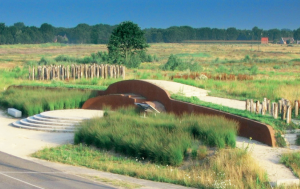
One of the Iron Age tumuli in Oss has a diameter of 53 meters and a height of 3 meters – the largest in the Low Countries – and would have required an area of 200 meters around it to produce the sods needed to built the tumuli, this must have been a rather complex and labour intensive activity. First the area needs to be cleared, next a circle was set out this was either done by digging a ditch or by installing a circle of poles. From this ground design the tumuli was built. The basic cultural and religious principles behind this tradition are also found in other tumuli cultures thoughout Europe as mentioned above.
The area was ideal for the building materials needed. The sandy soil on the Maashorst facilitates podzolization ideal for formation of soils that can be used for the production the sods. The sods here were quite thick.
Building such a grave would have involved the whole community and perhaps those from neigbouring communities. The sods need to be dug out, this was done with stone, bronze or iron knives, they also used shovels made of wood or antler. Archeologist have calculated that the 300×300 mm sods at the graves in Zevenbergen each weigh approx. 12 kilos. After they were taken out they were transported to the (nearby) hill. It could well have been that sod production for the tumuli dates back to the early Bronze Age. One of the tumili at Zevenbergen required a sod production are of 2500m².
Some graves consisted of circles of poles – as we saw with the tumuli in Haps (above) this is a feature of the period 1,500 – 1,100BCE – others had ditches around them. It has been suggested that not all of these poles were necessarily a structural part of the monument, but that it could have been used for shrines of that it was used for other ceremonial activities as part of the death rituals. Most tumuli are situated aprox.100 meters apart of each other.
The poles were placed at a distance of approx 75 cms of each other, so it didn’t create a protection zone or a closed environment. It perhaps indicate more a transition zone, the same could apply to the ditches. They most likely were of ritual significance.
While the area was first researched in the 1930s new more modern research was undertaken in the late 1990s. This has been documented in a publication by the archaeologist of the site Harry Fokkens and Richard Jansen. I have drawn upon some of their findings in the text below. [16. Het vostengraf van Oss, Harry Fokkens en Richard Jansen, 2004]
As mentioned above, the situation in Oss is rather unique in that we do have a combination of various burials. There are inhumations of people in stretched out position, others in a crouched position, as well as there are remnants of cremations. While inhumation was a normal activity in the Bronze Age they are very rare in this part of the world, where most people were cremated at that time. There is a similar burial in the burial ground of Zevenbergen.
Some graves have been reused, others built over and some have been flattened to allow new tumuli to be established. One of the tumuli was used four times for different burials between the Bell Beaker and the Iron Age period. Subsequent graves had cremation urns in them. There are also differences in size and form.
Reconstructed tumulus Oss
Zevenbergen and neighbouring burial sites
This burial ground some 400 meters to the east of the complex of graves in the vicinity of the chieftain grave, is since time immemorial, called Zevenbergen (Seven Hills). It is also situated on a low laying sandhill of the aforementioned Maashorst – 100 meters from the most northern edge of the Pleistocene peel fault – and must have been quite a feature in the landscape in the Bronze and Iron Ages. The oldest of the three tumuli dates from 1800-1500BCE and is positioned on the highest part of this hill ( approx 15 meters). Separately there were another five burials within the three barrows. A total of eight graves covering a period of approx. 500-700 years. Amazingly over such a long period these burial places were recycled; reclaimed for their own ancestors. The people moved form the Bronze Age to the Iron Age and also a change in cultural focus from Hallstatt to Marne.
The Zevenbergen area has been researched in 1933, between 1997 and 2004 and finally the last archaeological survey took place in 2007 .
The early graves also makes a clear link with the Únětice culture and thus a link with the bronze metallurgic innovations that came from the Danube region. The last excavated tumulus, the largest of the complex revealed valuable artefact’s perhaps belonging to the harness of a horse. Like the chieftain grave this would point in the direction of another elite grave and there for this tumuli was coined the ”grave of the prince”. [17. Prins onder de plaggen, Evert van Ginkel, 2009]
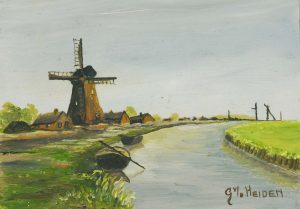
River flats near Oss – Painting Gerrit van der Heiden
With the arrival of the heavier mouldboard plough, in the first millennium BCE it also became possible to cultivate the heavier but much more productive soils of the lower laying floodplains of the river Maas 10 kms further north of the forest settlement.
Oss also has one of the largest Bronze and Iron Age archaeological sites of Western Europe, on the northern side of the current city in the floodplains 40 hectares of land have been researched. While the earliest farm dates back to approx 2.000 BCE, most finds are dating back to the Iron Age. At any given time not more than three farms were in operation. They lasted some 25 years and than a new farmhouse was built 50 to 200 meters further on. The farmhouses were approx 30 meters long and 5.5 meters wide.
While the trend towards a society based on individualism might have seen its starting point during the Bell Beaker period, it was not until the Hallstatt period before we see clearer evidence of this, namely through the elite burials.
This also had its effects on the broader society. A remarkable observation is that between 800 and 500BCE farm houses are becoming much smaller, in Ussen they decreased from 30 meters long to 12 meters. The conclusion must be that smaller units (individual families rather than extended families) occupied these farm houses.
There are 66 of such farms unearthed in this area which date back to the Middle and Late Iron Age. However, they were only occupied during a rather short period. This has brought a new expression to European archaeology: ‘roaming farms’. In some instance current farms are still within a 50-meter vicinity of these Iron Age farmhouses, again an example of this very impressive social continuity.
During the Bronze Age they started to cultivate emmer wheat, millet, field beans, pies, poppy seeds, flax and also held cattle, goats, pigs and sheep, they also had horses and dogs. During the Roman period chickens, grapes, herbs, vegetables and nuts were added. The first vegetable gardens and small orchards started to emerge.
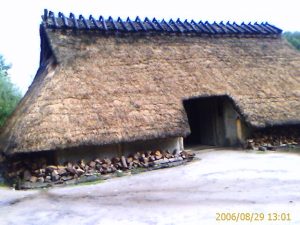
Reconstructed Iron Age Farmhouse Oss (Ussen)
One of these farmhouses has been reconstructed in a framework following the exact details and seize (17 meters long, 4.5 meters wide and 4 meters tall) as a climbing frame for children in the new suburb that now covers this area; in close proximity to its original position. The picture below shows a reconstruction at the open air museum in Eindhoven.
The increased significance of the floodplain settlements can also be concluded from the presence of a sanctuary. This particular one is known under its German name ‘Viereckschanzen’, and refers to rectangular ditched enclosures that were constructed perhaps as early as the Late Bronze Age but certainly during the Middle Iron Age (500BCE). They are widespread in Germany and parts of northern France. More recently they are also unearthed in the Low Countries, most of them in Brabant: Oss, Alphen, Hogeloon and perhaps also Zundert. Some of the sanctuaries became temples during Roman times, another one in Brabant, close to Oss and most probably one of the larger ones was in Kessel on the river Maas, near Lith; a bit further a sanctuary near Empel, close to Den Bosch and one in the Roman town Ceuclum (Cuijk). Elsewhere there are known temple places in Elst (Betuwe), Nijmegen, Ardenburg (Zeeland) and Maastricht.
From the forest to the floodplains
Despite a change in population growth in the Iron Age, favouring the settlements in the floodplains, at least until the early Middle Ages there also still remained a settlement concentration on the higher grounds. There is the legend that St Willibrord baptised approx 3km north of the burial grounds. Archaeological research has uncovered remnants of an old water stream close to where the current St Willibrord well is and they also found remnants of an early chapel at this site. Pilgrimages were still taking place at the end of the 19th century. Could it be that there was another farming settlement somewhere in between these two sites?
There is also evidence of an approx 7km long road linking these forest and river plain communities, known as the Kortfoort (means: shortest route). Indicating that both settlements were closely linked together, the walking distance between the two places is just over one and a half hour. Contacts between these two groups must have led to a unique set of social and economic dynamics: marriage, work, timber, wool, small game from the forest and cattle, agriculture and fish from the floodplains. The first known mill from around 1300 was halfway both communities, the Jonkers van Oss held the ban rights over the mill. [18. Molen Zeldenrust, Paul Budde, 1978, p5]
The Iron Age 1200BCE – 250AC
While iron was known before, it was until around 1200BCE before the first people in Anatolia started to master metal working. The technique to abstract iron seem to have started in the Tatra mountains of Slovakia. Separately it also started in Persia and India from here it also spread to Phoenicia, Greece here it still had an air of magic around it, but slowly it became more common and started to spread into Eastern Europe as well as further around the Mediterranean. Full developed ironware only started to reach northern Europe in the 8th century BCE. However, it was not until Roman times before its use in northern Europe became more widespread, this happened during the Celtic migration period (Celtic Iron Age). The key to success here was the ability to develop ovens that were hot enough.
Iron ore is far more common that copper and tin and enabled a much more wide spread utility use of the metal. However the metallurgical processes are more complex. It took several centuries before that process was fully developed, but once that was the case it created a true ‘people’s’ revolution. While tin and bronze needed to be traded, iron ore was widely available to local communities often within their own territories.
Within a few centuries the millennium old stone tools were replaced first by bronze and now by iron. Unlike copper and tin (needed to make bronze), iron ore was available in plentiful quantity around Europe. While iron rather rapidly started to replace bronze again, bronze remained the preferred metal for high quality art products; it kept its ‘elite status’ for a long time.
There is overlap between the Roman period and the Iron Age (Roman Iron Age). In Gaul we clearly speak about the Roman period, the Low Countries were a border area with still most of the native people linked to their old farming traditions, however with clear Roman influences as many farmers were involved in supplying the Roman military camps along the rivers. Even further north outside the lands occupied by the Romans their influence is evidence, reaching as far as Denmark.
Unlike copper and bronze, iron transferred the society and the economy, it became an accessible and affordable technology that did find its way all the way to even the poorest farmers for the tips of his plough or a knife in his pocket.
It also heralds the arrival of soldiers and swords. The Iron Age was one with significant more violence with many tribes throughout north western Europe being more or less in permanent war with each other.
Same people different cultures: Ahrensburg-Swifterbant-Vlaardingen-Bell Beakers-Hallstatt
Archaeologists have in the Bell Beaker culture also recognised influences from the earlier native Swifterbantculture. The Bell Beaker straddle both the stone and Bronze Age periods and extended into the Iron Age Hallstatt culture.
In their earlier phase their grave ware consists of Corded Ware pottery and polished stone axes. Contacts withnew developments which came from the east and finally reached this European outpost, later on resulted in the adaptation of new bronze ware, with only a very short period of copper ware. Very rapidly graves with bell beakers started to include battleaxes, indicate a change towards a more warrior like people, perhaps also as a result of this clash of cultures. They exported this new more aggressive culture along their trading routes. Along these routes we find daggers, archery equipment with barbed-flint arrowheads and wrist guards of fine stone.
The maritime nature of these trading people also required leather and later woolen woven jerkins, held with a belt with an ornamental bone ring to secure it.
They might have taking over the more aggressive nature of the invaders or migrants from then east, as we see a first change towards the individualisation of their society
From hunter gathers to semi nomadic Swifterbant people, early postoral Corded Ware and seafaring Bell Beaker people this culture provides an unbroken past with the earliest occupants of this remote cornes of the continent.
The difficult transition from Bronze to Iron Age
For several reasons the transition period between these two cultural periods has been a painful one. Climate change seems to have played a key role, this linked to poor agriculture practices led to a low level of yield and this in turn lead to a decrease in food production and population.
It took some time for iron to become more wide spread used, when that happened it led to higher levels of agriculture productivity and this linked to climate improvements led to a new period of economic growth that coincided with the arrival of the Romans which also led to an increase in trade. With innovations in agriculture tools it was now possible to farm the heavier loam soils.
With the increase in population the landscape changed into a cultural landscape with visible human elements such as farms, fields and tumuli, which created a sense of continuing history. This together with the late Bronze Age/Early Iron Age environmental/economic crisis could also have influenced different religious practices such as sacrifices to please the gods and ancestor worship as we will see below.
By the late Iron Age we see that permanent settlement and population increase resulted in small hamlets, the start of what would in the Middle Ages grew into villages.
Iron Age innovations
It looks like that the massive changes, which took place around this time in this region – changing the native, rather archaic, Mesolithic society into the much more modern age of the Bell Beakers – also had its effect onthe people in northwestern Europe. Travelling people along the river Maas must have brought them in contact with other cultures and as mentioned above we know that these interchanges greatly influenced these people. The fact that Bell Beakers are found in Oss indicates that the Mesolithic people here had also adopted this new culture.
However, settlements throughout the Bronze Age remain rather similar. They would not have been much larger than a few large farmhouses, similar as the ones mentioned above in Elsloo; three thousand years earlier. They were occupied by an extended family (10-15 people) and most probably their sheep and cattle. Reflecting the communal life of the Bronze Age communities. (See video clip: National Museum Leiden)
The impression is that there were many settlements only a few kilometres or less apart from each other. Close enough to conclude that there must have been regular contact between them.
It is estimated that in the Iron Age the population in the Netherlands increased to 25,000 people, an estimated three-fold increase in comparison to thew situation of 500 years earlier. However, this time as much as 80% of them living below the main river system. Above the rivers groundwater levels has started to rise and peat growth started to make agriculture more difficult.
By this time the Celtic fields on the less fertile sandy grounds had been largely exhausted and it is likely that (some of) the people who lived close to the tumuli on the southern side of what is now Oss, moved to the more fertile river plains. Here, on the 40 hectares excavated in Ussen, six distinct settlements and two burial grounds have been unearthed. These new and or extended settlements peaked during Roman times.
Carved wooden gable boards
Carved wooden gable boards Twente
Twente has a rich history of farmhouse with carved wooden gable boards (gevelteken) they are positioned at the top of the front gable and have a variety of pagan symbols that can be linked to handing over the house to the gods and invoking their protection against thunder (so called thunder brooms), the veneration of the sun (solar wheels) and a variety of agriculture symbols such as corn, onions, etc was used to invoke their protection against crop failures. In Twente there are also boards depicting two stylised horse heads and they are linked to two German brother heroes Hengist and Horsa, they were the leaders of the Saxon invasion into Britain. During the excavations in Oss-Ussen one of the wells also contained a remarkably well preserved carved gable board that looks very similar to ones in Twente, perhaps the sun and thunder broom symbols can be recognised here as well.
With the arrival of the Iron Age changes are starting to set in we do see changes in the structure within the settlements. Instead of a few large farms we see settlements with a larger number of smaller farms, perhaps indicating, as discussed above, more competition and an increased level of individualism. Also the use of iron tools greatly improved the yield of the Celtic Fields.
Not far from Oss towards the Peel morass an interesting Iron Age village (6th century BCE) was unearthed in Haps. The rooftops of these houses were supported on centrally placed rows of timber; an architectural innovation.
These settlements or small villages were a characteristic feature of the north western region of Europe from the Low Countries to Denmark. There were no known hill fortresses or other more significant towns such as those that had started to occur in Eastern Europe. Hill fortresses seem to be a misnomer as they were mostly used as protected places to store grain and they obviously had the potential to grow into market places and small settlements. Deep pits in the ground sealed by a clay top made it possible to store and keep grain for a year or longer, but obviously these pits needed protection.
It was during this period that the first coins started to appear (around 650BCE), indicating a more serious approach towards trade.
Hallstatt culture 900 – 600BCE
One of the few more easily identifiable Iron Age cultures evolved in Central European culture from the 8th to the 6th centuries BC and developed out of the Tumulus Culture. Hallstatt an Austrian lakeside village in Salzkammergut became an important centre of salt mining in Europe. It stretched in influences from the upper Rhine and upper Danube regions in the east to the Champagne-Ardennes in the west.
The west Hallstatt branch started to reach our region around 750BCE. Iron stared to appear signalling perhaps better weapons, burials became more varied, fashion started to become visible, this certainly was a period of significant change.
Salt was also big business along the coast in the Low Countries and here it continued well into Roman times. As we will see below, during the excavations in Oss they also discovered lots of evidence of the salt trade, perhaps here it was used in the tannery probably for products produced for the Romans, however, the exact links in the extensive salt trade are still unclear.
A continuation of more dense settlement (in a relative sense) also happened through this period and especially the archaeological sites in Oss shows significant evidence of this that continued well into Roman times.
Cultural changes
Until the 8th century there is no evidence of elite burials indicating a low level of competitiveness between people. The society remained stable, sedentary with small scale chiefdoms, where status didn’t seem to be important.
In the late Bronze Age – the dead were burnt on a pyre – in order to set the soul free from the body – and their ashes buried in urnfields. These sites don’t contain gifts and often there are more burials within one grave or urnfield. Offerings to the gods were made separately in bogs, rivers and other for them sacred sites, they contained vessels with food and other gifts but no human sacrifices.Initially most of the late Bronze Age developments, including the urnfield burials, continued into this period. However, the patterns changed, graves started to move closer again to the settlements and became more spread out. Some people are buried in more elaborate graves and grave gifts started to arrive.
This ritual would indicate a changeover period between different cultures and/or believes. One suggestion has been that is signifies a period where the position of chief possibly changed form elected or earned by its people to hereditary based on its relation with the gods. Burials are now far more materialistic with for example wagons, table settings and other necessities for for the afterlife. Perhaps it also indicates a return to ancestor worship.
The chieftain graves from the later Hallstatt period are an excellent example of that change, clearly indicating the importance of the person rather than that of the community. However, it is important to realise that we are only talking here about a few ‘rich’ graves and thousands of ‘normal’ graves.
We now also see human sacrifices. Tacitus wrote about the Semnones, most probably a branch of the Suevi, at meetings of blood relatives places in the woods, made sacred by their ancestors, they sacrificed fellow humans celebrating their ancient origins. He also indicates that the victims were picked by lot. Many of these sacrifices are known from the bogs in north Germany, the Low Countries but especially Denmark. Some of these bodies have been perfectly preserved – such as the Tollund man in Denmark.
The famous and beautiful decorated silver Gundestrup cauldron that was found in one of these bogs is also linked to sacrifices.
There are strong indications that a new goddess had supplanted her previous male partner in importance, in the northern lands this mother-goddess is often depicted naked with her hands held under her breasts and with collars around her neck and in her ears (we see this also with the Cannaanite goddess Asherah). The sacrificed victims also showed signs that can be related to collars and/or had collars buried near by. She might already have been prominent here since the Late Bronze Age, most likely the goddess Nerthus. This goddess could be the same as Nehalennia, who was also venerated in the Low Countries and perhaps there is even a link with the Brabantine Saint Gertrud. There are also strong links with other mother-goddesses, representing fertility of key importance to these farming cultures, in other parts of the ancient world: Ishtar, Astarte, Isis, Aphrodite. The fertility rites follows the cycle of the crops and evolves around the burring of the seeds, sleeping in the earth and the awakening in the spring. These fertility goddesses also played key roles in the underworld stories were similar cycles took place. The human sacrifice is linked to these rites.
Towards the end of this period there is also evidence that these people believed in a kingdom where the dead, after some passage of time, reside. This corresponds with similar believe in the classical cultures.
Elite graves
It was also in this period that individualism really became visible, suddenly gifts started to occur in the burials. This cumulated in so called princely or elite graves throughout the Hallstatt region. Until that time gifts were seen as belonging to the community.
There is also in our region – the outer edge of the Hallstatt region – a small cluster of these elite graves (Someren, Baarlo, Oss, Wijchen and Rhenen).
The chariot in the elite grave in Wijchen (750BCE) is one of the most important findings in the Low Countries dating back to this period. See videoclip.
The Chieftain of Oss
The famous elite grave in Oss from a ‘local ruler’ dating back to 600BCE clearly show that Hallstatt culture was also well established in what is now Brabant. The grave is part of large urn field that has on and off been used between 2,300BCE and 500BCE. This last date roughly coincides with the arrival of Germanic tribes in the region. It could well be that the Germanic tribes either replaced the proto-Celtic population or that the local population started to adopt cultural changes.
The bronze situla from the 53 meters in diameter large tumulus of the chieftain of Oss is also linked to this culture; interestingly the iron sword, with golden decorations, bend into the situla indicated that it was produced in southern Germany (approx 1300kms away).
The graves also provide evidence of extensive trade particularly along the rivers well into what is now southern Germany. It has been argued that the ‘king’ of Oss might have received his position because of the (salt) trade. Archaeological research in Ussen has unearthed numerous pipes used for packaging salt.
The grave also contained numerous other bronze, iron, wooden and textile fragments. They included two iron horse bits, four iron cheek pieces and two oval bronze yokes rosettes belonging to paired horse harnesses for draught horses most probably used for pulling a ceremonial cart.
The chief’s grave goods could not have been obtained through trade, they must have been gifts obtained on the basis of the importance of the person, hence the classification of ‘chieftain’. These are manifestations of a flourishing prestige goods economy.
For a long time the grave of the chieftain of Oss was seen as the start of the Iron Age in the Low Countries, however the original dating of the grave has now been reassessed as 100 later than originally was though.
However, as mentioned above it is important to put this in the context of still rather primitive farming communities.
This is one of the first graves that includes a sword; ; until a few hundred years earlier swords were, in this region, typically deposited in rivers or bogs.
Situlae are found in other elite Hallstatt burials and clearly indicate the importance of these graves. However, there are no indications that these rich elites had any effect on the local economy. These goods were imported gifts and as such were not part of the economy.
Further possible eleite graves in the area include the above mentioned grave known as the ‘prince of Oss’ at the Zevenbergen burial ground. Another one at the Slabroek burial ground is known as the grave of the princess as possible bracelets were included in this grave.
Fortress builders started to now also reach our region, while they had already been a feature for several millennia in the more eastern parts of Europe, the competing Hallstatt elites started to establish hill fortresses reaching as far as north France and southern Belgium (Buzenol, Kemmelberg and Hastedon). However by 350BCE they were again all but abandoned.
There is also evidence that there was a brisk trade going on between the Etruscans and the people living in the west Hallstatt region, some elite graves contain the remnants of the two-wheeled chariot a fashion learnt from the Etruscans. Some other elements of the warrior culture might also been influenced by these people. The Etruscans in turn were interested in the iron ore available in the Hunsrück-Eiffel region.
The rapid growth of this new level of elite also led to the development of the La Tène art (Celtic art). However, it wasn’t the Hallstatt elite that carried that forward, it is not know why but the system of the Hallstatt elite collapsed in the 5th century BCE.
Languages
As mentioned before, there is strong evidence that the Indo-Iranian-European languages can be traced back to the Eurasian Pontic-Caspian Steppe Cultures. The root of this language dates back to the period 4,500-2,500 BCE.
Analysing the Indo-European language, indicates that its early members were more involved in herding sheep and goats rather than in agriculture. Increasingly these people domesticated plants and animals, which slowly led to an increase in the population. At that time the population in this part of the world will have been in the low thousands.
Following the migration pattern as mentioned above, the Indo-European language started to develop into different languages. A proto Slavo-Germanic language developed into Balto-Slavic (1500BCE) and Germanic eventually they all branched of and by around 500BC during the Jastorf period (see below) Proto Germanic would have been a recognisable separate langue, which than further developed into Norse, Gothic, Swedish, Low and High German and later in Danish, Dutch, Flemish, Frisian, Icelandic and English as well. In this process the individual language also evolved of course for example Low German developed into Middle Dutch and Modern Dutch and Flemish over the last 1,000 years. It would have been difficult for a modern Dutchmen to understand their cousins from around 1,500, let alone from around the year 1,000.
The Lex Salica from around 600 AC provides us what is perhaps the oldest text in (hardly recognisable) Dutch: “maltho thi afrio lito”, this translate into: “ ik zeg je: ik maak je vrij, halfvrij”(I say to you: I make you free, half-free). The oldest literary – and quite famous – Dutch text is from around 1,100 :” Hebban olla uogala nestas higunnan/ Hinase hi(c) (e)nde thu”. This roughly translates into : “All the birds have made their nests except you and me.” Experts are still arguing about the ‘Dutchness’ of the text, it was most probably written in Kent (England) and could also be old-Kentish, perhaps with some old-Flemish in it as well.
The Celts 450 – 200BCE
As indicated the Hallstatt culture started to collapse in the 5th century BCE, perhaps under the weight of the competing local elite, it could well be that the gift exchange system dried up but there is no evidence to pinpoint a more exact reason. There are also some scholars who believe the Celts were simply a continuation of the Hallstatt culture. This culture influenced a large range of people from the Danube to the boarder of Scotland. Its culture is recognisable in language and in particular in names of people and places.
It looks like this culture somewhat continued in the Marne-Moselle region, it also here that the Hallstatt/Celtic La Tène pottery is found in some of the last elite graves, indicating a unbroken cultural development. These burials are still largely believed to represent a warrior society these people started amass to migrate south and that is why we are encountering them in historic times through the writings of Romans such as The Elder Pliny. They were mentioned as Gauls or Celts (Keltoi in Greek, Gaul in Latin, Galliërs in Dutch). Perhaps because of their earlier (Hallstatt) trading links with the Etruscan, most of them initially ended up in Alp region. They invaded Italy in 390 BCE (battle of Allia)and in 386BCE sacked Rome – which stayed under Celtic rule till 349 – from here they moved into the flood plains of the river Po.
There also was an eastern migration in the late 5th and early 4th centuries, along the Danube into modern day Hungary. They had intensive contacts with the Greeks and the Etruscan who influenced the famous Celtic artefacts. In 281 BCE they invaded Macedonia and two years later they mounted an army to invade Greece but were decisively defeated at Delphi. Trace remained a Celtic kingdom till 193BCE.
They also crossed the Hellespont and ended up in Anatolia (Galatians). They remained independent until it was incorporated in the Roman Empire in 25BC. Celtic was spoken here until the 5th century AD.
Wherever they went they intermingled with the local population, which rapidly took over the new culture.
There is no evidence of large-scale western migration, but anywhere under the river Rhine the Celtic culture became the norm even across the Channel in Britain.
Gaul, as it was known when the Romans arrived, was divided in three groups: Belgae (between the Rhine and Seine), the Centre group including Amorica and the Aquitaini. The northern Belgae (Nervii, Attrebates, Morini) where according to the Romans Germanic tribes that had adopted the Celtic language, they had originally arrived here from the German hinterland.
Above the river Rhine, life continued as it had done for the previous 1500 years the above mentioned villages were not touched by the Celts. At this point in time we see that these people get a name (from the Romans): Germans.
The Celts dominated most of Europe between 450 and 200BCE. They reached their largest extended in the 3rd century BCE. Shortly after 200BCE the Celts lost several important battles with the Romans and soon their influence started to dissipate.
The term ‘Celts’ might be closer linked to a common culture rather than a common people.
Linguistically they evolved from the Indo-European language group but, they are members of a different branch of this language group: Aryo-Graeco-Italo-Celtic. The Celts split of from the language much later than for example the Germanic people did, but the Celts far more rapidly spread throughout Europe.
There was a distinct class difference between the warriors and the rest of the communities, who were farmers and crafts people. The warriors didn’t work the land but were in charge of social order. The bravest of them was the chieftain.
There are indications that the warrior tradition might have originated in the hunting activities of their forebears in the ‘heroic’ times.
The focal point of their system of maintaining social order was their feast, (as discussed in the Icelandic examples of gift giving above). This took place at a round table with the chieftain taking a central position, next to the host. They were armed with their bodyguards behind them. Here rank was proclaimed, sometimes challenged (sometimes till death followed) and eventually ranks were accepted and witnessed by the assembly.
It was under the Celts that the raiding system, as already mentioned above with the Beaker People, started in all earnest. This was their key form of wealth creation; war was the status quo, peace the exception.
The Celts in Oss
The Celtic Gauls had already before Roman times, built their own civilisation; they had their own coins, kings, towns, trading activities and sophisticated craftsmanship in bronze and gold.
In Oss some of the ‘dullish’ Marne pottery has been unearthed during archaeological digs dating back to the late Iron Age (approx 150BCE). The Marne potters were amongst the first in north-western Europe to use the potters wheel.
This pottery was also well represented at the above mentioned sanctuaries of Empel and Kessel, clearly indicating that in the Late Iron Age, Celtic culture had well and truly penetrated the local population in Brabant. We now also come across influences from the northern Jastorf culture (see below). There are indications of locally produced material, including swords produced along Jastorf tradition. There are indications of ritual murders near the temples – close the the confluence of two rivers (Kessel – Maas and Waal and Empel – Maas and Dieze) – which also indicates Jastorf influences.
The Britons including Picts, Cruthin and Gaels.
The Britons (sometimes Brythons or British) were a Celtic people who lived in Great Britain before and during the Roman period. They spoke the Insular Celtic language known as British.
The Britons are assumed to have diversified from the “Pritenic” group (the later Picts of Scotland and Cruthin of Ireland) during the final centuries BC, the later part of the British Iron Age. Their classification as “Celts” has two senses, one being the modern linguistic sense, “speakers of a Celtic language”. The above mentioned term “Celts” (Keltoi, Celtae) in ancient ethnography did not extend to the Britons, although some writers noted their culture was very similar to that of the Gauls (i.e. to Continental Celtic groups).
The Britons consisted of many tribes, who were in permanent war witch each other and their territories were forever changing. When the Romans arrived in 43BC several tribes joined the Romans, simply because they hated other tribes more than they hated the Romans. This made it possible for the Romans to rather rapidly take control over the southern part of Britain.
At the time of our historical records, the Britons lived throughout Britain south of the Firth of Forth. After the 5th century, under the pressure of the Anglo-Saxon invasion of Britain, some Britons migrated to mainland Europe and established settlements in Brittany (today part of France) and Britonia (today part of Galicia, Spain).
Their relationship to the Picts north of the Forth has been the subject of much discussion, though most scholars accept that the Pictish language during this time was a Brythonic language related to, but perhaps distinct from, British. Pictish also merged with Gael that was spoken by people living in western Scotland and on the Island of Man. Gael is very similar to Irish and is considered it arrived from there. Scotti was a generic Latin name that started to be used from the 4th century onwards; the word might have the meaning of ‘raiders’ or ‘pirates’.
One of Pict tribes was the Caladoni and the Roman’s started to call the land north of Hadrian Wall Caledonia.
The earliest evidence for the Britons and their language in historical sources dates to the Iron Age. After the Roman conquest of Britain in the 1st century, a Romano-British culture began to emerge. With the beginning of Anglo-Saxon settlement in the 5th century, however, the culture and language of the Britons began to fragment and much of their territory was taken over by the Anglo-Saxons. By the 11th century they had split into distinct groups: the Welsh, Cornish, Bretons, and the people of the Hen Ogledd (“Old North”). The British language developed into Welsh, Cornish, Breton, and Cumbric.
Germanic awakening: Jastorf and Herpstedt-Nienburg cultures
The Germanic people – who also started to emerge around this time – are closely linked to the Jastorf and Herpstedt-Nienburg cultures. Initially it was believed that they had their origin in the southern parts of Norway and Sweden and the Danish peninsula. Some scholars however believe that they lived rather isolated in this area for a prolonged period of time. They slowly started to spread from what is now Denmark further into Europe, this happened in the first millennium BCE, possibly due to a deterioration of the climate in Scandinavia. Here they started to replace and intermingle with the local Celtic population. However, so far there doesn’t seem to be much archaeological evidence for this mingling of cultures.
It was at this time that also here the Iron Age cultures started to evolve. The Jastorf (600-100BCE) culture evolved in most of modern Germany. The Herpstedt-Nienburg evolved in northern Netherlands and neighbouring Lower Saxony. It was within these cultures that, from around 500BCE, the Germanic culture and language started to evolve.
The Jastorf culture however, was not only influenced by the Nordic Bronze Age culture (Scandinavia 1800- 500BCE) but also by the more southern Hallstatt culture (Central Europe 800-600BCE).
The Herpstedt-Nienburg group has characteristics of material culture closer to Celtic cultures, and shows evidence of significant contact withthe Hallstatt and La Tène cultures. This seems to have happened despite the fact that there was a serious natural barrier between these two cultures; the extensive Rhine Delta with the large floodplains of the rivers Rhine and Maas) as well as the extensive morasses beyond that. This area was largely unpopulated.
There are unconfirmed but possible indications that the Germanic tribe of the Eburones were the people that had also moved into Limburg and Brabant where indications of the Jastorf culture have been recognised. What also adds to this speculation is that near Empel (northeastern Brabant) a significant number of so called triskelion coins were found. A treskelion is a motif consisting of three interlocked spirals, or three bent human legs, or any similar symbol with three protrusions and a threefold rotational symmetry, it is a Greek word and they also used this symbol also for the island Sicily. This motif was also characteristic of the Celtic art of the La Tène culture of the European Iron Age. These coins – which had status value rather than monetary value – have been linked to the Eburones and had previously been found in Belgium and also in West Brabant.