Cities and city states had been in existence for millennia, starting with the Sumerians as early as in the 5th millennium BCE. Historians start talking about cities in those early days, once they have a population of around 5,000. Such a community would require some sort of central management and administration; an agriculture surplus with facilities for transport to secure stable food supply and storage facilities.
It is also important to note that no city can grown without the support of its agriculture hinterland. As a matter of fact – and further described below – most cities start and flourish based on the wealth and the economic activities in its agriculture region. If that agriculture lifeline gets broken the city will decline.
There are a video clips of early Greek/Phoenician cities in Sicily which we visited in 2010: Selinunte, Akragas, Syracuse and Segesta.
These cities became the foundation of the societies and economies that were built in and around them, increasingly they included whole arrangements of laws, privileges, statues and immunities of the entity as a whole, the various groups within the city and the relation between the city and its region and between neigbouring cities. A connected and interrelated society of cultures, social bodies and codes.
Athens is one of the earliest examples in Europe. Rome was the first true metropolitan here. However, it wasn’t until around the 10th century that cities started to develop north of the Alps. By 1300 only Antwerp and Paris had more than 100,000 inhabitants. It was during the 14th and 15th centuries that the above mentioned city-fabric started to take hold of Europe.
The arrival of cities also heralded the period where the link between men and nature became broken. Until this time all human settlements were driven by climate and natural features; cities became truly man made developments. Irrigation and transport developments played a key role in this process.
City privileges as they started to be issued in Medieval Europe also existed in ancient times. One of the oldest known legal codes that addressed a range of civil and criminal aspects was inscribed in Boustrophedon on the city wall of Gortys on the island of Crete, most likely in the 5th century BCE.
For millennia these unwritten and later written privileges functioned as a ‘constitution’ for the city states and later the medieval cities of Europe. In the medieval European context city privileges were preceded by tribal arrangements and later on more broader community based rules and regulations from guilds, fraternities and early communes. This was partly for social reasons (illness, old age, orphans). But members of these groups also started to represent themselves in relation to dealings with the local lords and church authorities. Slowly this developed in more formal relationships which were , even before formal privileges were issued, vigilantly administrated by the local magistrates and in general were respected by regional and later national rulers.
Roman, Merovingian and Carolingian towns
During Roman times urbanisation also started to occur in Europe. However, this concentrated in areas in Italy, Eastern Spain, Southern France, North Africa and areas along the Eastern Mediterranean.
In 98 Nijmegen was the first of two settlements in what is now the Netherlands to receive Roman city rights, Voorburg followed in 121. Maastricht and Cuijk were also early Roman settlements together with others along the river system often linked to military camps. In Belgium Tongeren dates back to those times as well as Doornik, Kamerijk, Noyon and Terwaan. In Rhineland Roman cities include: Cologne, Xanten, Trier, Aachen and Metz.
During the Merovingian and Carolingian times, Utrecht, Dorestad, Domburg and Tiel were established. Key trading cities mentioned in a document on toll from 779 mentions Amiens, Rouen, Quentovis, Dorestad and Maastricht a key trading centres.
While most of these cities more or less continued to exist during the collapse of the Roman Empire in the west, most of them only received again a more city like appearance from the 11th century onward, for the Low Countries that applies to Nijmegen and Maastricht.
During the Carolingian times there were hardly any settlements that could be called towns let alone cities. The farming population lived in villages which would would have between 3 to 6 farm houses an village with 1o houses would be considered large. Any administrative function, such as tax collection was centrally organised by the travelling court system.
Once the villages grew into towns new problems started to emerge that required an increase in administration.
Under Charlemagne the Frankish freemen (frilingi) started to take on juridical positions as scabini. When villages started to emerge these scabini – at a local level – were chosen from among the local freemen. The freemen combined were also allowed to use and manage the commons. Increasingly however, under the pressure of feudalism, the power was removed from the freemen and went to the (lower) nobility. From the 11th century onward are we seeing that the emerging cities are taking back some of this power.
Monasteries also played a key role in lifting the profile of rural areas; Ghent is an example of a city that has its foundation history to the Monastery of Ganda. (See: Missionaries and Monasteries). The ruralisation also saw the emergence of new rural elite and this led to the emergence of castles and this in its turn attracted settlements around these places. The Pippinides are one of the most famous of these rural elites, with Charlemagne born probably at one of these rural castles in Herstal.
Following the collapse of the short-lived Carolingian Empire, Europe came under attack from the Vikings, Magyar and Arabs. Without a central authority/central military in charge, the defense was up to the local nobility and war lords. Vikings were responsible for the first fortifications that were build in some of what still were mainly rural settlements. The fiercest attacks in the Low Countries happened in 835, 836 and 837 by Danish Vikings. During the 9th century several of the larger communities received their first defense system in the form of a circular wall and an outer moat (motte-and bailey).
This period of anarchy and Viking raids during the 9th and 10th century led to a situation whereby the whole of north western Europe was carved up by the local Lords, some with their castles at distances of only 5 kms of each other. In order to increase and protect their wealth they were in constant war with each other. For this they used their mini armies of knights, whose only profession was war. This was a time of hectic castle building, often such a fortification was simply a tool of war from where they could ravage the country side and escape back to. Soon the local lords also started to fight each other for power and land, which led to a further increase in these fortifications which over time grew into the medieval castles.
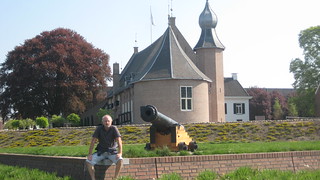
City like settlement started to evolve at these early fortifications, often at the foot of such a castle, or within its defenses structure. A good example of a settlement like this is Coevorden. It most likely had a motte-and-bailey castle in the 10th or 11th century. These strongholds were often situated at strategic position at cross roads, at fords by controlling such spots they could levy tolls.
Coevorden Castle
In the case of Coevorden but also in Ootmarsum settlements that started at the foot of the castle later on erected their own walls and moats.
In the 9th century Nijmegen, Deventer and Maastricht all received their first set of city walls and possible other defense buildings. Wooden citadels were built around St Omer, Bruges, Ghent and Courtrai. Dorestad did not erect any fortifications and was eventually totally destroyed by Danish Vikings in 863, never to be rebuilt again.
Other emerging new cities in this period followed: Deventer, Zutphen and Stavoren (the oldest town of the Frisian 11 cities); all situated along waterways and all involved in trading. Emden also evolved from its position as an early trading town in what is now northeast Germany.
In Belgium Doornik (Tournai) becomes the capital of Clovis, before it was moved to Paris.
Luik evolved from its function as an early bishopric,
Emerging cities case study Bruges
After the collapse of the Carolingian Empire, Danish Vikings invaded north-western Europe and without central power the local Lords had to fend for themselves. It was at that time that Bruges received its early fortification.
In 1127 when Count Charles the Good of Flanders was killed in Bruges, this city basically was still a castle city (Burgh), however many people had already settled around it. The revolt saw a hastily fortification of the larger city, a wooden palisade with towers, lookouts and gates, followed by a system of ditches. They basically copied the way Gent had grown its fortifications from a castle city of 3 hectares to a larger one of over 80 hectares. The castle cities remained the military and bureaucratic centre and of court also was the home of the court, but many of its form self-sustainability functions moved to the city (blacksmiths, bakeries, merchants, chapel) leaving the castle city itself to the household staff, administration, the military and the clergy.
The fortifications saw the extension of the protected space from the original just over one hectare city castle, to an area of 70 hectares, at that time large parts of the area were not yet developed. [1. The Murder of Charles the Good, Galbert of Bruges, 1967]
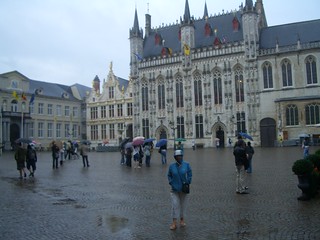
While the buildings have changed the Burgh is still the centre of town.
The Burgh – Brugge
The economic prelude to city formation
Centuries before city creation started to evolve in north western Europe in the 11th and 12th centuries there had, in many of these areas, already been developed rural markets for land, labour and capital, similar to what happened with the very first cities in the fertile crescent in the Middle East.
The cities started effectively feeding of the wealth and possessions created in the countryside, where the population had both their labour capacity and their land ownership available to become engaged in economic transactions.
Professor Dr. Bas van Bavel referred to this as frontier economies; established by settlers and peasants and later on supplemented by local rural oligarchies, aristocracies and/or effective rulers (manor houses).
Frontier economies have existed in Iraq (600-900), North-Italy (in the centuries running up to the Renaissance) and Low Countries (roughly 1000 – 1350 AD).
Another important element in the development of frontier economies is that the Low Countries became dominated by the Franks, which had a system of partial inheritance (Salic Patrimony, a custom also among the Frisians); this in contrast with the Saxons, who had primogeniture and agnatic inheritance customs.
Sustaining frontier economics is greatly helped with customs like partial inheritance, if you as the 2nd or 3rd child can sell your share and purchase a block of land for yourself and/or hire labour to extend it further with new land developments. Primogeniture or Agnatic inheritance strongly links capital to land and deprives other children.
Peasants developing frontier economics were able to create markets beyond the exchange of goods for land, labour and capital.
The thus widely distributed property endowment (and hence strong emphasis on property rights vs usufruct rights) trickle up a relatively wealthy peasantry able to sell or invest and engage in industrious (proto-industrial) activities to supplement their household incomes.
Cities appearing in or near such areas have a far wider economic base to draw produce from, than those appearing in areas where feudal lords etc. take their percentages.
Real industrialisation can start however only if sufficient access to (cheap) energy resources is available.
Economic development and growth halted, when merchants and guilds from the city were able to purchase land from farmers (who then subsequently moved to the cities) and thus prevented the further growth of these rural economies into proto-industrialisation in rural areas.
In the Netherlands this only happened in the late 16th and 17th century. Peasants in Holland produced peat and developed windmills. They effectively controlled the energy supply. Only in the 17th century when big polders – where water had to be emptied on a large scale by windmills – was large upfront investment capital required that went beyond the frontier economic method which is limited to the use of labour for economic development.
The jump to the next level of rural economic activity halts prematurely if cities manages early on the “overpower” their surroundings.
In the East, North and South of the Low Countries, but in particular in Flanders, it was the cities and guilds that overpowered the rural areas. But in Holland that happened in a time when more than 50% of the population already had moved to the cities.
Inequality rises after the frontier economies gives way (stops becoming the escape opportunity) and proletarianisation gradually develops (as some of the peasants lose out, but instead of ending up in serfdom (which happened in feudal societies), they move to the cities.
Growth and decline in wealth can also be seen archaeological evidence in the bones of people. In 0 AD, the average Dutch male length was 1.76m, in 1000AD it was 1.75 and in 1350 AD it was 1.74m it then went down to 1.67m in 1850.
In the late 19th century and early 20th a series of social changes (creation of buffer organizations – charities, unions, organised education – between the very rich top layer and a lot in the bottom) improved living conditions and today the average Dutch male length is 1.84m.
(with thanks to Hendrik Rood)
Most modern cities were founded in the Middle Ages
When missionaries started to arrive in the 8th and 9th centuries some of the rural settlements started to receive their first very simply wooden church structure this started to create some sort of a centre function. During the 9th and 1oth centuries – as mentioned above – the emerging castles became another attractive point for village and town formation. From this pre-city status some early planning started to occur that led to the emergence of more concentrated towns and cities.
As is still the case cities in general offer better opportunities, they also facilitated political power, security, economic growth, etc. At the same time the larger cities became the centre of knowledge, innovation and social and economic interaction. They became a vast pool of human capital that could be tapped for all sorts of reasons, economic, social, learning, developing, etc., a process that is still continuing at this time.
This in particular applied to the period that saw the greatest boom in town development. Apart from the above mentioned cities well over 90% of all modern cities emerged from the 10th century onwards in the southern part of the northwest European region and from the 13th century further to the north.
By the 10th century a large number of the farming communities in north-western Europe had grown into villages; led by developments in Flanders, Brabant and the Rhineland. The environmental conditions (Medieval Warm Period) led to an increase in agriculture production and this allowed for an increase in population. The increase in agriculture production also led to surpluses and a new merchant class started to evolve, which led to a growth in cities, especially those along the trading routes (ports and rivers).
As a result of this we see a large population movement away from the villages towards the newly emerging cities. But we also see people moving away to new the new frontiers, where land reclamation offered adventure and new opportunities especially in the northern part of the Low Countries, in north Germany and along the rivers in the middle of the Low Countries (see Oss below).
More commercially inclined Lords started to more serious exploit their demesne and started to sell their surpluses on the open markets. The position of these Lords changed form landowner to landlord; with more emphasis on material interests rather than on their previous paternal status. Market places started to evolve around castles and monasteries.
Amazingly by around 1200 most of the European cities as we know them today were well and truly established, very few new cities have been added over the last millennium.
By the 15th century ‘s-Hertogenbosch had become the 2nd largest city in the northern Low Countries. Many other cities were either established as garrison towns – or villages were upgraded for it; in particular – between 1270 and 1400 -by the Dukes of Brabant and Gelre along their borders (Grave, Oss, Heusden, Bergen op Zoom, Geertruidenberg, Eindhoven, Helmond, Roermond, Wageningen, Doesburg, Doetinchem, Lochem, Harderwijk, Elburg, Geldenaken, Landen, Nieuw-Genepiën, Geldern and Goch). Their origins are therefore rather different from those cities that emerged along then trading routes. The economic benefits were rather a side effect than a core reason. The involvements of the Dukes, Counts and Bishops were aimed at strengthening and expanding their powerbase. Most of these sort of cities however, never really had the economic roots that would allow them to grew into larger towns.
All of the substantial towns and cities which developed during the Middle Ages grew along the main river systems or sea arms.
Another interesting development happened in Zeeland, here new cities emerged on the back of the spectacular developments in neighbouring Flanders. Cities such as Aardenburg, Oostburg, Hulst, Axel, Middelburg and Zierikzee all flourished as they could participate in the economic growth as trading ports. They also suffered from the downturn as apart from Middleburg none of these cities saw any further growth after Flanders economy started to deteriorate at the end of the Middle Ages [2. Stadswording in de Nederlanden, 2008, p15].
Soon after that however, other port cities in these areas started to grow and flourish they include: Goes, Veere, Vlissingen, Brouwershaven, Goedereede, Brielle, Schiedam and Rotterdam. In Friesland we also see a growth in city formation – Dokkum, Leeuwarden, Bolsward.
Ghent and Middelburg grew within the protection area of their Abbeys. Interestingly one of smaller town featured in this history, Wietmarschen, had its Golden Age of growth between 1320 and 1489, this was as a result of a religious tourism boom as the local monastery drew pilgrims from well beyond its own region to adore its Maria shrine, especially accommodation was a booming business in those years.
Two other cities who saw their growth periods in the 111th-13th centuries developed from the administrative centres of their countries; Paris and London.
Other cities have a more environmental origin there are the so called ‘dam’ cities of which Amsterdam and Rotterdam are the most famous. Land reclamation caused a very poor drainage, this resulted in sea water entering the river systems. In order to stop this from happening dams were built. These places on the border of sea and rivers became important staple-markets.
The effect of land reclamation also resulted in very poor agriculture yields and the people were forced to look at other way to make a living and shipping and trading was an area that provided some opportunities. The wetlands were also better suited for cattle-breeding – lack of land also forced these farmers to look at intensive cattle-breeding – and this led to the start of what is still a very successful Dutch diary trade.
Interestingly the growth of the cities didn’t occur through natural growth, in fact in cities the death rate was higher than the birthrate. The cities grew because of an ongoing influx of people from the rural areas. This led to a rather rapid process of organisation. We speak of urbanisation as between 20-30% of the populations in the region lives in cities. Early urbanisation took place in North Italy, the Low Countries and in some parts of England where during the Late Middle Ages 40-50% of the population lived in cities, other parts of Europe only reached such levels during the Industrial Revolution.
An average town had between 5.000 and 10,000 inhabitants. Their local economy was based on trade and industry rather than agriculture.
Population Medieval cities approx. 1300
City
Population
Paris
215,000
Milan
180,000
Florence
120,000
Venice
100,000
Bruges
50,000
Ghent, Ypres, Liege
40,000 each
London
20,000
While at that time around 95% of the population of Europe still lived in the rural areas, in the Low Countries close to a third of the population lived in the larger towns. However, many of these cities still had a very strong rural character with farms still dominating the city landscape.
Villages along the trading routes started to attract merchants. While the power of the nobility started to fade, with less local wars to fight and more powers flowing to the kings, at the same time the merchant became the ‘nouveau rich’.
Trade demanded markets, which in itself required organisation. The emerging guilds played a key role in these developments.
Local markets and fairs
One the most common city privileges is that of the right to hold markets. Towns have a weekly market and there is also always an annual fair. This is the biggest event of the year as exotic goods will be far sale as well as the ability to buy wholesale. These events are usually held in the summer between June and September and preferable in conjunction with the patron saint of the town.. They mostly lasted for three days, starting on the eve of the feast. These fairs attract hundreds if not thousands of people. There will be jugglers and tumblers, musicians, dancers, soothsayers, doctors, dentists. There is strict control on the goods for sale, regulated by the local guild. There will be instant punishment availabale with the pillory ready for use.
During the event there was also ‘market peace’. ‘Peace’ meant freedom as well as the provision of safe travel and trading conduct during the market days. Toll levies were often abolished or lowered during such periods in order to attract merchants to the town.
The market halls – which were considerable in size in the Low Countries and the Italian city states – became the focus point for most of the economic activity. The obviously attracted trade as well as often on the square and streets around it. Here were also the officials who kept an eye on the weight and measure standards for a whole range of different products and this was also the place were taxes, fees and penalties were collected. Obviously this was the communication centre of the town. If you needed to know what was going on this was the place to be and often officials from the counts and dukes had their officials walking around here to pick up any intelligence regarding activities taking place in these cities. This was also the spot to make announcements, listen to preachers, organise protest, start an uprising and so on.
Most business-to-business deals were done in one of many the taverns and often different trades took place in different taverns.
It was for these trade skills that during the day the population of the city increased two or even three times when the people from the neighbouring villages came to town either to buy or to sell. During the Middle Ages most people lived in villages (80-90%) there were some exceptions such as norther Italy, Flanders, Brabant and Holland. Here 25-50% of the population lived in cities. But either way people from regional and rural areas regularly traveled to the cities. Obviously national and international travelers were also attracted to the cities, for business, administrative reasons and other activities. Particular on market days the cities often nearly bursted out of their seams (constrained by the city walls).
Traveling times
During Roman times, it was possibly for well trained soldiers – to travel up to 80 kms a day. This was a well maintained road system, with regular horse relay stations and resting places. Emperor Tiberius broke a record by travelling 800 kms in 24 hours. During the Middle Ages – most of that infrastructure disappeared or was neglected and as a result traveling times were roughly as follow:
Distances covered by larger parties (courts groupd of merchants) varied from 15-30 km per day.
On horseback they could cover 30-50 kms per day
By ship (river) 100 – 150 km per day were achievable.
Sea travel was the fastest and, with good winds, more than 200km per day could be covered.
Of course records were also broken here and in 1307 an English court messenger traveled at a speed of 80 miles a day. Travel across the Channel usually took less than a day, but could also take three days or more depending on the often unpredictable weather.
Traveling was very uncomfortable, especially on horseback. On his way from Brussels to Halle in 1406, the dying Duke Philip the Good of Burgundy had the road in front of him levelled by workmen walking in front of his litter, in order to make the trip more bearable.
The Vikings, who in previous centuries had terrorised these regions, had settled and were now using their maritime skills to the benefit of trade; they were instrumental in establishing the wool trade between Flanders and England. Their trading network reached as far as Russia.
Already in the 9th and 10th centuries do we see cities emerging based on international trade (for example: Stavoren, Medemblik, Tiel and Zaltbommel). Most of the other emerging trading towns in the 12th and 13th centuries also had a distinct international trading character and many were part of the Hanseatic League (see: The Late Middle Ages).
Other cities covered in this research such as Oldenzaal and Ootmarsum developed along the trading routes that went further to the east.
It were the trading places, rather than for example Episcopal towns or military frontier towns, that started to grow into cities.
Inns (herberg, wirtschaft)
Already in Roman times did we see tabernae (hostels), cauponae (inn), mutationes (horse relay stations, complete with blacksmith, veterinarians and cartwrights).
The function of these places seemed to have changed by the Middle Ages. The first references are more in relation to the provision of mercy to travellers. In the early days they were mainly court officials, merchants and increasingly also pilgrims. They were often part of a monastery.
Gradually we start seeing the arrival of commercial inns. They also became the first ‘community’ buildings and in many towns all over Europe it was here that for centuries the council meetings took place, and often the place were documents were kept. Town halls started to arrive much later and in some of the smaller towns not until the 18th century.
The innkeeper was one of the notables of the town, a man of reputation. This is in stark contrast to the reputation of many of these inns, mostly they are referred to in history as rowdy places, with abusive alcohol abuse, fighting, gambling and prostitution.
Interesting none of that was – by law – allowed during council meetings.
Staying in an inn wasn’t cheap, especially when travelling on horseback. A bed (sharing) a meal, stabling and feeding a horse could cost around 40 cts (the average of a tradesman day wage)
The Guilds
From the 12th century onwards another group started to rise, that of the artisans. One of the first guild in the Netherlands was that of the weavers in Ootmarsum they were first mentioned in 1100.
Guilds were organised in occupational groups, they often lived in the same street, sometimes because of economic reasons, sometimes because of their working activities near water or away from the larger population groups. They were instrumental in the development of the emerging cities. They organised trade and commerce which became the economic foundations for the cities. Similar to the early communes also the early guilds were heavily opposed by the clerical and secular establishment. However, it were economic factors that made the growth of cities unstoppable.
It became obvious that these emerging cities required legal concessions that were better suited to the organisation and management of these places, which were rather different from the feudal arrangements that manages the rural areas. As a matter of fact the economic success of these towns required them to be protected from manorial laws. Many of the city privileges that were officially issued in the 12th and 13th centuries were based on these early unwritten concessions. These privileges in turn attracted many of the peasants to the cities and within a century most serfdom had all but disappeared in the newly urbanised regions.
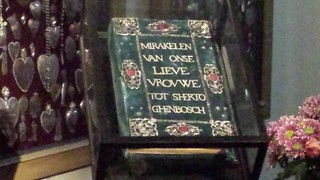
Privileges were highly guarded by the cities as they often needed to be used to fend off aggressive ruler who wanted to take power away. They were used to show (new) rulers what rights had been granted to them. The Rood Privilegeboek (Red Privileges Book) of Den Bosch is a good example of this. The version that still exists dates from 1580, with some of the privileges of course dating back to previous times.
Initially the new city elite (merchants) didn’t allow trades people to become involved in the local leadership. The merchants were instrumental in organising the guilds so they could keep them under their control. However, with a booming economy the position of this new group became more and more powerful as their numbers kept swelling.
The increasing power of the artisan guilds
With the cities, increasingly the artisans became more powerful once they started to organise their own guilds, they brought prosperity to the town. However, there were differences between the early merchants and the emerging artisan guild system . In Florence for example there were the 7 ‘Arti Maggiori’ (major guilds – like those of judges, bankers, solicitors, merchants, chemists, doctors) who were far more influential than the 20 ‘ Arti Minori’. They received legal recognition in order to maintain price control and the hallmark of product quality, which were both in the interest of merchants and consumers. In some cities over 100 guilds operated during the 13th and 14th centuries. Regulations applied to quality of product and unfair competition. A training system of apprentices, journeymen and masters stayed in place to well into the 19thcentury. In the weigh house (Waag) in Amsterdam one rooms still shows the masterpieces submissions made by the journeymen of the bricklayers as proof of their professional skills. However, only as the guild agreed that the market was large enough was an approved journeyman allowed to open his own shop. Journeymen and apprentices were most of the time not allowed to marry and lived with the family of the master. With the exception as some simple products such as soap, tallow (animal fat) candles and wooden plates , the guilds dominated all other products, its production and its sale and through this system they also controlled most employment in the cities.
Slowly but steadily the artisans obtained more power. In 1274 the weavers and fullers of Ghent deserted the town in protest against bad working conditions. This must have been one of the earliest organised strikes. In 1279 and 1289 Flemish guilds revolted and the Count had to force the magistrates of the towns to keep accounts of public income and expenditure.
The economic growth also led to an increase in the power of the Flemish cities. This often led to revolts between the cities and the count. In 1302 this led to the end of the power monopoly that the city elite had on the cities. After the battle of Kortrijk (Courtai) the artisans obtained 20 of the 26 alderman’s seats in Ghent. They could now also be elected as governors of the guilds, this form of ‘democracy’ also spread to Brabant, Zeeland and Holland. Unique to the Low Countries the guilds here were able to take control over the cities political and economic affairs. While the Count of Flanders did support the towns, he had very little influence over them.
Another interesting development was that large parts of the less skilled work was outsourced to bordering regions, one of the first pre-industrialisation examples of the deployment of low-wage strategies. Because of the critical function of the rural area, cities extended their political influence over their regions (see below).
While Guilds were powerful organisations the position of the skilled workers in the Middle Ages was similar to the poor underclass, still very precarious. The numerous wars, feuds and natural disasters could also threw this class into misery and poverty.
Increasingly guilds became represented in the town councils and were involved in the decision making process in relation to taxes and warfare. As a side effect this power was also used to create trade protection rules and regulations that often gave them monopolistic position. This stifled competition and innovations. It also created an artificial shortage of labour in these trades and professions.
This protectionism has also been mentioned as one of the key reasons in the slow growth of the population between 1350 and 1500. By the 16th century this system had become so restrictive and inflexible that it stiffed innovation and economic growth.
This was also linked to developments on the land, as indicated before during the previous boom period all arable land was cultivated and the population could easily spread and grow, by 1250 the most fertile grounds were occupied, leaving only marginal lands to be further exploited. In both villages and towns the new generation had to wait till the previous generation died before they could take over the trade, craft or land. This also led to rather late marriage patterns and lower birth-rates.
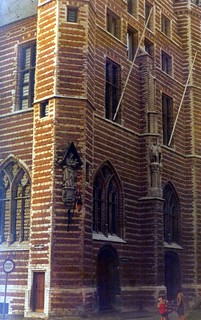
The Vleeshuis (meat house) of the Butchers Guild in Antwerp
Religion as a corporate strategy
During the Middle Ages state and church affairs were far less separated and sometimes even fully integrated. Guilds therefore also were close intertwined with the catholic religion.
The participation in church activities also enhanced the social function of the guild. However, the function of the guild went well beyond that of looking after its trades members and their families.
Initially guilds could have their own meeting rooms within the churches and rapidly guilds started to have their own altars and chapels within the church. Churches of course were the places were everybody in town went and these chapels where therefore an ideal opportunity to impress to the city folk (their customers). Altars were the eye catchers and significant investments were made in these corporate exhibitions. These chapels and their artworks formed an important part of the marketing and PR strategies of these commercial organisations.
Chapels had a very high real estate value and churches therefore were able to generate significant income from the various guild, which was often used to also increase the prestige of the church itself. The Brabantine Gothic is a clear expression of this.
Not only was the boarder between secular and religious blurred the same applied to the boarders with commerce. Religion therefore was an import element of the business strategies from the guilds.
Furthermore having their own chapels also gave the important members an opportunity to get their personal representations closer to God. They could be represented in the artwork and even could get a burial in the chapel or church, therefore – as the medieval people believed, significantly improve their changes for a better after life.
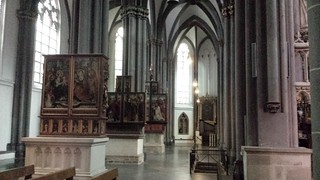
The cathedral of Xanten has 24 side altars set up by guilds and fraternities
With the rise of national governments, the power of the cities started to decline and in parallel the power of the guilds also declined; a process that was completed in many parts of western Europe by the 17th century.
The structure of the city – fortification process
As mentioned many cities started within the protection of grew. Early examples here include Namur in 937, Cologne in 948 and Verdun in 985. We also saw that Ename and Antwerp started as fortresses by the local counts, both rapidly grew into ports and in the case of Antwerp, it subsequently grew – by the mid-Middle Ages – into what probably was the largest city of northern Europe.
By around 1100 also Ghent, Utrecht, Tournai (Doornik) and Liege and Bruges were walled. Walled cities grew in a rather concentric way; very different from the old Roman patterns which were designed in squares.
Defense also became a contentious issue on two levels, one in relation to the counts and dukes and two in relation to its own citizens.
Traditionally the nobility had the role of defending the land and that also included the towns and cities, however increasingly the costs and the scale went beyond what the local nobility could provide and the cities increasingly started to take their own initiatives most of the time in cooperation with or with the approval of their land lords. These developments were prevalent for the cities on the borders of the various counties and duchess. In particular in the case of the more wealthier cities, more (delegated) authority was claimed to better organise their own (defense) affairs.
This created sometimes tension with the local population as land had to be appropriated for the purpose of building walls, fortification towers, etc. While most of the time the notion of the common good was understood and accepted, conflicts arose regarding compensation, maintenance, access and cost sharing. The Roman Justinian Code that also covered the distinction between commercial goods and common goods (princes, kings) was by the time the medieval cities started to arrive largely forgotten.
An interesting essay has been written by Ellen Wurzel on how this process developed in the city of Lille [3. Defense, Authority, and City Limit: the fortifications of Lille in the late Middle Ages. Jaarboek voor Middeleeuwse geschiedenis 14/2011, pages 150-182]
These walled cities also started to become a major problem when the population started to grow, while many cities saw new rings of walls being built further out, in general terms they remained a limitation to growth. These towns also created a sharp contrast between town and region [4. Stadswording in de Nederlanden, 2008, p43]. Increasingly the cities started to control the region around it, this was most notable in north Italy where city states emerged, they took full control over their region. To a much lesser extend Groningen in the Low Countries is a good example of a city – at least economically – controlling its region (ommelanden).
The structure of the city – lay out of the city
During this hectic period of city building we also see some interesting town planning developing. This was also the period when in many instances the old Carolingian wooden churches were replaced, the larger towns started to see the arrival of a 2nd church. Town squares arrived and from here the main streets left the town in 2, 3 or 4 directions. City gates and other stone buildings started to appear in the main street, which started at the main gate, close by where the shops with the actual shop or workplace along the street with large wooden panels that could be opened to show their ware. In the 13th century the majority of these houses were still wooden constructions but during the next century most of the more prominent houses had been replaced by stone structures.
Further away in the small alleys the one bedroom houses where the poor lived often with 6 or more people in one house.These houses remained for many centuries wooden structures and were often the reason of the many city fires that went through these places. Life took place outside. The most likely impression that modern visitors would get was the terrible smell and the filth in the streets and waterways. Within the walls often as much of a third of the space was occupied by churches, monasteries or manors which all were walled off again within the city. Most cities started of with a hundred or so inhabitants and by 1400 this would have grown to a few thousand, very few cities by that time had more than 10,000 inhabitants. Outside North Italy and Flanders not more than around 10% of the population lived in cities, so during the day the population of the city could easy double with people from the region flooding into town to sell, buy or visit.
In the more successful cities the density of the housing slowly started to push farms outside the wall. Land became valuable and we start seeing the arrival of the typical city architecture that is still preserved in several of these cities. If not, we know it from the mainly paintings especially from those made by the artist of the Nederlandish Renaissance (Jheronimus Bosch, Pieter Breughel, Peter Paul Rubens, etc)
Markt Den Bosch
With the equally hectic dyke building activities we also do see some towns moving; an example is Heusden there is still a small remnant of the old village, know ad oud-Heusden.
Ootmarsum also underwent a similar development and also here oud-Ootmarsum is still a separate entity. This had nothing to do with dyke building. It was the new church that was built that started to attract other city activities around it. The irregular pattern of this city indicates more of unplanned development but a gradual growth from the original medieval village.
So, when looking at those early cities it is also important to recognise that these were no linear developments. We often see population followed by depopulation and sometimes it reached total or near total abandonment. Parts of Roman cities often became stone quarries for new settlements that were built a kilometre or so away what in a previous period had been a thriving centre. Sometimes what used to be a Roman city disappears and instead a range of new settlements are built a satellite centres around the old town. In a place like Oss, often ravaged by wars we see building materials from one (destroyed) building popping up on the other side of the town in a new building.
In order to create solidarity among the early citizens symbols and myth were often used to promote a political-cultural identity. Sometimes heroic stories from crusaders were used such as in the case of Haarlem, where legend had it that their citizens were involved in cutting through the chain that was laid in the river Nile in front of the Egyptian city of Damietta. The Holly Blood in Bruges, brought to this city by their crusading count Diedrick, the shroud of Padua and the Holy Oil of St Thomas in Canterbury. Even the smallest town would have a patron saint and again this saint would fulfil the same role, providing solidarity, unity and a unique identity.
The organisation of the cities
Of course the structure was one element that started to define the city, but far more importantly was its organisation.
By that time communities also started to receive a juridical position – an essential element to classify it as a city – under a Lord or through privileges handed out by Dukes and Counts.
As those who started to occupy the cities were ‘free men’ and not serfs, they had to assist each other for example in relation to the protection of the new town. Similar to the old tribal tradition, these people sworn a pact (conjurationes) to protect themselves in order to arrange for a peaceful co-existence. An oath was taken on holy objects insuring divine punishment to those who would break it. This group-forming resulted in the formation of more or less free and self-governing communities, the for runners of the city councils. In the very first city documents these places are referred to as ‘communes’.
Some of the first recorded ‘commune oaths’ date from Flanders: Cambrai 1077, Saint Quentin 1080, Beauvais 1099, Noyon 1108, Laon 1109 and Valenciennes 1114. All of these cities developed their own customary law and fiercely competed which each other and often raged war against each other. Resolving conflicts were mostly done through blood feuds and weregild. The maegth (maagschap, kinship, clans) played a key role in this. Family relationships were carefully maintained and a ranking system was used to provide compensations but also the maegth was held responsible in case the perpetrator could not be found. These conflicts often involved large families, and a complex system of respect, homage and gift exchanges supported the maeght. Often these conflicts also led to factions, this could indeed be around families but also around political and commercial interests, most of the time these factions didn’t extend beyond the city elite. Later on we see that they sometimes also get aligned to territorial conflicts such as the Guelphs and Ghibellines, Hoeken and Kabeljauwen, Schieringers and Vetkopers and the Leliaards and Liebaards.
These sworn pacts of patricians – all the free citizens – men who at that time were mainly the early merchants and landowners – formed the vroedschap (a large college of wise men) they managed the commune, they appointed around four burgomasters to manage the daily affairs of the vroedschap. With increased involvement of the local land lords (counts, dukes) the official representative of the local lord became the schout (bailiff) and together with the schepenen (the closest English terms are alderman) they formed the daily running of the city, most if not all of the schepenen were also members of the vroedschap. Any of the other official functions within the city were also executed by members of the vroedschap.
These vroedschappen became the first city councils which consequently grew into the modern local government systems. Most cities retained their own legal systems until the French Revolution.
The early vroedschappen obviously looked after their self-interest and for example determined the hours that markets would be open, how many markets would be organised, which coins would be accepted and they set prices for imported and local goods. These patrician groups grew into what we now would call plutocracies, often split along incumbent commercial interests, factions and political grouping always fighting each other for power (not all that much different from current political situations).
The following example from Utrecht shows how the vroedschap was elected. By lottery the town’s 21 guilds provided each 5 electors. These electors appointed per guild two aldermen. These 42 aldermen elected 24 councillors and they in turn elected 12 magistrates (schepenen). Together with the councillors they formed the ‘new council’, who were in charge of the city privileges, the most important of them being the local jurisdiction which applied within the so called ‘city mile’.
It were these early ‘free men’ who received the privilege of citizenship. Others would later be allowed to become citizens, for which they had to pay a fee. These men (not women) were also supposed to have the means to defend themselves and as such form a militia later divided in squads per wards. They also had political and certain legal rights – as per official city privileges, that slowly started to replace earlier unwritten privileges. Most people that lived in a city however, never received citizenship and as such had no say in its affairs. Often not more than 15% of the population were citizens in this legal sense. My great-great-great-great grandfather bought citizens right for himself – for 12 Reichsthaler – when he came from the rural village of Wietmarchen and settled in the city of Nordhorn in 1771.
Obviously the feudal powers initially objected to the formation of these ‘independent’ communes and these lords tried to extract money from people who wanted to join the vroedschappen. Time and time again we see the feudal powers using all possible means to condemn, ridicule and badmouth these groups, simply aimed at protecting the incumbent interests.
In some cases the nobility and clergy took the attitude if you can’t beat them, join them. This led to a further formalisation of the structure of the city, which increasingly was reflected in the formalisation of the old rules and regulations into city privileges.
A clear indication that the power of cities was rising happened in 1191 when the Count called the Flemish cities together to be the guarantee for a peace treaty between the Count and the King of France. In 1194 the cities were again called together by the Count , this time together with the cities from Brabant, Hainault and Namur to be the guarantee for a similar treaty this time between Duke Henry III of Brabant and the Count of Flanders and Hainault. The city of Utrecht was mentioned in a similar situation in 1196.
In Liege in 1288 the abbot of St Trond decided to set up his own commune, in order to maintain in control. However in 1303 merchant and trade representatives of the city started to make their entry in the City Council. After a revolt in 1312 the local trade guilds basically took over control of the Council. In 1304 the Guilds of Utrecht also obtained representation within their City Council.
Examples of cities with their leading groups of city elite:
Ghent: viri hereditarii – original landowners
Paris: prevot des merchands
Bruges : The London Hanse
Florence: Guild of the Cloth Guild
Louvain: Guild of the Cloth Guild
Deventer : Merchant Guild
Metz: Pairages five family groups with original landownership
As mentioned before and as can be concluded from the list above, it were the merchants who took the lead in developing the early organisation of the emerging towns and cities. As these cities grew the original families of the sworn group were able to hang on to privileges without necessarily passing all of them on to the newcomers. They also were the original owners of most of the land in these cities and this in turn brought also certain rights with it and rapidly these positions became hereditary and a ruling upper class was formed. Other new rich merchants were also able to also secure themselves a position within this group. Well aware of their position and rapidly becoming more and more wealthier saw this group adopting the popular and fashionable culture of the day that of the knights, complete with heraldic colours, robes and other paraphernalia to further underline their status. They became the first builders of the imposing city mansions of which a few still remain in places such as Ghent and Bruges. In 2007 we stayed in one of such renovated city mansion on the Graslei (see picture below).
The level of wealth and consumption among these new elite was beyond the imagination of the feudal lords from the preceding era.
Often for generations local city councils were dominated by certain powerful families. As an example, throughout the 15th and 16th centuries the Zoudenbalch and van Voert families are the most prominent ones in the vroedschap of Utrecht.
In the end these early democratic systems in Flanders and Brabant didn’t evolve any further and became rather archaic. Especially the conservative stand of the trades groups who had official representation in the city councils were only interested in protecting their monopolies and stopped innovation not just in an economic sense but also in a political sense.
Peter Henderikx in his contribution to the book city forming in the Netherlands describes how integrated the cities had become. For this he uses the example of the Loonse War in 1202 (see Holland). Already at that early stage the following cities are all closely related and interwove: Dordrecht, Haarlem, Vlaardingen, Zierikzee, Utrecht and Leiden[5. Stadswording in de Nederlanden, 2008, p49].
This situation is not unique, we see many cities strengthening their ties within city confederations (stedenbond), they were basically pacts to assist each other, especially in conflicts with the Count or Duke. These confederation are most of the time within the geographic boundaries of the county or duchy. However, often when it came to the crunch they failed to provide central leadership and failed to cooperate divided by parochialism, pettiness, internal competition and greed. Over time this made it easier for the upcoming monarchies to neutralise the cities and to stamp their authority on them.
Unlike Flanders and Brabant there was better cooperation between the cities in Holland, which made them far more politically powerful.
Within these confederation there was always one leading city, in Flanders this was Ghent, in Brabant Leuven and in Holland Dordrecht. [6. De Hertog en zijn Staten, Robert Stein, 2014, p74]
Graslei Gent
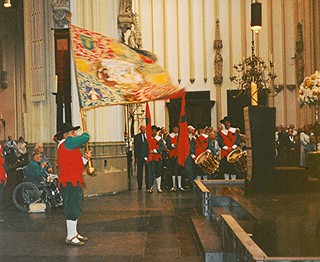
Apart for the artisan guilds, town militias also formed their own guilds (schuttersgilde, schutterij).The traditional of schuttergilde is still very much alive in Belgium and the Dutch provinces of Limburg and Brabant. They organise annual tournaments where their traditional militia skills are tested.
Gilde St Antonius – St Sebastiaan, Udenhout. St John Cathedral.
St Sebastiaan Guild – Oss
The most important guild in Oss was the Sint Sebastiaan Guild. This became known as the ‘Schuttersgilde’, the town militia.
The Sint Sebastiaan Guild was first mentioned in official documents in 1428, during the reign of the Burgundy Duke, Philip the Good. And in the 16th century its Articles were confirmed in an official document from the Holy Roman Emperor Charles V.
As in many places elsewhere, in Oss the Guild had an altar in the local church (Grote Kerk).
In 1868 the local church in Oss dissolved the Guild because, according to the local priest, it had become more of social club!
However, in 1998 the Sint Sebastiaan Guild was revived and it is now one of the most active guilds in Brabant – with their flying standards and drums they now once again form an important part of local activities in Oss.
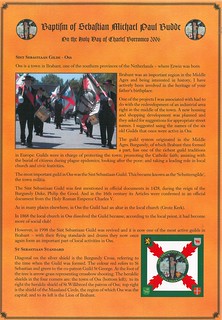
St Sebastiaan Standard
Diagonal on the silver shield is the Burgundy Cross, referring to the time when the Guild was formed. The colour red refers to St Sebastian and green to the co-patron Guild St George. At the foot of the tree is arrow-grass representing crossbow shooting. The heraldic shields in the four corners are: the town of Oss (bottom left); to its right the heraldic shield of St Willibrord the patron of Oss; top right is the shield of the Maasland Circle, the region of which Oss was the capital; and to its left is the Lion of Brabant.
Images of the St Sebastian Guild on a baptism commemoration of Sebastian Budde
The famous Belforts (belfries) were an expression of the self confidence of the cities; they were among other things as watch towers for the security of the city.
Belfort Coutrai (Kortrijk)
From the early 14th century the concepts of ‘common or public good’ – as it had been used in Roman Law – started to reemerge in legal treatises. However, the city magistrates who were the key people in charge of the ‘common good’ were not the only power in town there were also the merchants, nobility and the church.
Managing the city was often a power play and had as much to do with claimed authority, money and priviliges as it had to do with the common good.
In medieval cities often a third of the land and the building were in the hands of the clergy, they had their own privileges and immunities and they of course also had to cooperate.
The dynamics of all this is what really started to make the city, its social structure rather than its territory. And looking back in the end it were the city magistrates who were able to claim political authority and this became the key managers of the cities, as such they were also able to levy city taxes to built and maintain the fortifications and pay fees for those who maintained parts of the moat, earthworks, walls, etc.
Nevertheless throughout the Middle Ages and increasingly in the following period the land lord (later the state) also retained its own rights and jurisdictions – through their Chambers of Account – as of course did the various religious institution. It was not uncommon that a medium sized city had over 50 independent authorities all with their own (feudal) rights and legal systems.
Administrative functions of the city officials
Property sales, testaments and other civil contracts were handled by the schout and schepenen. These were very essential elements for a city to function, (local) jurisdiction is always the key element in the city privileges that followed in the following century. The first deeds and contracts – known as chirographs – were cut in two or more pieces depending on the number of parties involved. The cutting was done along curved or indented lines. Each party kept its own part and only together did the document have legality. The chirographs were later replaced with protocols, charters and deeds issued by the sheriff, baliff and/or magistrates, sealed with their stamp.
Bailiff/Schout/Baljuw/Drost
The rank bailiff was first used – from the 13th century onwards – in Flanders, Holland, Henegouwen, Zeeland and in North of France. The bailiff was one of the first judicial civil servant appointed and paid for by the ruler to represent him mainly in regional areas and regional towns. In Flanders the Duke usually appointed the bailiff and in France the King. The position originates from France when King Philip II Augustus installed the first bailiff. In the northern parts of continental Europe this position was known as “Baljuw” a direct derivative from the French word “Bailli” but also words were used as “drost”, “drossaard” (Brabant), “amman” (Brussels), “meier” (Leuven, Asse), “schout” (Antwerp, ‘s-Hertogenbosch, Oss, Turnhout), “amtmann” and “ammann” (Germany, Switzerland, Austria). In the Low Countries the schout was in charge of low justice, while the Baljuw was in charge of high (criminal) justice.
Because of the juridical roles the local authorities played in these emerging city they also became a depository of local knowledge, often in the minds of these authorities and because of this they played a key role in developing and maintaining the social structure and local cohesion, keeping the peace.
Once the dukes, counts and kings started to exert their authority over the cities they wanted their share of the various transactions, fines and other official incomes. It is estimated that roughly a third of this money stayed with the local authorities, the rest went to the Duke. In situations of church fees and taxes only a quarter stayed with the local church. The schout and schepenen also had an administrative and managerial function in relation to the church and the poverty councils.
The administrative function related to this work was initially done by these schepenen, there actions and outcomes were written down in protocols (dingrol) but slowly developed into a separate function, which became a hereditary privilege, which lasted until the French Revolution.
After the schepenen had finished their year of duties they could be elected as sworn members (gezworenen). Their task was to assist the schepenen in money matters. The actual management of the money affairs (taxes) was in the hands of borgemeesters. They were appointed annually by the schepenen on Candlemas (Feb. 2). This title evolved during the 14th century into burgemeester (mayor), they had administrative functions and didn’t need to be appointed by the sovereign ruler.
There is a subtle difference between these two words. ‘Borg’ can be translated to deposit and has a distinct financial meaning. ‘Burg’ refers the burgers and indicates the leader of the burgers. Like burgemeesters, also borgomeesters were appointed not elected, this is even until this day the case in the Netherlands.
Originally the function of ‘vorster’ was linked to the hereditary secretary. It was a law enforcement function mainly in the sense of a bailiff. He carried a green stick with him as different from the red stick carried by those in charge of police functions.
The appointments of schepenen, jurors and burgomasters were compulsory. As mentioned above, together they formed the ‘vroedschap’ (city council), were also other elected burgers could be part of.
The maintenance of the city was a costly affair, mainly financed through a tax on consumer goods. It doesn’t come as any surprise that these taxes were always a bone of contention. Also because any one with territorial rights required their own taxes, lords, overlords and churches. Wars were always the best reason to levy ‘special’ taxes, which often lingered on for a long time, especially if losses were occurred and financial compensations were required by the victor.
While these ‘special taxes’ were voluntary, the reality was that in the case the ruler couldn’t pay his debt, it were often the merchants who were arrested and their merchandise confiscated cities often had no other choice than the bail their ruler out. The money often was taken away from infrastructure projects such as city walls, council halls and other public spendings.
The Low Countries were one of the few ‘enlightened’ regions in Europe where their ruler allowed the cities to have a key say in their internal affairs and often they were able through tough negotiations with their overlords in relation to taxes. Nevertheless during the 15th and 16th century the state was able to cream off large amounts of money from the fabulous rich towns. We also start seeing that the economic rich states were able to spend more money on war and therefore also grew militarily much stronger. The Low Countries became pioneers in ‘modern’ warfare in the 16th century and were able to defeat a significantly larger power such as Spain.
Already in the 12th century we saw that powerful cities in Flanders were able to claim reparation for the injustices done to them by William of Normandy and later by Louis VI of France.
Justice in the Middle Ages
Only slowly do we see an improvement to a more legal resolve, the first city prisons started to arrive in the 13th century and more sophisticated laws started to arrive during the 14th century. But corporal punishment remained the main outcome of sentencing. It was not just a punishment but also a retribution for the other party and it was seen as setting an example for the whole community. Justice was done in public and was widely ‘advertised’ to draw in the crowds. The death penalty was for murder and manslaughter, mostly executed by sword but also by breaking wheel, gallows or quartering. Homosexuality resulted in burning on the stake, counterfeiting by immersion in boiling substances, etc. Mutilation was another form of punishment and could be done as an’ eye for an eye’ punishment, depending on the harm done to the other party. But a spy could also be punished by eye protrusion, theft by cutting of the hand, pickpocketing by cutting of the thumb, etc. Marking was another form of punishment. Beggars had to ware a collar with the seal of the city on it, Jews had to wear certain marks on the clothing (only one country had decreed their Jews to wear the six pointed yellow star; Portugal). Lepers were another’marked’ group they had to wear clothing made of of grey wool, sometimes it was decreed to have threads of red through it to create a dramatic blood image. Also mentally ill people were sometimes ordered to wear some sort of a uniform. Prostitutes were often forbidden to wear expensive garments and also they had to wear red or yellow marks on their clothing. Over time the legal systems started to see changes. More and more punishments for minor criminal events could be paid in money. Corporal punishments decreased and instead banishment and pilgrimages were issued.
It was not until the 16th century (Charles V) before retaliation was formerly outlawed. Increasingly the cities secured the ratification of their rights by the counts in exchange for the payment of levies, rents and taxes rather than through war.
Life in the city
With arrival of cities a totally new society started to emerge.
It allowed, for the more entrepreneurial people, to escape the system of serfdom that held a stranglehold on the village population, they now for example were able to become successful tradespeople . Many of course never made it that far and these walled cities very rapidly became overpopulated with slumps and this in turn created fertile grounds for poverty and uprisings.
These town-based structures provided some sort of an alternative to the social structures which were provided within village communities. During the Middle Ages approx a third of the population of the cities consisted of the poor, perhaps an equally large group was situated just above the poverty line was and in times of famine, epidemics or other disasters they also became part of the poor.
The other third of the population existed of schooled labourers, trades people and small retailers, these people were in general the ones that also belonged to the guilds and confraternities. Less than 1% could be classified as wealthy.
A good tradesman could earn around 50- 60 guilders or 6- 7 pounds a year. A labourer not much more than 15 guilders or one pound and six shillings. Purchase power varied widely but foodstuff in the cities was the most expensive in relation to wages and land prices. Of course many people, even in the towns, would grow at least some foodstuff themselves and would heave a few chickens, a pig and/or a goat. In the rural areas most people were self sufficient, be it through a limited amount of produce, so a not a very varied diet. For trades people being a member of a guild was essential, however entry into a guild could cost as much as 1/3 of his annual wage.
For many centuries social and economic developments depended totally on the people themselves. There were little or no structures and none them significant enough to rely upon. At a basic level people had to protect themselves and most would be armed with knifes, swords and bow and arrow if they were travelling. Those caught doing something wrong received the most brutal treatment with torture and often hanging for rather small offences such as stealing. The Middle Ages can certainly be called violent. A ‘good’ father would beat the children as a ‘teaching tool’. Violence was also seen as normal towards women, servants and animals.
The average age of course was also much lower and young men at an early age (12) were often treated as adults. Many of the nobility were leading armies at the age of 16 or 18. With fewer older people, wisdom and knowledge had little time to grow and often decisions were made on the spot without much strategic thinking attached to it.
This strong medieval emphasis on the group , created a positive attitude towards everybody inside it, at the same time this led to an indifferent and hostile attitude towards those outside that group (whoever those others might be), but in particular travellers, vagabonds, etc). At the same time these structures also kept many people honest under such level of social control.
There were many groups within the city society: former peasants and city folk, able and disable people, men and women, Catholic and non Catholic, locals and ‘foreigners’, guilds and other city groups. Group attitudes also effected the relationships between cities which often led to ‘campanilismo’ (bell-towerism) or parochialism. This was further emphasised with religious symbols (they all had their own saints. In order to make sure that everybody new the borders of their town or neighbourhood, boarder points were marked. Annual processions were organised along these markers during the Rogation Days .
Tight knit communities were needed, where people could trust each other in order to survive in such a violent society. This had also its negative effects such as protecting criminals within their own group, extortion, corruption, etc.
On the other side the infallible believe system of the people of the Middle Ages also led for a caring for the poor and the sick and the importance of doing good deeds, penitence, etc. Hospitals, schools, orphanages, etc were all started under the leadership of the Church. Once started to grow bigger these social services were also provided by secular fraternities (and also the guilds).
Pieter Brueghel
High Middle Ages – Cities rivalling the nobility
Initially the cities were also early adopters of new administrative innovations. They had the economic powers to also finance these new developments and were a force to be reckoned with. Their administrative powers however, started first in the cities in Flanders, with the arrival of regional schouts (bailiffs). However, between 1350 and 1550, the cities, especially in Flanders were able to claim a very high level of independence. The cities were involved in all major political decision both in relation to national and international affairs and they also participated in military actions. We also see similar developments in North Italy and within the North German Hanse cities. Cities in France and England never reached that level of political influence.
In regions such as Flanders, Brabant and Northern Italy the cities had a balancing influence on national ambitions. They functioned as a counter force to centralisation. This led to far more dynamic developments in these regions in relation to politics (early forms of democracy), trade, art and sciences. However, these developments required a stronger government, interestingly this, in northern Italy, led to the individuals either being given, or seizing themselves, greater powers within these republican communes they sometimes ruled with absolute power, individual families were sometime able to dominate a city for a century or more: the Visconti and later the Sforza in Milan, the Gonzaga in Mantua, the Este in Ferrara and Modena, the della Scala in Verona, the Malatesta in Rimini and the Medici in Florence.
Cities also started to take over more and more functions from the church; this led to a more secular society – ruled by secular courts – even in cases such as heresy, marriage and divorce. Cities were often also able to levy taxes on church properties.
Late Middle Ages – rulers are taking the power back
While initially the local rulers were happy to leave the cities alone as long as they paid their taxes. Nevertheless the power of these early towns and cities was seen as a threat to the landlords and their vassals. Eventually in the Late Middle Ages and beyond when these regional states became more powerful and started to encroach on the political powers of the cities. As a result in the 15th and early 16th century there was a more or less permanent state of war between the cities and these landlords.
The cities were seldom able to combine forces against these counts and dukes and this became their downfall, eventually Charles V was able to permanently subdue the cities under his power. This in turn under his successor led to the independence war between the Low Countries and Spain. With the northern part of the Low Countries liberated we again saw here the cities taking the lead which led to the Golden Age of the Netherlands in the 17th century.
The undermining of power didn’t just occur in relation to the cities it had an equal effect on the lower nobility, also they started to lose more and more of their powers.
The lower nobility in Brabant never became as powerful as their counterparts in Germany and England. However, for the local peasants all of that didn’t matter whether they were ‘owned’ by lords, kings, and abbots or as in the case in Wietmarschen; abbesses. However, under its local rulers – the Lords of Oss – there is not a high level of evidence of local feudalism in Brabant and Flanders.
We also see political tension occur during the period of power transitions. On one side, the ruler find himself increasingly in conflict with jealous nobles, while on the other hand he has to deal with a rapidly increasing individuals and groupings within and between the cities. In both situations however, the rulers with their increased administrative, legal and military powers became the winners and successfully played the various parties against each other. The more powerful regional administrative systems started to take more and more functions away from the cities and many of the nobles were – as compensation for their dwindling powers – appointed as functionaries within the new systems.
In the Netherlands, after the take over by the Burgundians we see mainly southern nobles from Flanders and Brabant being appointed also in the counties above the main river system. This added an extra tension to the situation, with now not only the local patricians revolting against the Burgundians an even more so the Hapsburg rulers, but also the local nobility who saw their lucrative privileges and offices being given to the southern nobility. In order to limit the power of the cities, the Duke of Burgundy was able to reduce the number of people in the vroedschappen (by now more formal city councils). In Haarlem, Duke Philip the Good reduce the vroedschap from 80 to 40 members. Such reductions and also replacements of members by appointees of the Duke became the norm during the next few centuries.
As mentioned above, within the vroedschap the burgomasters were basically the persons in charge of the daily management in town. They were traditionally democratically elected by the free citizens . However, increasingly these burgomaster were now chosen by a vroedschap dominated by the Duke/Count/King, thus limiting the level of broad citizenship participation in these political functions.
Below are some case studies on how that worked in practice.
‘s-Hertogenbosch and the Meijerij
The Dukes of Brabant started in the 12th and 13th centuries to expand their influence to the northern regions along the river Maas. There were no cities here and this area started to become more developed under the Dukes. So here it were the Dukes who appointed the officials. This was still organised around the system of the vroedschap, but now with more direct influence from the Duke.
After the founding of ‘s-Hertogenbosch in 1185 the region around the city was divided in four administrative quarters. The hoogschout (senior baljuw, baiiff) resided in here and was the representative of the Duke for the whole region (Meijerij). He had the jurisdiction over criminal law. Each of the four quarters had a kwartierschout (local bailiff) and the execution of the law was in the hands of these local bailiffs.
By the end of the Middle Ages the capital of this region, ‘s Hertogenbosch (Den Bosch) had around 20,000 inhabitants. It had one of the highest number of religious inhabitants, 1,100 monks and 100 secular clergy, this was 5 times as many as in most other cities. They occupied as much of a quarter of the land within the city, lived secluded within their high walled enclosures, didn’t pay taxes and were often accused of gluttony and drunkenness. The presence of these monastic communities often led to political and economic conflicts. For example their workshops could produce goods cheaper than those provided by the taxpaying craftsmen in town.
Its city council was managed by the so called ‘three members’.
The ‘first member’ were the aldermen, former aldermen and sworn members, they were nine in number During the time the Dukes of Brabant they were appointed by the Duke and formed the daily management of the city. They were responsible for administration, law enforcement and criminal prosecution. They sat for one year, with two of them sitting for 2 years. After their term they stayed on sworn members for another year within the ‘first member’.
The ‘second member’ consisted of past aldermen for as far as they were not part of the ‘first member’, they were called the counsellors.
The ‘third members’ were the deacons of the most important 17 guilds of the city, they consulted with their guilds through the so called ‘Achterraad’ (back board). Deacons were appointed by the ‘first member’.
The Gallows of the Judiciary of Ravenstein.
Gallows
The Provincial Archivist of Noord Brabant, archivist Henk Buijks came across this interesting map from the German cartographer Christiaan Sgrooten (appox 1532-1608). To his surprise he noticed between Heesch en Schaijk a drawing of gallows with the text “Ravesteins Gerycht (Judiciary of Ravenstein). This is the exact location of the archaeological evidence of the gallows found on one of the burial mounds of Oss. It looks like that it were criminals condemned by the court of Ravenstein who we executed here.
As Ravenstein was an independent county it had its own jurisdiction. In neighbouring Oss the local bailiff had no jurisdiction over criminal law, this was done by the high-schout in Den Bosch. The gallows in Oss were just outside the city gate (Linkensweg – Linken’s graveyard is a reminder of that spot)
The development of Oss
While Oss for some three thousand years had flourished as an agriculture community or perhaps better a group of settlements, its importance as a ‘centre’ started after the Dukes of Brabant added the norther part of Brabant to its dutchy, Oss became an important border town and its prosperity increased in after the dukes had put dykes along the river Maas, which led to the reclamation of very fertile agriculture lands.
The most obvious developments would have been that it became a centre amidst its successful agriculture settlements and such started to become a market place. An indication of these trading developments might be the fact that in 1286 the inhabitants of Oss received the freedom of toll throughout the Majory.
There is (some disputed) evidence that the city already enjoyed city rights earlier, perhaps from 1304 [7. Oss een stad, 1998 p 39].
This doesn’t sound unreasonable as it received its first magistrates in 1309. The trading function of the town was further confirmed in 1340 when it received its first market privilege and it had a Drapers Hall in 1346.
This could be an indication that the town had a direct link with the booming drapers markets in Flanders. Because of the enormous demand the traders supplying the cloth markets had to go further into the country side to buy flax and the suburb ‘Vlashoek’ (flax corner) could be an indication where the local flax was grown. This was also the most prosperous period for the emerging city; soon its economic progress would turn into a set of dark ages that lasted for nearly 500 years.
While the town grew at its own strength to economic prosperity it most likely didn’t receive its city privileges for that reason.
Population developments Oss
Year
Dwellings
Inhabitants
1374
2200
1438
447
2235
1464
321
1605
1472
199
995
1480
229
1145
1496
243
1215
1526
468*
2340
1736
507
2535
1795
2766
1875
4517
1932
14.786
2008
76.498
* of which 86 are non taxed (poor people) and 16 important houses
Oss as boarder town
Oss was only 5 kilometres from the river Maas, and as the largest towns in this region it became a prime target for attacks. Between 1250 and 1280 the dukes of Brabant had nearly completed the dykes along the river Maas, this allowed for a more permanent settlement around what is now the centre of town (De Heuvel – The Hill). This also brought the first legal rights to the region, an arrangement regarding the commons of the various villages in the effected area.
Around Oss, an early indication of the tension between Gelre and Brabant is the defence wall (landweer) east of the emerging centre of Oss this was built in 1259, indicating that the problems were expected/coming from the direction of Gelre [8. Geschiedenis van Oss, Jan Cunen, 1932, p33]. See also video clip.
Landweer
There were several of such defence works around both Oss and Berghem. Excavations in Berghem show that the wall itself was aprox 5 meters wide, with 6 or 7 rows of poles on each side and on the outside ditches. The whole defence area was 15 to 17 meters and these fortifications went on for several kilometres. There were opening for roads and these ‘gates’ formed half circles with boom gates. The oldest reference dates from 1402 in reference to its position around Berghem, also covering the eastern boarder of Oss. The current boarder between Oss and Berghem and Schaijk (currently named Landered) marks the exact position of the Medieval landweer. Until modern times the tracks traversing this area did bend to not cross this border.
In 1359 the militia guild started to built a earthen wall around the town.
Map Oss within the city walls
While the town already had a set of privileges, further ones were issued at the onset of the first Gelre War in 1387. The town received a new set of city walls, gates and fortifications in that year [9. Tussentijds 1/09, Gerard van Alphen, p14].
During the 2nd Gelre War, in 1397, the new town gates were severely damaged. The City received its officiial city privileges in October 1399 from Duchess Johanna of Brabant. The rebuilding and most likely a much more robust Graafsche Poort (Grave Gate) was completed in 1407 [10. Geschiedenis van Oss, Jan Cunen, 1932, p33].
Oss commemoration 575 years city privileges, with Duchess Johanna.
Also in the 14th century a stronghold (Terwanen) was built by the local Lords of Oss (Jonkers van Os(s).
Shortly after the peace treaty was signed after the 2ndGelre War in 1399 Duchess Johanna provided Oss on the 14th October 1399, with Town Privileges.
Official city rights were often already based on previous rights [11. Stadswording in de Nederlanden, 2008, p45] and often were a confirmation of what already was in place and several of the official privileges given to Oss indeed confirm that.
Town Privileges of Oss
City governance (the right of local government and judiciary and law making
City walls (the right to erect a defence wall around the current town centre)
Market right (the right to hold a market and receive a quarter of the income from the market fees)
Appointment of two borgemeesters – in charge of the local finances.
Citizens were forgiven any previous obligations to others, except to those in Den Bosch.
For obligations made in Oss with others in Oss they could only be prosecuted in Oss.
Tax rights (keur) on all cloth produced in the of Oss (the quarter of the Marjory of Den Bosch of which Oss was the mains city)
Establishing of a cloth guild in charge of executing the tax right
Toll freedom throughout Brabant
Armed forces of the Duchy were not allowed to claim goods and services without payment.
Freedom of taxation and army duties outside the regional Quarter of Oss.
All current inhabitants and their descendents were subjects to these rights and the city had the right to provide the privilege to others for the payment of two guilders.
The city had the right to expropriate properties needed for the erecting of the fortifications.
The Schout had to pledge by oath to uphold the city rights
Bonds agreed between two citizens made before the shout or schepenen were legally binding
Citizens could not be prosecuted outside the city of Oss
All accusations against citizens had to be dealt with within two day.
The next privilege is a rather unusual one. Citizens accused of manslaughter or involved in it, in Oss or in the Marjory of Den Bosch could not be prosecuted unless they were also accused of this crime by two other independent citizens of Oss
Freedom of wood tax.
In relation to the manslaughter issue mentioned above, those accused of it were outlawed and could be executed without pardon within the forbidden area. Often their house would be burned and they basically had nowhere to go. Those who would house exiles were fined. Murder was seen as more serious and often led to more cruel treatment (disembowelment, quartering) that was always followed by death. [12. Bourdondië voorbij. Karel van Charolais en de zitting van de Hoge Vierschaar van Zeeland in 1454. Corien Glaudemans. p357]
Schout and schepenen are mentioned for the first time in Oss in 1286 [13. Oss een stad, 1998, p 35]. As elsewehere the schepenen (aldermen) initially only represented the local landowners not the total population.
In 1309 the Duke appointed the Schout for the quarter region Maasland. When in 1399 Oss received city rights, the Schout of Maasland also became the Schout of Oss.
Medieval administrative system in Oss
Funtions
Numbers
Schout (sheriff/bailff)
1
Schepenen (magistrates)
7
Gezworenen (jurors)
5
Burgomeesters
2
Vorster (bailiff)
1
Church wards
4
Secretary (clerk)
1
The schout also appointed their schepenen (from scabini (Lt) – magistrates) this was done on an annual basis from Bamis (1 October) – till Bamis (Bamis is the holy day of St Bavo). Initially they operated on personal authority; not as a council. Their most important function was jurisdiction both in civil and notary affairs in relation to property, private disputes, bankruptcy, etc. They also had the right to charge, fees, fines and local (village) taxes. There was during the Middle Ages no separation between administration and jurisdiction. However, the more serious crimes had to be deferred to the high schout in Den Bosch.
The development of Nordhorn
During Germanic times Nordhorn already had an important river crossing. After Charlemagne conquered the Saxons in the latter part of the 8th century, a church was built. Next to the church a Schultenhof was established for the local official (Schulte, Schout, Bailiff).
Most probably by 800 a small watchtower existed on a small island in the river to protect the trade route of the counts of Bentheim. The place received its city privileges (Wigbold Rights see: County of Twente) in 1379 – during a period of hostilities between the Count of Bentheim and the Prince-bishop of Münster.
It is most probably around this time that tower was extended to a stronghold. Apart from its defensive function the site was used as a hunting castle for the counts. The island was from that time onwards named Burginsel. This also saw the centre moved from the church, Schultenhof and the old river crossing a kilometre or so further north.
Nordhorn became an important staple-port for sandstone trade of the Counts of Bentheim this was the largest ‘company’ in Germany during the Middle Ages [14. Nordhorn, 1978, Herman Specht, p 13].
Nordhorn Burgstrasse – entrance to the Burg
The settlement was used by the Johanniter monks and in 1578 was sold by Count Arnold II to the Monastery of Frenswegen (this monastery was in 1809 handed over to the church of Ootmarsum). The Augustine monks rebuilt the ‘burg’ into a residence and a chapel, from now on known as ‘Klosterburg’. It was used during the 80-year freedom war of the Dutch against the Spaniards as a refuge for Dutch Catholics. After the reformation the ‘Klosterburg’ was classified as a Catholic building and the Catholics were thus able to continue to practise their religion. In many other places in Europe far less tolerance existed between the two communities.
Gerhard Hermann Budde (born 1731), son of Bernardus, left Wietmarschen for Nordhorn and became a citizen of the city on 12.02.1771, as was recorded in the ‘Bürgerbuch Nordhorn (citizen book of Nordhorn): Gerhard Budden uyt het Wietmarschen. He most probably had to pay 12 Reichstalers for this privilege.
Here he marries Maria Wolterink at the church at the Burginsel. The chapel, the old and the new current church were all called the St Augustinus Kirche. It was in this church that the Buddes were baptised, got married and finally were farewelled from this church at their funerals. The settled at the Burgstrasse; the main street leading from the township to the Burginsel.
Early pictures from the Burgstrasse show the gates that led to the bridge that went over the Vechte to the castle. The site is now a beautiful park.
Stadtpark Nordhorn
River Vechte
The Vechte originates in the Baumberge hills in the German state of North Rhine-Westphalia near the city of Münster and flows north into the state of Lower Saxony, past the towns of Nordhorn and Emlichheim, across the border and then westwards into the Dutch province of Overijssel. Here, it flows through the northern part of the Salland region past Hardenberg and Ommen.
Close to the city of Zwolle, the river suddenly bends north to end in confluence of the Zwarte Water river near the town of Hasselt. Source Wikepedia.
Wandering through the region Ootmarsum, Bentheim, Nordhorn one can still sense the close relationship between the places and the people; indicating the oneness of the land which once belonged to the Tubanti; the combined Germanic roots of this region.
Tribal structure continued in neigbourhoods
The very early start of the cities looked similar to the original tribal structure of the communities before 1100. The behaved in many ways similar to extended families, the cities continued that tradition but once they grew the ‘family feel’ disappeared. In many towns this quasi tribal structure continued in the neigbourhoods (buurten). Well into modern times neigbourhood duties (buurplicht) remained in use in situations of birth, marriage, death and so on.
In Ootmarsum the city was divided in four neighbourhood quarters (vèèrln): Schild, Markt, Ooster and Hogelinden. Each neighbourhood appointed its own magistrate and he appointed a burgomaster. Here the elections took place on the evening before Petritage (Chair of Peter – Cathedra Petri – 22 February). These 4 together appointed two more burgomasters this brought the total of the board at 6. They dived the various functions among each other: the ‘cameraar’ and ‘vice cameraar’ who looked after the finances; the ‘zegelaar’ and the ‘vice-zegelaar’ as notaries and the ‘breukmeesters’ in charge of collecting penalties and fines. Every duo also administered justice for one month, so each duo did so 4 times a year [15. Het Drostenhuis van Ootmarsum, 2009, p 33].
In Nordhorn the city was divided in 12 neigbourhoods (Rotten). The City Council’s (Rat) year also started on Petritage and in the Middle Ages consisted of the following persons:
Schöffe (Schout) headed the city administration.
Four burgomasters .
Two Lohnherrn (surveyors) who mainly had to look after the various bridges and roads.
Four Gemeinheitsleuten (jurors) they were in charge in inspecting the weights and measures. quality of the bread, chimney maintenance and minor legal issues.
12 Rottmeisters (neighbourhood magistrates) originally they were in charge of local guards in case of war, they also were in charge of fire fighting and floods caused by the river Vechte.
Empfanger, he looked oafter the finances of the town.
Stadtsekretär (town clerk).
Stadt- und Gerichtsdiener (bailiff) also the town’s gatekeeper.
The normal Rat meetings were held in the Rathaus (city hall). At important events the Rat could call all citizens together before a decision was made. In front of the Rathaus the community would gather for the ceremonial events on Petritage at the opening of the new civic year. At this day also the new citizens were welcomed, leases were renewed, annual salaries as well as annual dues to Counts and Bishops were paid.
Depending on the local situation other functions could include; bell ringer, medical doctor, teacher, garbage collectors, market supervisors, fortification maintenance, etc.
In order to pay for all of this local taxed were levied and also those who wanted to become a citizen had to pay for that right. Sales tax, poll tax and tolls were other forms of taxations.
Social structures: Brotherhoods/Confraternities
Apart from the horizontal strata in the city society also vertical groups formed, mainly stimulated by the equality of people as preached by the church. Some of these Fraternities predates the more formal city structures and they played a key role in the social structures of the emerging cities, offering assistance with funeral arrangements, providing commemorative services, looking after widows and orphans, etc). From the start they did have a more religious character however, they also were instrumental in the incorporation of similar social support and services to the members of the emerging guilds. as we saw within the structures of the guilds They organised their own processions and other religious festivities.
They also often had altars and chapels within cathedrals and churches or meeting places elsewhere in town.
Below we will also discuss the Illustrious Brotherhood of Our Blessed Lady in‘s Hertogenbosch in the Saint Jan Cathedral.
Some of these fraternities also held collective penitence flagellations sessions.
Swan Brothers and the Illustrious Brotherhood of Our Blessed Lady of Den Bosch
The miracle images of the Virgin Mary also led to new religious confraternities dedicated to Mary, adding another level of religious lay community to the landscape. In ‘s Hertogenbosch (Den Bosch) the Illustrious Brotherhood of Our Blessed Lady ( Illustere Lieve Vrouwenbroederschap) was officially incorporated in 1318. It still exists today and its members include the current Queen and Crown Price of the Netherlands. Other famous members include Prince Willem of Orange (1556) and the painter Jheronimus Bosch (1487). These members ‘Zwanebroeders’ look after the Sacraments Chapel with its famous sculpture of the Holy Virgin Mary in the St Jan Cathedral. Zwanebroeders (Swan brothers) was the nicknames given to the non clergy members of the confraternity, they each year had to donate a swan to the sworn members of the group.
Many of the Knights of Oss, starting with Marcel van Oss in 1376, were also members of the brotherhood Already from its very early days, women could also be members of the brotherhood; Marcel’s wife Margriet was also a member.
Apart from looking after the Chapel, the members were also active in looking after the poor and during the High Middle Ages they also played a key role in the promotion and the development of ‘s Hertogenbosch as a centre for (church) music.
There hardly will be a visit to the Netherlands where I will not include a visit to the beautiful cathedral and to ‘Marieke of Den Bosch’. It makes you feel a part of a tradition and a culture to which our forebears also belonged to and participated in.
Our Lady of Den Bosch also became the focus for pilgrims and many miracles are attributed to her; the have been recorded in the Miracle Book of Den Bosch (Bossche Mirakelboek). It was mainly a regional pilgrimage place and in May as a young child we cycled, early in the morning ,the 20 kms to Den Bosch to do the pilgrimage.
Mirakelen Boek St John’s Cathedral Den Bosch
However at the same time of devotion and spirituality moral rules also changed as many people preferred to get the maximum out of their short life. Zwanenbroeder Jheronimus Bosch very vividly painted all of these images: death, doom, spiritualty, pageantry, moral decline and so on.
Social structures: services
While originally the church had looked after the social welfare of the people, increasingly cities and guilds started to become involved in such activities as well. Towns started to employ doctors and midwifes, guilds and fraternities had funds for widows and orphans (midwifes in some towns had their own guilds). Most of these functions functioned totally separate from the monarchy and could not easily be brushed aside by ‘the state’.
The Flemish city of Ieper became, in 1525, one of the first to establish a city based relief services for the poor complementing the charity services. Ghent followed in 1535, Antwerp in 1540 and Mechelen in 1545. [16. Bourgondie voorbij. Trots op Nederland. Martin van Gelderen, 2010, p415]
Surprisingly the medical profession didn’t feature high in these Middle Age professional structures. The professional results of university-trained doctors were not visibly better than for example barbers and quakes. There was a severe lack progress in medical science, certainly in part linked to the decline in reason as mentioned before.
Hygiene in the Middle Ages
Hygiene in the Middle Ages was poorly understood and extremely basic in terms of the disposal of waste products and garbage. However, on a personal level people did wash and bath. Soap was introduced in Europe by the crusaders .Teeth were cleaned by rubbing them with a cloth. Mixtures of herbs or abrasives were also used including the ashes of burnt rosemary.
Erasmus (1466-1536) wrote describing the state of the Medieval floors during the Middle Ages:
“The doors are, in general, laid with white clay, and are covered with rushes, occasionally renewed, but so imperfectly that the bottom layer is left undisturbed, sometimes for twenty years, harbouring expectoration, vomiting, the leakage of dogs and men, ale droppings, scraps of fish, and other abominations not fit to be mentioned. Whenever the weather changes a vapour is exhaled, which I consider very detrimental to health. I may add that England is not only everywhere surrounded by sea, but is, in many places, swampy and marshy, intersected by salt rivers, to say nothing of salt provisions, in which the common people take so much delight I am confident the island would be much more salubrious if the use of rushes were abandoned, and if the rooms were built in such a way as to be exposed to the sky on two or three sides, and all the windows so built as to be opened or closed at once, and so completely closed as not to admit the foul air through chinks; for as it is beneficial to health to admit the air, so it is equally beneficial at times to exclude it”.
Following the devastating outbreak of the Black Death in England (1348-1350) a link appears to have been made between health and hygiene. In 1388 the English parliament issued the following statute in an effort to clean up England and improve Middle Ages Hygiene:
“Item, that so much dung and filth of the garbage and entrails be cast and put into ditches, rivers, and other waters… so that the air there is grown greatly corrupt and infected, and many maladies and other intolerable diseases do daily happen… it is accorded and assented, that the proclamation be made as well in the city of London, as in other cities, boroughs, and towns through the realm of England, where it shall be needful that all they who do cast and lay all such annoyances, dung, garbages, entrails, and other ordure, in ditches, rivers, waters, and other places aforesaid, shall cause them utterly to be removed, avoided, and carried away, every one upon pain to lose and forfeit to our Lord the King the sum of 20 pounds…”
Beer the common drink
There was little clean water and water was not used for drinking, only in emergencies by the poor people. Beer was the alternative with somewhere between one and two litre per day per person (young and old); roughly 4 to 8 times the current average consumption. Beer was of similar strength as what is available today (4-8% alcohol); however, cheaper lighter beers (2-4% alcohol) were also available but were clearly seen as inferior quality. In the southern parts of the Low Countries wine was also used, predominantly white wine, but mainly used by the middle and upper classes. For ordinary people, wine would in these regions be a treat for special occasions. Milk was hardly used, mainly for the sick. It was used in porridge and soup making. Mead (honey wine) was also used similar to wine. It in particular remained a popular drink around Den Bosch in the 15th century, when elsewhere the popularity of mead was declining. Tea and coffee only started to arrive in the 17th century.
Both the ruler and the city authorities often made large quantities of beer available to the people at events such as visits or celebrations in relation to the ruler and his family. Beer was also a popular gift at any occasion. So clearly the authorities actively supported the use of alcohol, it was the custom, partly as a moral obligation to its people as well as a way of creating solidarity among its citizens.
And as is still the case, alcohol was also a lucrative way to generate tax income.
The high level of alcohol use often led to other problems; in particular this had its effect on the level of violence used under the influence of beer.
Source: Bier drinken met maten, Leen Alberts, Jaarboek voor de middeleeuwse geschiedenis 2010
City life required surnames
The growth in population also started to see the need for surnames. In the settlements from before 1000, it was simply enough to be named John’s son and everybody would know who you were. In villages and certainly in cities from around 1300 this naming system did no longer suffice.
Initially the word son or daughter was dropped and the name simply became Jan Klaas, Pieter Gerard, etc. In the 2nd half of the 14th century ‘son’ came back but this time at the end of the name. In Oss we come across names such as Herman Theyn Peterssoen, Art Dicker Berwijn Cleasen, Heynen Ghenen Boidevelkenssoen,), Rubke Hennesoen, Jan Dircsoen.
Still in Oss, others received their surname from their profession Lambrecht die moelner (miller), in cities the name of the town the person came from could also become a surname (Aelbert van Lent, Gisbert van Heumen, Claes van Liebergen). In villages features such as water, moor, spring, uphill, wood, etc. became other possibilities to distinguish people and these distinctions grew also into surnames. Jan Anthonis van Hoevel.
In Wietmarschen (and also in other parts in the German-Dutch region), the name of the farm became the family name. To the original name of the owner ‘inck’ was added (also ‘ink’ and ‘ing’), this word is linked to the ‘enk’ and ‘es’ the land that belonged to the farm.
The early family (farm) names in Wietmarschen include: Bernynck, Lugerinck, Bolmerinck, Wichboldinck and Rotgerinck.
People who moved to the farm (for example an external male marrying the only or eldest daughter and who took over the farm also took the name of the farm as his surname).
Around 1650 Conrad Woeste marries Helena Budde, he takes over the farm and he changes his name in Conrad Budde.
So in those early days, in many situations the surname does not represent a hereditary name. Until well into the Late Middle Ages the only ones with reliable hereditary surnames where the wealthy and political classes, they traveled and needed to be recognised by their surnames. Towards the 15th century also names of ordinary people who were described by features, became official hereditary names.
The city-rural networks
As mentioned above the link between the (agriculture) region and the city is a critical one. While cities first emerged in a prosperous agriculture region, there long term success and survival also depended on that.
In the Low Countries towns were reasonable spread out throughout the region. The inland agriculture town of Oss for example was in 1374 – with an estimated population of 2,200 inhabitants – the 19th largest town in Brabant, a position it never reached again until margarine production started here in the late 19th century (that number has been disputed with others estimating the population in that year under the 1,000 [17. Oss een stad, 1998, P 40].
This was the 2nd time of a rapid decline, the first time being the collapse of the farming communities that coincided with the decline of the Roman Empire that in this border region in the 3rd century.
Oss is also a good example of a place that became the spill of a regional network with neighbouring villages. The central town became provided the market role not just for the city but also for the whole region.
The town was able to get that position in its own little “Golden Age” because of its rich agriculture lands – especially its grass lands for cattle – but perhaps the ‘cream’ was provided by the lucrative flax production. Business men from the cities in Flanders and Brabant started to look for new production areas there where the wages were lower. The production of flax was a very labour intensive activity and this it made sense to look at places such as Oss for extra production. This flax was than of course ‘exported’ to the other cities in Brabant and most probably Flanders. Ongoing wars between Brabant and Gelre (1386 – 1543) and later on the 80 Years War (1568 – 1648) ruined this economic opportunity for the next 400 years..
In some areas we see that cities started to dominate their direct environments, the Brugse Vrije is such a region and was basically ruled as a small fiefdom by the City of Brugge. Gent and Ieper both exerted similar power over their region. Groningen tried to dominate its region (Ommelanden) and this led to centuries of conflict. Dordrecht dominated nearly all of South Holland and four cities in Gelre: Nijmegen, Anhem, Roermond and Zutphen each controlled their quarter of the Dutchy.
The collapse of cities
Interestingly, urbanisation throughout history has also been followed by the decline of cities. At certain points in history the economic and political powers shifts back form the city to the (agriculture) region.
This started already many thousands of years ago in Mesopotamia and other cities in the Middle East. The collapse of the Roman Empire saw urban population shrink to often less than a third of their seize during the heydays.
The crackdown on the cities in Flanders and Brabant in the 16th century by the Spanish-Hapsburg emperors saw a strong depopulation of these rich cities and the region rapidly fell back to a mainly agriculture based society.
The decline of the Hanze cities along the Baltic coast was followed by agriculturalistion of the region. The same happened after the end of the Dutch Golden Age when the economic power of the Republic moved from the urbanised western provinces to the agriculture region in the east.
Looking at these situations also makes it clear that while the historic focus of these periods often is on the glamorous urbanisation and the economic developments around this, in all reality the agriculture areas closely linked to these cities in the end provided more long term economic stability.