Duchy of Brabant – 1190
While this title Duke of Brabant was granted to Godfrey III of Leuven (Godfrey VII of Lower Lotharingia), it was his son Henry who was the first one to use the new title. See: Counts of Leuven.
By now it boarders of Brabant had become more defined. It was now well and truly situated to the south-east of the county of Flanders, west of the county of Hesbaie and north west of the county of Hainault.
Duke of Brabant Henry I
| Born:1165 – Leuven | |
|---|---|
| Father:Godfrey III (d August 21, 1190) Duke of Lower Lotharingia (as Godfrey VIII since 1142), Count of Leuven and Brussels, Markgrave of Antwerp, landgrave of Brabant | |
| Mother:Margareta of Limburg (1135 – 1172) Marriage: 1155 | |
| Accession:Duke of Brabant 1183/1184, Duke of Lower Lotharingia 1190-1222 | |
| Died:5 September 1235 in Cologne | |
Burried:together with first wife Mathilde and daughter Maria in the St Pieters church in Leuven
. |
|
| Marriages | Children |
| Mathilde of FlandersDaughter of Marie of Boulogne and Matthew of Alsace1170 – 1210Married: 1179 | Marie c. 1190 –1260 x in Maastricht 1214 Otto IV, Holy Roman Emperorx 1220 Count William I of Holland |
| Adelaide b. c. 1190 – 1263x 1206 Arnulf, Count of Loos,x 1225 William X of Auvergnex 1251 Arnold van Wesemaele | |
| Margaret 1192–1231x 1206 Gerhard III, Count of Guelders | |
| Mathilde c. 1200 – 1267x Aachen 1212 Henry II, Count Palatine of the Rhinex 1244 Floris IV, Count of Holland | |
| Henry IIof Brabant | |
| Godfrey Lord of Gaesbeek and Herstal 1209 –1254x Marie van Oudenaarde | |
| Mary princess of France daughter of King Philip II of France.Married in Soissons April 22, 1213 | Elizabeth d. 1272)x in Leuven 1233 Count Dietrich of Cleves, Lord of Dinslaken |
| Marie, died young | |
As the first Duke of Brabant, Henry I successfully expanded his territory between the rivers the Scheldt and the Rhine, he also extended the territories in northern Brabant, forcing the Counts of Gelre and Holland to retreat into their own territories. In order to consolidate his power he used local strongmen in exchange for his protection. However, there was not yet a unified territory Brabant but it started to develop as such over the following century.
Under Henry I, there was a town policy and town planning. Henry’s attention went out to those regions that lent themselves to the extension of his sovereignty and in some locations he used the creation of a new town as an instrument in the political organisation of the area. Among the towns to which the Duke gave city rights and trade privileges was ‘s-Hertogenbosch. Legend has it that he founded this city, which translate into forest of the duke, in 1185. The capital town of what is now North Brabant in the Netherlands. The administration was led by a meier (mayor, senior schout) appointed by the Duke. Overtime the Meierij of ‘s-Hertogenbosch was further extended and divided into four quarters each of them with their own schout and administration:
- Oisterwijk (capital Oisterwijk)
- Kempenland (capital Oirschot and later Eindhoven)
- Peelland (capital Sint Oedenrode)
- Maasland (capital Oss)
Henry and his counterpart Otto I of Gelre arranged in 1206 the marriage between their children, Margaret of Brabant and Gerhard III of Gelre. Margaret would receive the allodium of Rothe (St Oedenrode) which was a Gelre enclave in the Duchy. The eventually was transfered to Brabant for 200 marks in 1226. This was a significant extension of his territory, it was roughly the size of what later became the Quarter of Peelland
Saint Jan Cathedral
In 1185 Henry I also laid the foundations for the Saint Jan Cathedral (Saint John the Evangelist). The base of the current tower dates from 1220. The building of the current Gothic cathedral started in 1380, when the ‘Miraculous Statue of the Blessed Virgin Mary’ was discovered. During that period the famous double section of flying buttresses were constructed decorated with the 96 stone figures added to the buttresses which are inspired by the word of Jheronimous Bosch. The construction was completed by approximately 1530 – shortly before the iconoclastic outbreak in 1566, which eventually led to the church falling into the hands of the Protestants from 1629 till 1810. In 1480 the Sacraments Chapel was added home of the Illustrious Confraternity of the Our Lady and the miraculous statue. Miraculous because the statue was discovered in a deplorable state it seemed to have been dumped in the past because it was so ugly, attempts were made to reinstate it but the statue was ridiculed because of its ugliness (hence her name the Black Madonna) . However, after a range of miracles the statue became the focus of pilgrimage and she rapidly became known at the Sweet Madonna of Den Bosch, a title that she still holds up till today.
Later on when the city started to grow Mayors were appointed. This resulted in the Mayorie of ‘s-Hertogenbosch, Tienen and Leuven. Some of the Mayories were split in smaller areas again this for example led to four regional areas in the Mayory of ‘s-Hertogenbosch, one of which became the Quarter of Maasland of which Oss became the principal town.
Henry I also ruled over the important trading route between Brugge and Cologne.
However, he was unable to hang on to power in Lower Lotharingia (1222) and from that moment onwards Brabant and Lower Lotharingia each went their own ways.
He was one of the leaders of Fourth Crusade under the leadership of Emperor Heinrich VI of Germany, arriving in Palestine in mid 1197. He relieved Jaffa, took interim control of Acre and captured Beirut.
He was able to utilise the wars between the powerful House of Welf (Bavaria) and the Hohenstaufer family, by repeatedly switching camps. At stake here was the imperial election. During one of these switches he received, in 1204, from one of the powerful players the German king Philip of Swabia, the regency over Nivelle and the agreement that this would become a heritable territory under Brabant. Henry’s son Duke Henry II would marry the daughter of the emperor (before 1215).. He also became the co-ruler of Maastricht
In 1191 he succeeded to get his brother Albert appointed as the bishop of Liège.
He was not always successful; on October 13, 1213 he received a bitter defeat by Steps, while trying to invade Liège. The Count of Flanders used the opportunity to invade Brabant and Henry was forced to assist Flanders at the battle of Bouvines, against the French. After this defeat he immediately pledged his allegiance to the King of France Philip August. Soon after this he married his daughter Maria.
It is interesting to note that the annual revenue of the city of Leuven was larger that that of the Count of Brabant, similar in neighbouring Flanders the income of the city of Ghent alone was larger than the income of the Count of Flanders. However, over time the cities would lose that advantage as they failed to cooperate in their struggle for autonomy, with the growing military power of the Dukes and Counts the towns gradually lost their power, this in its turn also led to subdued economic growth as the towns were no longer able to independently pursue their commercial goals.
In 2005 we visited the tomb of Henry I and that of his wife and daughter in the St Pieters church in Leuven.
Else van Brabant
This mythological daughter of one of the Dukes of Brabant features in the so called story of the Knight of the Swan. This is a medieval tale about a mysterious rescuer who comes in a swan-drawn boat to defend a damsel, his only condition being that he must never be asked his name. The earliest variants of the story appear in French chansons de geste attached to the family of Godfrey of Bouillon, the first ruler of the Crusader Kingdom of Jerusalem.
In the early 13th century the German poet Wolfram von Eschenbach adapted the Swan Knight motif for his epic of the Arthurian hero Parzival, member of the Holy Grail order. Here the story is attached to Loherangrin, the son of the protagonist Parzival and the Grail maiden Condwiramurs.
Members of the Holy Grail order are sent out in secret to provide lords to kingdoms that have lost their protectors and Loherangrin is eventually called to this duty in Brabant, where the duke has died without a male heir. His daughter Elsa fears the kingdom will be lost, but Loherangrin arrives in a boat pulled by a swan and offers to defend her, though he warns her she must never ask his name. He weds the duchess and serves Brabant for years, but one day Elsa asks the forbidden question. He explains his origin and steps back onto his swan boat, never to return.
This version later inspired the opera Lohengrin by Richard Wagner.
Duke of Brabant Henry II
| Born:1207 – Leuven | |
|---|---|
| Father:Henry I(1165 – 1235) | |
| Mother:Mathilde (Maud) of Boulogne and Alsac (1170 – 1210) – Marriage parents: 1179 | |
| Accession:Duke of Brabant and Duke of Lower Lotharingia 1235 | |
| Died:February 1, 1248 in Leuven (buried in Villiers) | |
| Marriages | Children |
| Marie of HohenstaufenDaughter of the German King Philipp of Swabia and Eirene Angelina.of Byzantium1201–1235Married: 1179 Leuven | Henry III, Duke of Brabant d. 1261 |
| Philip, died young | |
| Matilda 1224 –1288)x in Compiègne 1237 Robert I of Artoisx 1254 Guy II of Châtillon, Count of Saint Pol. | |
| Beatrice 1225 – 1288x at Kreuzburg 1241 Heinrich Raspe Landgrave of Thuringiax in Leuven 1247 William III of Dampierre, Count of Flanders | |
| Maria c. 1226 – 1256 x II, Louis II Duke of Upper Bavaria. She was beheaded by her husband on suspicion of infidelity in Donauwörth. This proofed to be a false and politically motivated execution. In penitence Louis founded the Cistercian friary Fürstenfeld Abbey (Fürstenfeldbruck) near Munich. | |
| Margaret d. 1277 Abbess of Herzogenthal | |
| Sophie of Thuringia daughter of Ludwig IV of Thuringia and Elisabeth of Hungary1224 – 1275 | Henry 1244–1308 (illegitimate?)created Landgrave of Hesse in 1263. |
| Elizabeth 1243 – 1261x in Braunschweig 1254 Albert I, Duke of Brunswick-Lüneburg | |
Henry II had great influence in the affairs of the Duchy of Gelre and the County of Holland, during the time that their rules were underage. William II of Holland – his nephew – the son of Henry’s sister Mathilde and Otto II of Guelre was the son of his sister Margaret.
He refused the title of King of German in favour of his nephew William II.
Under his rule the duchy expanded eastwards utilising the quarrels between the prince-bishop of Liège and the cities within that bishopric. He also supported the German emperor Frederic II, this delivered him the county of Dalhem.
Thüringen
During a short period between 1247 and 1275 the land county of Thüringen (through inheritance from his mother side) was united with Brabant. An interesting anecdote here is that the mother of Sophie of Thuringia is Saint Elizabeth she was married to Count Louis IV of Thuringia. She put her life to the service of the poor and for that was ousted and settled in the County of Hessen. Jan van Cijck was a vassal of the Duke of Brabant and married Jutta van Nassau who was related to Counts of Hessen. In 1308 he founded a chapter at the St Elizabeth church in Grave and at that time he indicated that his ancestors has chosen Elisabeth as the patroness saint of this church, this must have happened somewhere between 1235 and 1308.
On the 12th of January 1248, a few days before his death, Henry became the first ruler to issue special land privileges for his subjects, providing legal security during the transition of powers to his son, the new duke Henry III. This developments was driven by the increased power that the cities started to exert.
Duke of Brabant Henry III
| Born:c.1230 – Leuven | |
|---|---|
| Father:Henry II(1207 – 1248) | |
| Mother:Marie of Hohenstaufen (1201–1235) – Marriage parents: 1215 Leuven | |
| Accession:Duke of Brabant 1248, the former duchy of Lower Lotharingia was assigned to him | |
| Died:February 28, 1261 in Leuven | |
| Burried:together with his wife Aleidis in the Dominican church in Leuven | |
| Marriages |
Children |
| Aleidis of BurgundyDaughter of Hugh IV, Duke of Burgundy (Carpet)c. 1233 – October 23, 1273Married: 1251 | Henry IV, Duke of Brabant (c. 1251 – aft. 1272) |
| John I, Duke of Brabant (1253–1294) | |
| Godfrey of Brabant, Lord of AarschotKilled at the Battle of the Golden Spurs in Kortrijk on July 11, 1302.X 1277 Jeanne Isabeau de Vierzon (d. after 1296) | |
| Marie of Brabant (1254, Leuven – January 12, 1321, Murel) x at Vincennes on August 27, 1274 to King Philip III of France. Crowned Queen of France Paris, Saint Chapelle 24 June 1275. She became the mother of Philip Hardi Duke of Burgundy. | |
| ? van der Balch | illegitimate son: Gilles |
The disputed territory of Lothier, the former Duchy of Lower Lotharingia, was assigned to him by the German King Alfonso X of Castile. Alfonso also appointed him Imperial Vicar to advance his claims on the Holy Roman Empire.
Following his father’s example he provided special privileges to his subject, two day before his death, to appease them in accepting his son as the new duke, who at that time was still underage.
After his early death his wife Aleidis held the regency for her sons Henry and John from 1261 till 1268. Under Riparian customs the coming of age was set at 15 years of age. Aleidis corresponded with Thomas Aquinus (see xxx)
Duke of Brabant Henry IV
| Born: Leuven1251/52 |
|---|
| Father:Henry III(1230 – 1261) |
| Mother:Aleidis of Burgundy (c. 1233 –1273) – Marriage parents: 1251 |
| Accession:Succeeding his father as the Duke of Brabant at about the age of ten, he proved infirm of mind and body, and was in Cambrai in 1267 deposed by his mother-regent in favour of his younger brother John I. |
| Betrothal:with Marguerite of France but this was not consummated |
| Died:He retreated as a canon at the St Etienne monastery in Dijon where he died after April 29, 1272 |
Duke of Brabant Jan I the Victorious
| Born: Brussels1252/53 Brussels | ||
|---|---|---|
| Father:Henry III(1230 – 1261) | ||
| Mother:Aleidis of Burgundy (c. 1233 –1273) – Marriage parents: 1251 | ||
| Accession:Duke of Brabant since 1267 after his brother Henry IV was deposed by his mother regent because of an infirm mind and body. Duke of Lothier and Limburg since 1288 | ||
| Died:May 3, 1294 Antwerp or Leuven. Mortally wounded at a tournament during marriage festivities in Bar-Le-Duc. | ||
| Buried:Franciscan Church Leuven, tomb was demolished during the iconoclasm in 1566 | ||
| Marriages | Children | |
| Marguerite of FranceDaughter of IX of France and Marguerite Berenger of Provence1255 – 1271Married: September 5, 1270Buried St Denis Paris | Son born and died in 1271 | |
| Margaret of Flanders daughter of Guy Dampierre, Count of Flanders1251 – July 3, 1285Married: 1273Burried Brussels | Godfrey (1273/74 – died aft. September 13, 1283) | |
| John II of Brabant (1275 – 1312) | ||
| Margaret (4 October 1276 – 14 December 1311, Genoa)x 9 June 1292 to Henry VII, Holy Roman Emperor | ||
| Marie (died after 2 December 1338) x 1305 to Count Amadeus V of Savoy. | ||
| Unknown | Many illegitimate children:Jan van Meeuwe, Lord of Donghelberhe and WaverJennequin van MechelenJan LylisterJan van der PlaschMargareta van Terveuren | |
At the age of 23 he went – in 1276 – with his brother Godfrey on crusade to Spain to fight the Muslims. Throughout his life he maintained his combative personality not just in wars but also during tournaments. For this he travelled to Holland, France and even England. He became the legend of these events. During a tournament in Windsor in 1280 he defeated all other Europeans and was able to ask the hand of King Edward’s daughter for his – at that stage – 5 year old son.
The costs of this ‘hobby’ were extraordinary and in order to maintain his lifestyle he increased taxes, for it he was loathed by his people. The lavish lifestyle not just of Jan I but also of his successors in the end caused the bankruptcy of the family.
He was one of the most powerful rulers in the region and successfully expanded his territory between the rivers Rhine and Meuse. This of course did bring him in conflict with neighbouring rulers, namely the archbishop of Cologne. Jan I successfully aligned his territorial ambitious with the trade ambitious of the cities under his rule and this secured him the finances to wage the wars. The most important battle fought at Woeringen (nowadays a suburb of Cologne). The battle was fought for the possession of the duchy of Limburg, and was one of the largest battles in Europe in the Middle Ages.
Jan I was killed on 3 May 1294 at a tournament at Bar-le-Duc, arranged by Count Henri III of Bar to celebrate his marriage to Margaret’s sister Eleanor.
Jan I is still well-known as the epitome of a perfect knight, chivalrous and brave.
The Battle of Woeringen – June 5, 1288
This conflict is in essence one between Brabant and Gelre. Gelre had been increasing their powers by taking control over the Betuwe, the Veluwe and the County of Zutphen. This brought them in conflict with the Dukes of Brabant.
After, in 1282, duke Waleran IV of Limburg died, the duchy of Limburg was inherited by his daughter Irmgard, who was married to count Reinoud I of Gelre. She died childless a year later, and her husband claimed the duchy. This claim was recognised by King Rudolph I of Germany.
However, after her death Waleran’s brother Adolf of Berg also claimed the duchy. A year later, he sold his claim to duke John I of Brabant, who wanted to expand his territory and reunite the former duchy of Lotharingia. The duchy of Limburg was like Brabant also derived from the prestigious Lower Lotharingia title. Limburg was furthermore important because it was on the trade route to the Rhine. Limburg was named after the city of Limburg at the river Vesder
Between 1283 and 1288, there were several smaller confrontations between both sides , none of them decisive. During these preliminary skirmishes, the various local powers chose sides. The archbishop of Cologne Siegfried von Westerburg, Count Henry VI of Luxemburg and his brother Walram I of Ligny, and count Adolf of Nassau-Weilburg joined forces with the Guelders side as well as the Lords of Boxmeer, Groesbeek and Gennep, while the counts of Loon, Tecklenburg and Waldeck as well as the Lord of Cuijk were allied with Brabant.
In a last minute change to the already volatile situation, Reinoud sold, in 1288, his rights to Limburg to Henry of Luxemburg, only just before peace talks were scheduled. This angered John of Brabant, who immediately started a campaign against Reinoud. The two sides finally met at Woeringen, a castle on the Rhine, which at that time had been taken by the archbishop of Cologne. The citizens of Cologne however fought on the side of Brabant.
In the earliest phases of the battle, John of Brabant and Henry of Luxemburg met. In this fight, Henry was killed by a Brabant knight. Soon after that, the archbishop of Cologne entered the battle with too little support from his army, and he was captured by the count of Berg. The battle ended in a victory for Brabant when Reinoud of Guelders was captured and lord Walram of Valkenburg had to retreat. Walram of Ligny was killed.
The number of deaths at the battle of Woeringen is estimated at 1100 at the Gelre side and 40 on the Brabant side. The battle meant a rise in power of Brabant and Berg, while the city of Cologne gained its independence from the archbishop. In 1289, the duchy of Limburg was added to the duchy of Brabant.
It is believed that this was one of the last battles typical to the Middle Ages, where the combatants were mainly knights and their direct helpers. It also shaped – until today – the boarder between Rhineland and the Low Countries.
John I is said to be a perfect model of a feudal prince in the days of chivalry: brave, adventurous, excelling in every form of active exercise, fond of display, generous in temper. This made him very popular in Middle Ages poetry and literature. Even today there exists an ode to him, so well-known that it was a potential candidate to be the North Brabant anthem. Jan delighted in tournaments and was always eager to take part in jousts and that is how he died at a tournament during wedding festivities.
He became a subject of many legends. One of them tells us about the victory in Woeringen where he stood on a pile of beer barrels to address his soldiers during the victory celebrations. This led to his many ‘associations’ with beer again even till today there is a Belgium beer named after him: Hertog Jan beer.
This battle has also been very influential in what would become the border between the Netherlands and Germany.
Duke of Brabant Jan II, the Peaceful
| Born:September 27, 1275 | ||
|---|---|---|
| Father:John I, Duke of Brabant (1253–1294) | ||
| Mother:Margaret of Flanders (1251 – 1285). Marriage parents: 1273 | ||
| Accession:Duke of Brabant and Duke of Lothier and Limburg since 1294 | ||
| Died:October 27, 1312 at Tervuren. He suffered from kidney stones. | ||
| Buried:St Michael and Gudula Cathedral Brussels | ||
| Marriages | Children | |
| Margaret Plantagenet Daughter of King Edward I of England and Queen consort Eleanor of Castile 1275 – 1318 Married: July 8, 1290, Westminster Abbey | John III | |
| Maitresse Elisabeth Cortygin | Illegitimate son Jan van Cordeken Lord of Glymes (See Bergen op Zoom)Other illegitimate children:Jan van Corsselear. Lord of Withem, Wailwilre, Machelen. La Rochette and Colonster.Jan van Wyvliet. Lord of Blaesveld and KuycJan van Magermann | |
Jan was sent to live in England in 1284, when he was eight or nine. His father was a long-time ally of Edward I of England, and the younger Jan’s marriage to Edward’s third daughter Margaret was planned in the late 1270s, when both children were toddlers. Margaret was born on 15 March 1275, so was a few months older than her husband. He married her on 8 July 1290 at Westminster Abbey, in a magnificent ceremony.! Jan was still fourteen (fifteen in late September), Margaret fifteen and a few months. Jan’s retinue consisted of eighty knights and sixty ladies, wearing costumes of Brabant.
When Margaret’s mother, Eleanor of Castile, died in 1290, her father remarried to Margaret of France. She was daughter of Philip III of France and Maria of Brabant (daughter of Duke Henry III of Brabant – see above).
In 1292/93, Jan was living in the same household as Edward I’s nephews Thomas and Henry of Lancaster, and their household records are extent for this year. The young men spent a pleasant life travelling round England visiting tournaments, and the records are full of references to their horses, hawks, minstrels and games. In 1293, they stayed at Kingston with Jan’s young brother-in-law, the nine-year-old Lord Edward, on their way to a joust at Fulham. Jan had thirty horses and twenty-one grooms, the Lancaster brothers thirty horses and twenty-four grooms. Edward’s clerk gloomily recorded the huge expenses of their short stay.
After the sudden death of his father Jan II, aged eighteen, was taken home by merchants of Brabant, and sailed from Harwich in late June 1294. Margaret, for some reason, stayed in England, where she had her own household. She joined him in Brussels in 1297.
Jan and Margaret had only one child, a son Jan, born sometime in 1300. In addition, Jan had four illegitimate sons – who were all called Jan. (Must have been fun in the nursery.) Jan had a mistress named Elisabeth Cortygin, who was the mother of at least one of the Jans – Jan van Glymes, who was legitimised in 1344 – but I don’t know who was the mother of the others.
On 25 January 1308, Jan and Margaret attended the wedding of Edward II and Isabella in Boulogne, and a month later, their coronation at Westminster. Jan had brought with him the holy oil of St Thomas of Canterbury, which had come into his possession, but for some reason it wasn’t used. Edward II would later claim that the disasters of his reign were a direct consequence of his failure to be anointed by this holy oil.
Holy oil of St Thomas of Canterbury.
Thomas Becket (Saint Thomas of Canterbury) circa 1118 – 29 December 1170) was Archbishop of Canterbury from 1162 until his murder in 1170. A chapel was added to the cathedral as a shrine for the relics of the saint. This became one of the most popular pilgrimage sites in England.
When Thomas Becket was forced into exile in France by King Henry II he was in prayer when he had a vision of the Virgin Mary holding a golden eagle, which she gave to him saying that this held the oil that would anoint all the future kings of England.
Another prophecy connected with the oil was that the fifth king after Thomas Becket’s time (who was, in fact, Edward II) would reconquer the Holy Land if anointed with it.
Jan remained on very good terms with his brother-in-law Edward after Edward’s accession, and in fact Edward’s relations with Brabant were probably the friendliest he had with any country. In 1311, Edward chose Brabant as a possible haven for the exiled Piers Gaveston, and trade connections between the two countries were excellent.
(Thanks to Kathryn Warner for her excellent blog on Edward II)
During his reign of Brabant continued supporting a coalition to stop French expansion. He supported the English and thus secured the wool trade with that country, which led to a golden economic period in Brabant history.
John II tried to conquer South Holland from the pro-french count John II of Holland, but was not successful.
After a long illness (he suffered from kidney stones) he died at the age of 37. He was buried in the St. Michael and Gudula Cathedral in Brussels. Margaret died twenty-two years after her husband and was buried with him. Both tombs have since been destroyed.
John II left behind as heir his 12 year old son Jan. Because of the wars, Jan II had left behind an enormous debt and the creditors now started the pressure the merchants in Brabant to pay the money. The cities decided to provide the new Duke with a loan of 40,000 pounds in exchange for an agreement nthat would see them leading the Duke’s Council for a period of six years, until the Duke’s coming of age. In 1312 the famous Charter of Kortenberg was signed. They also pressured him to sign, on the 14th of July 1314, the Charter of Walloon, which provided the cities with political and financial independence.
Charter of Kortenberg
The Blijde Inkomst (Joyous Entry see: Duchy of Brabant) and the Charter of Kortenberg were among the first documents that are leading the society in the direction of democracy. This movement still had a long way to go as the privileges were still very much limited to the well to do citizens.
On September 27, 1312, the Duke of Brabant signed the charter (proto constitution). It was valid for the entire duchy.
Wikipedia lists a modern version of the Charter.
We duke John II of Brabant, agree
1: That no other demands or taxes are levied than those which are known as the three feudal cases:
- at the knighthood of my son
- the wedding of my daughter
- and if I should be taken captive
The taxes will be reasonable (fiscal prerogative).
2: An honourable jurisdiction for rich and poor (judicial prerogative).
3: To recognise the freedom of our good towns (municipal prerogative).
4: To establish a council (Staten van Brabant) which shall be comprised (sic) of :
- 4 knights or nobles.
- 10 representatives from the 5 cities as follows:
- 3 from Leuven
- 3 from Brussels
- 1 from Antwerp
- 1 from ‘s-Hertogenbosch
- 1 from Tienen
- 1 from Zoutleeuw
5: That the Estate Council would meets every 3 weeks at the Kortenberg Abbey. It would monitor whether the financial, judicial and municipal prerogatives are observed.
6: That, in the future, improvements are introduced to the administration of the land by the council.
7: That upon the death of members of the Council of Kortenberg, new members be designated.
8: That the members of the Council take an oath on the Holy Gospel that they will pursue the best interests of the public.
9: That the people have the right to resist should the Duke or his descendants refuse to observe the Charter of Kortenberg.
From 1332 onwards the council was extended by two more members; Antwerp was allowed a second member and Nivelles (Nijvel) was added with one member.
Copies of the Charter were made available to all parties concerned. The original copy was kept by the Duke in a separate chest with three different key, one held by the Duke, and one each by the cities of Leuven and Brussels. The chest could only be opened if all three keys were present.
This Council of Brabant (Staten van Brabant) was also the precursor of the “Estate assembly” (members came of the three estates; the first estate was the clergy, the second estate was the nobility, and the third estate was the municipalities.
Kortenberg is situated 16 kms west of Brussels.
For more information see also: Court System and political developments
Duke of Brabant Jan III, the Triumphant
| Born:c. October 30, 1300 Brussels | ||
|---|---|---|
| Father:John II, Duke of Brabant (1275 – 1312) | ||
| Mother:Margaret Plantagenet (1275 – 1318). Marriage parents: 1290 | ||
| Accession:Duke of Brabant and Duke of Lothier and Limburg since 1312 | ||
| Died:December 5, 1355 Brussels. | ||
| Buried:Cistercian Abbey of Villers (now Belgium) | ||
| Marriages | Children | |
| Marie d’Evreux Daughter of count d’Évreux (Carpet) and Marguerite d’Artois (Carpet)Married: 1311 Died: 1335 | Joanna, Duchess of Brabant (1322–1406) | |
| Margaret of Brabant (February 9, 1323 – 1368)x at Saint-Quentin on June 6, 1347 Louis II of Flanders | ||
| Marie of Brabant (1325 – March 1, 1399)Lady of Turnhoutx at Tervueren on July 1, 1347 Reinoud III, Duke of Guelders | ||
| John (1327–1335/36)X Marie de France (contract 1332) | ||
| Henri (died October 29, 1349) Lord of Limburg and Mechelen. Bethrotheld to Jeanne de France (daughter of the Duke of Normandie) | ||
| Godfrey (died after February 3, 1352) Lord of Aarschot | ||
| Various mistresses | He had 20 illegitimate children | |
Jan III was born sometime in 1300 as the only child of Jan II and Margaret. He succeeded his father at the age of twelve. In 1311, he married Marie d’Évreux, who was born in 1303. Marie was the eldest daughter of Louis, Count d’Évreux, who was the half-brother of the French King Philip IV and the son of Marie of Brabant, sister of Duke Jan I – which makes Jan III and Marie second cousins.
Jan III continued his father’s policy of friendship with England, and in 1319, was happy to accede to his uncle Edward II’s request to limit Scottish trade in Brabant.
Interestingly, in 1325, Marie’s youngest sister Jeanne d’Évreux, then aged fifteen, became Queen of France by marrying Queen Isabella’s youngest brother Charles IV, although they were first cousins. Charles was desperate for a son; he didn’t get one, and when he died in 1328 the throne passed to their cousin Philip de Valois. In May 1326, Queen Isabella, her son the future Edward III and her husband Roger Mortimer (the defacto king) attended Jeanne’s coronation, Roger wearing the late King Edward’s robes, to the great annoyance of his son. What followed next became part of the start of the Hundred Year War between England and France.
His alliance with England improved the power of Brabant and during his reign, some of the sovereigns in the Low Countries did become his enemies, among them Flanders, Liège, Holland and Guelders. For that reason between 1332 and 1334, he had to face an economic blockade from a coalition of his enemies. However, in 1334, a peace agreement was arranged, in Amiens, where the French king declared that Jan III of Brabant would hand over the town of Tiel and its neighbouring villages Heerewaarden and Zandwijk to the county of Guelders. In order to protect himself from his neigbouring enemies Jan, from 1335 onward started to shift his alliance more towards France. In 1336 he was able to annex the enclave of Mechelen which belonged to Liège.
However, alliances kept changing, in that same year King Edward III paid him £60,000 over 4 years (a sum equal to the combined income of England and Guyenne for one year), further more he offered to install the Staple (official depot where England’s wool was stored) in Antwerp, this was important for his cities who all flourished from the wool trade. This led to a severe economic recession in Flanders (its Count was an ally of the French King). A revolt from the weavers led by Jacob van Artevelde saw Flanders support being given to Edward.
All together Edward received the support from a range of nobles on the continent. The Emperor provided 2,000 troops, the Duke of Brabant 1,200, the Counts of Hainault and Guelders and the Margrave of Juliers each 1,000, the Count of Loos 200, the Count Palatine 150, the Count of La Marck, the Margrave of Brandenburg and the Lord of Falkenburg each 100. Under Edward’s leadership they conducted the infamous chevauchée (a devastating scorched earth policy aimed at killing the rural population). Jan’s support also briefly saw, in 1339, the war moving into Brabant, from where an invasion into France took place.
In 1338 and 1339 Jan signed a number of contracts with both knights and freemen for the delivery of military services for as long as the war between France and England continued. In all he contracted 868 horsemen. Otto van Cuyk was one of the larger supplies with 100 troops. [1. Bourgondië voorby. Ridders en hun ruiters. Peter Hoppenbrouwers, p336]. In that year a big English fleet arrived on the shores in Brabant and for a brief moment the Hundred Year War touched Brabant. Part of Edward’s household, which also sailed to Brabant, was John Chaucer, the father of one of the most famous medieval writers Geoffrey Chaucer.
Edward and his wife Philippa of Hainault had their court in Antwerp. Their son John was born in Gent (John of Gaunt), where his wife had to stay when Edward went back to England to raise more money to pay for the support of Jacob van Artevelde.
In 1342 Jan and the Count of Hainault meet with the papal representatives at Antoing and conclude to undertake an independent peace with France, promising that unless Philippe VI invaded Flanders they would not make war on him without at least one month’s notice being given.
Brabant didn’t escape the Jewish persecution fury, under Jan III Jews started to be discriminated at in 1350.
Marie d’Evreux died on 31 October 1335, and was buried in Brussels. Jan didn’t marry again, but as Marie had borne him three sons and three daughters, he probably felt that he didn’t need to. At the end of his life he apparently had a whopping twenty illegitimate children. When Jan died on 5 December 1355, at Brussels, his three legitimate sons had all pre-deceased him. He was succeeded by his eldest daughter Johanna.
In the succession planning John III had arranged, at her birth, a marriage for Johanna with William IV, Count of Holland (1307 – 1345). However, he had died in battle without producing an heir, thus foiling that project of unifying their territories.
Desperate for a solution John III gave in to the new European powerhouse of Luxembourg who wanted to forge its own relationship with the region. A marriage was arranged for Wenceslaus with Johanna.
As Duke John III would die without a male heir and the fact that he knew that his daughters Johanna and Margaret contested his succession he negotiated a charter of privileges (The Blijde Inkomst) with the cities of Brabant that would guarantee their acceptance of Johanna as their new ‘natural’ ruler. The cities were in particular nervous about the fact that through her marriage with Wenceslaus of Luxembourg, their lands could fall to the heirs of the House of Luxembourg.
Already earlier in the year the cities had formed a confederation which was joined by the nobility a few month later, securing their combined interest in this period of significant change.
De Blijde Inkomst
In order to prevent the collapse of the Duchy of Brabant the ‘Joyous Entry’ charter was negotiated with the cities. This would secure a harmonious and peaceful entry of the Duchess of Brabant into the city of Brussels. The document is dated 3 January 1356. The charter was not completely new, but followed an old custom in Brabant of “landcharters”, such as the first on just before the death of Henry II in 1248, the Charter of Kortenberg, granted by Jan II in 1312 and the “Walloon Charter” of 1314.
The six specific freedoms or “privileges” of the Blijde Inkomst detailed powers granted to the church, the towns and some nobles, by means of which the Duke’s heirs, Joanna, Duchess of Brabant and her consort Wencelaus of Luxemburg, could collect taxes.
The end clause was the most important one as it basically annulled all obligations of the cities towards its ruler, in case the ruler violated the chapter.
The Joyous Entry has been viewed an equivalent in the Low Countries of Magna Carta’s establishment for England of a rule of law, the only other medieval document with claims to comprising a written basis of governance, in the other early successful example of a nation-state.
After their accession to the duchy the Dukes of Brabant pledged to adhere to the text in the document by making a ceremonial entry into the main cities of Brabant.
In the midst of the Eighty Years’ War in the Low Countries, a book was repeatedly published (the 1578 edition safely from the city Cologne, outside the territory) with the Latin title Laetus introitus, with the view of reminding the Spanish King and ruler of among other territories the Spanish Netherlands, Philip II and his military commanders of the constitutional restraints of the Blijde Inkomst. This also gave heart to the insurgents in Brabant.
The Joyous Entry was officially declared null and void when the Revolutionary French forces took possession of the Austrian Netherlands in 1794. A formal city visit of the Belgian monarchy is still referred to as a “Joyous Entry”, a reminder of the Brabant tradition of the rule of law.
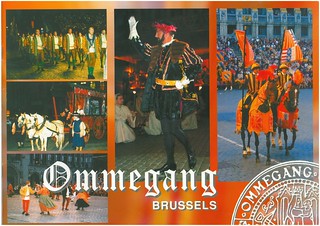
While we were in Brussels in 2005, Louise and I saw the enactment of the Blijde Inkomst from Charles the V in 1549.
Duchess of Brabant Johanna
| Born:June 24, 1322 Brussels |
|---|
| Father:John III, Duke of Brabant (1300 – 1355) |
| Mother:Marie d’Evreux. Died: 1335 Marriage parents: 1311 |
| Accession:Duchess of Brabant and Limburg since 1355 |
| Died:September 1, 1406 |
| Buried:Brussels, Carmelite Church |
| Marriages |
|
Duke Wenceslaus of Brabant
| Born:Prague, 25 February 1337 |
|---|
| Other names: |
| Father:John the Blind, King of Bohemia |
| Mother:Beatrix of Bourbon |
| Accession:Duke of Luxembourg from 1355, Duke of Brabant 1355/1356 |
| Died:Luxembourg, 7 December 1383. There are speculations that he might have died of leprosy (Johanna stayed in Brussels). His last wish was his heart to be displaced from his dead body and sent to his wife. |
| Buried:Orval |
| Marriages |
| Joanna, Duchess of Brabant (1322–1406) Married 1352 (15 years of age) |
Johanna being the eldest became the heir to the duchy after the death of her father in December 1355. Her first marriage to Willem II, Count of Holland and Hainault – brother of Philippa of Hainault, wife of Edward III – ended childless after his death in 1345 at the battle of Stavoren. This ended the hopes for a personal union between Brabant and Holland as Johanna remarries with the Duke of Luxembourg.
Interestingly, part of the marriage contract with Holland granted Joanna an annual pension of between 8-10.000 pounds, as she lived on for another 60 years, this often became an issue of dispute between the two countries.
The new European powerhouse of Luxembourg (whose dynasty at that time held the Holy Roman Emperor’s Crown) also forged its own relationship with the region. The marriage that was arranged for Wenceslaus (who at that time in 1351 was 14 years of age), he was the half brother of Charles I of Bohemia and Count of Luxembourg.
His grandfather was the Holy Roman Emperor Heinrich VII, his father the King of Bohemia was killed at the Battle of Crecy in 1346, and his niece Anne of Bohemia married the English King Richard II in 1382.
Jan III’s second daughter Margaretha (1323-1368) married Count Louis II of Flanders, the great-great-grandson of Guy de Dampierre, and his youngest daughter Marie (1325-1399) married Duke Reinald III of Gelre, son of Eleanor of Woodstock and grandson of Edward II.
The Count of Flanders now considered himself Duke of Brabant by right of his wife and invaded Brabant. This led to a succession war between Brabant and Flanders (1356-1357). However, he was unsuccessful. It is interesting to note that the daughter of Johanna’s sister Margaret would marry Philip the Bold, who eventually – through clever politics – would become the new ruler of Brabant.
In 1353 Charles entrusted Luxembourg, his father’s inheritance, to his half-brother Wenceslaus. In 1355 when Charles was elected Holy Roman Emperor he raised Luxembourg to the status of a duchy. He therefore became the first Duke of this territory. At the occasion of his marriage with Johanna he was also made Duke of Brabant.
In August 1356 Wencelaus called upon his half-brother the Holy Roman Emperor, Charles IV to support him by force of arms to fight Flanders.
In Maastricht, Charles met with the parties concerned, including representatives of the towns, and at the signing of the peace treaty in Aat in 1357, all parties agreed to change certain terms of the Blijde Inkomst, to satisfy the Luxembourg interests.
Chapter vii of de Blijde Inkomst was nullified, which stipulated that the Duchess Joanna, if childless, should be succeeded by her natural heirs—her sisters. This would mean that Brabant would fall into the hands of Luxembourg (Holy Roman Empire) and not into the hands of Flanders (France). However, the all important cities of Antwerp en Mechelen didn’t agree with.
So the plan was that by changing the Blijde Inkomst the Holy Roman Empire would eventually get control over Brabant. While this partly eventuated some 200 years later (Charles V), other intrigues stopped this from happening at this stage.
But more trouble continued, Wenceslaus also failed to prevent the seizure of Brussels by the Flemings supported by troops from Gelre and Gulik and he was made a prisoner in Ghent. This defeat on August 22, 1371 – at the Battle of Baesweiler (north of Aachen) – was a victory for the towns over the feudal nobility. Thereafter, Wenceslaus had to face continious internal disorders.
In the end Wenceslaus squandered the opportunity that he was given in 1357 to increase the influence of Luxembourg in this region.
On the positive side he was a great patron of the arts and established a court that in its splendour equaled that of the famous Burgundian court. By the 15th century the court employed some 250 people, while many were part of the household, it also included the staff and management of the administration, finances and jurisdiction. With its many functions, events and festivities it also was an economic engine for many of the people in town.
Wenceslaus died in 1383 and this put Johanna in awkward situation, she was running out of money and Gelre used the opportunity to invade Brabant (Gelre Wars).
She was advised by Thomas Aquino that the ruler was only allowed to raise taxes if they were used for the common good and in relation to war such taxes were only allowed to defend the country. The ruler also had to make sure that ‘good works’ had to balance the tax burden in order to balance the well being of her subjects.
She turned to Philip the Bold for assistance. He provided her with a considerable army during the wars in 1385-1390 and 1397-1399. This didn’t cost him much as a used as this was financed by the French Crown and taxed on the people of Brabant. While this didn’t deliver the military successes it increased Philip’s political power.
In 1390 the penniless Johanna secretly arranged with Philip the Bold the succession to Burgundy. Philips in turn paid off her debts to the various nobles she had borrowed from. In 1397 she also had to cede the incomes of Limburg. The old and dementing duchess was in 1404 no longer able to rule and handed the reign over to her sister Margaretha, who ten days later passed this on to her son who would after the death of Johanna become Duke Anton, the governor of Brabant.
The eventual acceptance of Burgundy as the new rulers was also favoured by the States-General of the cities of a nearly bankrupt Brabant. This happened when Johanna died in 1406 and in 1407 Brabant became a part of Burgundy.
The succession was not accepted by Sigismund of Luxembourg who in 1410 had become Holy Roman Emperor. This in turn led to decades of political interference, diplomatic missions and sometimes even wars. However, despite all of this Brabant ultimately stayed under Burgundian rule. The marriage of Philip the Good’s daughter Maria with Maximilian of Austria led to yet another twist in the ruling of this part of Europe when it finally under the Hapsburg emperor Charles V became part of the Hapsburg-Australian dynasty.
It was Johanna who in 1399 – during the Gelre wars – provided my home town Oss in Brabant its privileges.
Burgundian Rule
Philip the Bold cleverly recognised the independence required by Brabant and the political subtleties with the emperor and rather than putting Brabant directly under his control he appointed his younger son Anton as the new duke of Brabant. He married Johanna of Saint-Pol (Luxembourg). For the following few decades Burgundy was unable to take full control of Brabant, they were forced to install separate dukes in Brabant. Anton died at one of the battles of the Hundred Year War at Agincourt/Azincourt in 1415. He had arrived late at the battlefield where he on the side of the French fought the English. He didn’t wear his surcoat/over coat – which would have his coat-of-arms on it – and wore a herald’s tabard instead, he was captured but not recognized and had during the massacre its throat cut. High ransoms could be earned from captured nobles.
Anton left two under-age boys 12-year old John and 11 year old Philip of Saint-Pol.
John tried to use this opportunity to take over full control over Brabant; Sigismund however, vigorously opposed this move. The States of Brabant were able to use the stalemate and made the young John the new duke under their supervision. John IV married, in 1418, Jacoba of Bavaria, the heiress to Hainault, Holland-Zeeland.
This of course also weakened the independent position of these counties as they were drawn in closer into the Burgundian sphere. After the assassination of John the Fearless in 1419 it was Philips the Good who brought these lands permanently and firmly under his rule, as will be discussed below.
Nevertheless Brabant remained a vibrant region, in particular its cities Brussels, Antwerp, Leuven and ‘s-Hertogenbosch, and the enclave of Mechelen,

A clear reminder of the wealth of this land is its architecture of this period, known as Brabantine Gothic (1350 -1550), with cathedrals and town halls which are famous around the globe. During various visits we have visited many of these splendid building, including our very beloved Saint Jan cathedral in ‘s-Hertogenbosch (video clip) which I have been visiting ever since my childhood and hardly a visit to the Netherlands will pass without a visit to Our Lady of Den Bosch. Other highlights of Brabantine Gothic include: St Peter in Leuven, St Rombouts in Mechelen and St Gudula in Brussels. As well as the town halls and merchant houses around many a splendid square.
While all of the Brabantine Gothic buildings are exceptional, the church of Our Lady in Antwerp (Onze Lieve Vrouwe Kerk) is certainly ranking amongst the top. In 2005 we spend there several hours wandering and listing to the stories from one of those incredible knowledgeable local guides, what a privilege to walk into such a person
For a full overview of the developments of Brabant during Burgundian times see: Brabant under Burgundian rule.
The History of Northwestern Europe (TOC)