Introduction
Throughout history there has been tension between east and west. The first people who arrived in what is now Europe some 5000 years ago came from an area around the Caspian Sea. During the Greek period we saw battles between the Greek and the Persians. The Romans conquered large parts of the Middle East (which they called Asia) and while less successful the crusaders followed in their footsteps, however this time based on religion rather than pure conquest. On the other side, the Muslims conquered Spain and parts of what is now southern France and the Ottomans conquered Byzantium and the Balkans and stood in front of the gates of Vienna. The battles between east and west are still one of the major conflict trigger points of the 21st century. The Crusades should be seen in that context and were as such a series of cultural and religious motivated military conflicts. In particular they have to be placed in the context of the militant religious developments that were happening in Europe. The significant increase in religious activity also saw an explosion of church building, devotion, the worship of relics and so on.
With the collapse of the Carolingian Empire and soon afterwards the decline of the Byzantium Empire, other groups started to invade areas that had been under Christian rule. Muslims had already conquered Spain and started to invade Palestine and took Jerusalem, Vikings, Magyars and Slavs also created havoc in Europe.
The Muslim Conquest
What followed after Muhammad (570 -632) had united the Arab tribes is n one of the most remarkable conquest the world has ever seen. Coming from nowhere, within 50 years the Muslims had taken over the Persia Empire and Syria, North Africa and Spain from the Romans and thus created an instant new world power.
This also stopped the progress of Christianity, set in motion during Roman times. Most catholic communities in Syria, Middle East and North Africa converted to the Islam. The Coptic Church in Egypt was reduced to a fraction of its original size. Many of these Christian Churches were prosecuted by the orthodox Catholic Church who had declared Arians, Nestorians, Monophysists and Copts to be heretics. Until the Crusades were launched Islam was very tolerant to other religions and throughout the Arab world Christians, Jews and Muslims worked together in particular in areas of Science and Literature. They cooperated in the translation of the various classic works that were freely available to all religious during that period. Those three hundred years were also the Golden Age of Arab history. The Muslim Army also entered France as a represailles against the Emir of Catalonia and his supporter the Duke of Aquitaine. In 732 they were finally stopped during the battle of Tours/Poitiers by the army of the Frankish king Charles Martel.
Twenty years later, on the other side of the Empire at the battle of Talas (modern day Kazakhstan) the Muslims defeated the T’ang general Kao Hsien-Chih, however it at the same time it ended their conquest on the eastern side of their newly created empire. These two battles defined the extend of the Arab conquest. While the Roman Empire was severely effected by the conquest, the Chinese Empire remained unaffected by it.
Berber Muslim Spain was part of the Umayyad caliphs of Damascus and was named Al Andalus. But the Muslims here also had their own feuds and in 750 they were replaced by Abbasids of Baghdad. During another Muslim revolts a group of 15.000 Berber Muslims (Moors) had to flee Spain and went to Egypt where they were bribed to move on. They took Crete and this was felt as a threat by the Byzantine governor of Sicily. who in 823, sought the help of the Muslim ruler in Tunis, they were only happy to oblige but of course didn’t leave Sicily and also established a foothold in the boot of Italy. From here ravaging bands of Moors moved north, penetrating the mouth of the Rhone River and in 846 even sacked Rome. In 850 Emperor Louis, the son of Lothar I, was able to expel the Muslims from the heel of Italy.
Finally by the middle of the 11th century Arab power in Europe had been drastically reduced. The Normans had taken over most of the Arab territories in the Mediterranean (Sicily, Italy). And the Caliphate of Cordoba had disintegrated through internal fighting into many mini fiefdoms. From the north the Reconquista had started, putting further pressure on the Caliphate.
During the intervening centuries Muslims, Christians and Jews were peacefully living together in the conquered territories. However this was all to dramatically change and the legacy of what was about to happen is still reverberating in our modern times.
Fueled by the success in the Mediterranean further plans were developed to win back the lands conquered by the Muslims.
Increasingly within the Muslim world rival groups fought for control and in 1037 a Turkish based group Sunni Muslims, the Seljuk founded an empire stretching from the Hindu Kush to eastern Anatolia and from Central Asia to the Persian Gulf . They in turn were from around 1092 to 1265 challenged by yet another Muslim group the Assassins. In 1092 the famous Seljuq vizier Nizam al-Mulk was murdered by an Assassin in Baghdad. All of this played a role during the Crusades where rival parties were used by each other to gain an advantage in their campaigns. The Franks (history refers to the crusaders as Franks, as they were the ones who undertook the First Crusade) were able to conquer large swaths of what they called the Holy Land, as the Muslims were unable to muster a united force against them.
Other rival groups which were once part of the Seljuk Empire became more independent, the Mameluke were able to beat back the Mongols. They established the Mamluk Sultanate (1250–1517)in Egypt and Syria. They also fought the Crusaders effectively, driving them out of the Holy Land by 1291.
Another emerging Turkish power were the Osmans, who established in 1288 their own independent sultanate in northwest Turkey, they would take over the Mameluke and also conquer the rest of the Middle East, in North Africa they added Libya to their Ottoman Empire. In 1453 they successfully besieged Constantinople, which meant the final end of the Byzantine Empire. The Empire was eventually dissolved in 1918, after World War I.
If any lesson should be drawn from all of this is that all these crusades and conquest led to failure and to nothing but destruction and alienation between people.
The prelude to the crusades
Mass pilgrimages had already preceded the crusades, in particular the ones in 1033 and 1064 – many led by the poor – had attracted many thousands of pilgrims. Religious fantasies about Heavenly Jerusalem were dating back to Jewish times. In the simple minds of the poor it was easy to confuse the earthly promises of the ‘golden paradise’ with the spiritual notion of ‘Heavenly’ Jerusalem.
Once back in Europe many talked about atrocities again the Christian people by the Muslims in the Holy Land, this created fertile ground for religious actions these people. At a time when the Church went through reforms (Cluny) and revival, it felt on top of the world and was ready to spread its message by sword as well as by the holy scriptures. The afterlife was promoted at the most important goal and life and people would have to spend all their time to prepare for that and to ensure that they were cleared of any sins in order to enter heaven.
For this and other reasons Pope Alexander II declared in 1063 that anybody who died in fighting the Muslims (or the Saracens as they were called by the Europeans during the Middle Ages) would receive an indulgence, a full or partial remission of temporal punishment due to sins which have already been forgiven. Crusaders who would die in battle were promised to go straight to heaven. All of this fitted well in the infallible medieval belief. This offer was later also extended to the Teutonic Knights who were fighting the pagan Slavs and also those fighting heresy (eg the Cathars). In an era were faith was more important than reason this was a very powerful incentive, especially among the warring and murdering nobles who could in this way get an absolution for their sins. When the first crusade was declared thirty years later the system of indulgences was well established and participants were eager to earn them.
It has been argued that the crusades were simply a reason to divert public attention from deplorable internal affairs of the Church, the papacy was still recovering from the period of pornocracy. The indulgence system was a clever way of regaining control again. It also fitted in the Pope’s strategy to stop the ongoing wars (Peace of God) between the hundreds of dukes and counts in Europe.
But there were of course also other reasons for a crusade. By this time the Seljuks had taken control of the Holy Land. By 1068 they had neutralised the Byzantine Empire in the Middle East. In 1074 the Byzantine Emperor Michael VII send a letter to Pope Gregory VII asking him for assistance to fight the Seljuks. This was a rather surprise request as only 20 years earlier the Byzantine Church had broken with the Roman Catholic Church after the Great Schism that had occurred in 1054.
This was a perfect opportunity for the Pope to proclaim a crusade as by liberating Byzantium from the Muslims they could seize control and that would bring the Eastern Church back into the bosom of Rome.
All of these conflicting elements certainly played a role in the fact that the Crusades ended in so much disaster. From the First Crusade onward there was a serious conflict of interest between the Frankish (Latin) and Byzantium forces. But also within the Frankish forces there was not a lot of unity many of them often in conflict which others, rampaging through the region and establishing rival kingdoms. These conflicts of interest are perhaps the most important reason of the failure of the crusades.
Another question asked by historians is, how much the crusades had to do with defending the East or with solving problems in the West. It was not a coincidence that the Crusade was proclaimed in France, where the French king Philip I faced excommunication; it was suggested that the barons and princes should devote their forces to defend their brothers in the East. Flanders took a leadership role in the Crusades, as one of the richest emerging states in Europe they send a large number of crusaders and also Brabant took a relative large share in the expedites, In contrast the nobility in the northern part of the Low Countries – which stood under the influence of the German Emperor – were less enthusiastic. It was under the Flemish leadership that the First Crusade was won and this would be the only major success in all of the history of this sad series of enterprises.
Other circumstances included the limited influence of the Pope on the Catholic Church, the warring fractions in Rome and Italy in general and the political interest the Holy Roman Emperor started to show in the papacy. A century earlier the Cluniac reformation had started to address some of the structural problems of the Church and the reform mood was still alive. Not that the intentions for the crusades were not deeply motivated, but they did allow for defusing issues which otherwise would have been fought out in Europe
In the decade preceding the address of Pope Urban II in 1095, in Clermont where he preached the crusade, Flanders, northern France and Rhineland had gone through a time of severe hardship, since 1085 there had been constant floods followed by famine and plague.
The fact that the crusades were based on devotion rather than sound militarily planning, also made them in the end unwinnable. After the successes of the First Crusade, there was on ongoing chronic shortage of manpower. At is heights the Latin States together could field between 1750 and 1800 knights and about 10,000 infantry. However, there is no evidence that such a large force was ever brought together under a central ruler. Whatever success happened in consequence years was thanks to the Frankish rules of Jerusalem, they were men of energy and military ability. However, this was no longer a match when the Moslims finally were able to unite the various Syrian and Egyptian groups under Saladin. The end started with the huge losses on the side of the crusaders during the battle of Hattin in 1187. The only way the Christians would have had any chance of maintaining power in the Holy Land would have been through permanent migration and/or through ongoing strong military aid from the west; neither happened. In all reality and as a matter of fact it remains remarkable that against all odds, the crusaders were able to hold on as long as they did. [1. Warfare in feudal Europe 730-1200, John Beelen, 1971, p126-150]
Following the First Crusade subsequent popes didn’t support the popular crusades and urged the military leaders to take control. Only the Pope could sanction a crusade. However, this never led to a force big enough to maintain control over the Latin States.
It is also easy to see that spirited promotions of the crusades resulted in fanaticism that for example saw many Jews slaughtered by the ‘pilgrims’ on their way to the Holy Land as well as in cities such as Jerusalem where the three different religions had been, for centuries, living peacefully next to each other.
The concept of the crusades was so popular that dozens of them were proclaimed not just aimed at the Holy Land, but also against the Muslims in Spain (Reconquista), the Cathars in France, the Tartars, Slavs and Baltic people.
On the more positive side, the crusades played a key role in the re-discovery of the long lost knowledge from the Greek and Romans. Trade was another side effect of the crusades as well as the earliest form of tourism and international money transfer (Knights Templar).
Military Orders
The military orders were the first secular Catholic organisations, specifically founded for crusading; they are the combination of military and religious ways of life. Some of them, like the Knights of St John and the Knights of Saint Thomas, also cared for the sick and poor. However, they were not purely male institutions, as nuns could attach themselves as convents of the orders. One significant feature of the military orders is that clerical brothers could be, and indeed often were, subordinate to non-ordained brethren. The Hospitallers and the Knight Templar had together around 600 knights in their service. One could only be a member of one order. All crusaders wore a cloak with a cross on it, however the designs varied between the Orders. These orders stood directly under the control of the Pope. As a consequence the secular rulers of the Latin States could not recruit these knights, these rulers had negotiate the support of the orders. This independence of the orders weakened the overall military power of the Latin States,
After the First Crusade captured Jerusalem in 1099, many Christian pilgrims traveled to visit what they referred to as the Holy Places. However, though the city of Jerusalem was under relatively secure control, the rest of the Outremer (lands overseas) was not. Bandits abounded, and pilgrims were routinely slaughtered, sometimes by the hundreds, as they attempted to make the journey from the coastline at Jaffa into the Holy Land.
The orders became a favoured charity throughout Christendom, and the larger ones grew rapidly in membership and power. Non-combatant members of the orders managed a large economic infrastructure throughout Christendom, innovating financial techniques that were an early form of banking, and building many fortifications across Europe and the Holy Land.
In all over 30 military orders emerged during the Middle Ages. the Hospitallers and the Knights Templar became the two most powerful organisations.
Knights Hospitaller
In 600, Pope Gregory I commissioned he building of a hospital in Jerusalem to treat and care for Christian pilgrims to the Holy Land. In 800 Charlemagne enlarged the hospital and added a library. In 1005, Caliph Al Hakim destroyed the hospital. In 1023, merchants from Amalfi and Salerno in Italy were given permission by the Caliph Ali az-Zahir of Egypt to rebuild the hospital, it was rebuilt on the site of the monastery of Saint John the Baptist ( close the to Church of the Holy Sepulchre, at the square that is currently known as Muristan) and was served by Benedictine monks.
After the conquest of Jerusalem in 1099 during the First Crusade,the Blessed Gerard was allowed by a Papal bull of Pope Paschal II to found a new the Order, out of which two major Orders evolved, the Order of the Knights of St. Lazarus and the Order of the Knights of St. John, better known as the Knight Hospitaller. Initially their task was to look after the pilgrims, they also looked after the many injured crusaders and the Church of St John the Baptist was used as their hospital.
Gerard acquired territory and revenues for his order throughout the Kingdom of Jerusalem and beyond. His successor, Raymond du Puy de Provence, established the first significant Hospitaller infirmary near the Church of the Holy Sepulcher in Jerusalem (see videoclip). The current Muristan covers the extended are of the buildings of the Order, today only a small monument and a few inscriptions are all that reminds of that complex.
Only gradually did the Order become involved in military activities. After Jerusalem in 1187 had fallen to the Arabs under the leadership of Saladin and after the failed Third Crusade that ended in 1191, the Knights came to the conclusion that it was unlikely that this city would be recaptured quickly. Under the peace treaty between Saladin and Richard Lionheart the Christians received the small coastal stroke of Palestine – including Acre. As Guy de Lusignan and Henri de Champagne had provided the Knight with significant land grants in Acre and because of the important strategic position of this town the Order decided to built their new headquarters here, for the approximate 300 knights. The remains of their compound – a small city in its own – are recognised as World Heritage (see videoclip).
The city had become part of the Kingdom in 1104 when Baldwin I – in order to secure a good port needed for the essential communication with Christian states – conquered it with the assistance of the Genoese fleet; its official name given by the crusaders is: Saint-Jean d’Acre.
In 1191 the city became the new capital of the Kingdom of Jerusalem. Acre now entered its Golden Age and became one of the most important cities in the Middle East. The port brought significant wealth to its population. Other military orders such as the Templars, Teutonic Knight sand the Orders of st John and St Lazarus all establisher themselves in the city. The same applied to overseas city states and countries established their own compounds (khans). This wealth became also its downfall, as infighting and corruption became endemic. When a group Christians attacked and killed a group of Syrian traders the Mamluk army of Sultan Malik al-Ashraf besieged the city in 1291, which fell after 43 days, more then 20,000 of its citizens were killed. The knights were able to flee the city through a secrete tunnel (Templar Tunnel) to the harbour where they escaped by ship (see videoclip).
As mentioned before these Orders became the favourite charities for European nobles and enormous amounts of property and money was donated. In order to manage all these properties Europe was dived in eight ‘languages’. Each of them consisted out of one or more grand-priories, they in turn were split in commandries. The head of the Order was the Master who was elected for life by the brothers (knights, priests, servants and nuns – the latter in a separate convent). Daily life was in the hand of the prior and military affairs under the control of the marshal. They also had their own navy under the control of the admiral.
The Order, already in its early stages, had its own centre in the Low Countries; perhaps as early as 1122 did it receive property in Utrecht where the Saint Catharijne (Catherine) monastery and a hospital was build. If this date is correct it was the oldest centre of the Hospitallers north of the Alps. From here six new establishment were founded in Ermelo, Haarlem, Tiel, Middelburg, Werendike, Domburg and Oudewater. At the start of the 14th century another six commandries followed in Kerckwerve, Woerden, Harmelen, Buren, Anhem and Nijmegen.
After the loss of the Holy Land the order sought refuge in the Kingdom of Cyprus. However, they soon after that went to the Greek Island of Rhodes. Here they were evicted by the Ottomans in 1522. In 1530 Charles V granted the Hospitallers the island of Malta, basically to keep the western Mediterranean free of the Muslims. They did so by attacking Muslim traders, confiscating their goods and selling it; the crew were sold as slaves.
They successful withstood the Siege of Malta in 1565 under the Grandmaster Jean Parisot de la Valette. The Ottoman suffered an other naval defeat in 1571 at the Battle of Lepanto in Greece and this basically ended their expansion in Europe. With no military function left the Hospitallers basically became the pirates of the Mediterranean. They maintained their feudal system with basically all of the people of Malta being their serfs. This ended with the invasion of Napoleon in 1799 – on his way to Egypt – he ended also this part of the ‘Ancient Regime’. In 1802 the island was taken over by the Brits and in 1964 Malta became independent.
Recently the Hospitallers returned as a charity organisation under the name of the Sovereign Military Order of Malta; they are still recognised as a sovereign international organisation.
Knights Templar
Around 1119, two veterans of the First Crusade, the French knight Hugues de Payens (from Champagne) and his relative the Flemish Godfrey de Saint-Omer, proposed the creation of a monastic order for the protection of these pilgrims. Saint-Omer is close to Boulogne and this is were Baldwin of Boulogne and his brother Godfrey of Bouillon came from, leaders of the First Crusade. So there most certainly this region and its leaders were key to the leadership of the crusaded. Furthermore their overlord Count Robert of Flanders – he himself an early Jerusalem pilgrim as well as a participant in the First Crusade was also a great supporter of the crusade movement
It is also no wonder that King Baldwin II of Jerusalem agreed to the request of the creation of the military order and gave them space for a headquarters on the Temple Mount, this is were today stands the Al Aqsa Mosque. The Temple Mount had a mystique, because it was above what was believed to be the ruins of the Temple of Solomon. They were also put in charge of the protection of the Holy Sepulchre. Godfrey of Bouillon had already established the canons of Holy Sepulchre and this now further boosted this institution.
Hugues became the first Grand Master of the Order. They initially followed the Rule of Saint Augustine and the traditions of the Canons of the Holy Sepulchre. Together with the politically engaged Saint Bernard of Clairvaux, he created the Latin Rule – the code of behavior – for the Order, which was confirmed at the Council of Troyes in 1129. This was not an easy achievement as the Church did have problems with the integration of the military with he monastic elements. This was a key reason for the conflict that reamined in place between two of the most influencial Christians of the time St Bernard and Peter the Venerable. Over time the Templars were no longer simply protecting the pilgrims but also became an active military force of the Kingdom of Jerusalem and participated in the crusades.
They were known as the Poor Fellow-Soldiers of Christ and of the Temple of Solomon (Latin: Pauperes commilitones Christi Templique Solomonici), commonly known as the Knights Templar. According to legend, Hugues and Godfrey were so poor that between the two of them they had only one horse, and this gave rise to the famous image on the seal of the Templars, of two men riding a single horse. For the first decade the knights wore rags and cast-offs.
On his visit to Flanders, England and Scotland in 1128, he raised men and money for the Order, and also founded their first House in London the area here is still known as Temple. Count Willem Clito of Flanders donated a range of financial privileges that provided the Order with significant ongoing income. In 1142 Duke Godfrey II of Brabant provided similar privileges to the Knights and this formed the basis for the first Commandry in Brabant in Brakel (Alphen). Two years later followed by donations from the Lord of Breda. [2. Krijgers voor God, Michel Nuyttens, 2007]
St Bernard also twice toured Flanders which resulted in a boost of further funds for the Knights.
During their heydays they had over 1,000 commandries in Europe, at least 800 of them in France, 60 in the Low Countries, 40 in England and Scotland and 36 in Germany and all along the pilgrim routes to the Holy Land. On average a commanadry would only have a few Templars, there would only have been a few with maximum 20 members. At that time they could mobilise over 600 knights and 2,000 sergeants. Throughout their vast network they had 7000 members of which 3000 of them were in France. From the 13th century onward they also had their fleet of ships, mainly around the Mediterranean.
The Order consisted of four classes:
- The knights, fratres milites (fighting brothers) – original of noble origin.
- The chaplains, fratres capellani (praying brothers) – spiritual elite and in charge of the Order’s (secret) knowledge.
- The squires and heralds, fratres servientes (serving brothers) – they wore black mantles.
- domestics, agriculture workers, servants and craftsmen, fratres famuli et officii (working brothers) – they wore blue or brown livery. They were further divided in freeman, vassals and masters.
From the outset their activities were military and unlike the Hospitallers, who evolved from a ‘caring’ background. Unfortunately through its activities in the Holy Land they were unable to claim one single military victory of their own. This is not necessarily a sign of their weakness but of the hopeless mess in which the crusades were organised and executed as mentioned in the introduction. Another contributing factor could have been the lack of strong governance and unity within the Latin States and the rivalry between the Military Orders and also within the Order itself. Nevertheless the lack of victories also led to questions about the enormous costs of this war effort with little result to show for.
Another observation is that while the Order was rich in resources and very busy with all of the affairs in relation the management of their large number of properties, there was a constant shortage of manpower, horses and supplies in the Holy Land.
Because of their richness they became key bankers to the various kings, counts and dukes and even the pope. They also had a large treasure of jewels, valuable artifacts and money which was manged by their treasurer. This richness also led to envy which led to speculations regarding their activities.
The fall of Acre in 1291 became the death nail for the Knights during the siege its Grand Master Guilaume de Beaujue – a nephew of the Flemish Countess Margareta of Constantinople – was killed. the Knights consequently withdrew to Cyprus. The less capable Jacques the Molay was elected as the new Grand Master.
When the Holy Land was lost, support for the Order faded. More rumours about the Knights emerged such as secret initiation ceremony this only fueled the mistrust. King Philip IV of France, deeply in debt to the Order, took advantage of the situation and started to plan a campaign that would lead to the persecution of the Knights. He was among others supported in this by the Duke Jan II of Brabant. In 1307, many of the Order’s members in France were arrested. The Pope was also pressured into condemning the Knights. Eventually they were tortured into giving false confessions, and then burned at the stake. Under pressure from King Philip, Pope Clement V disbanded the Order in 1312. See also: The battle between religion and state. A large number of their properties were handed over to the Hospitallers also, many of the knights who escaped the prosecution joined the Hospitallers.
In October 2007, the Roman Catholic Church acknowledged that the Knights Templar were innocent. The announcement was made seven days before the 700th anniversary of the persecution of the Order.
In 2009 we visited the Templar chapel from the 12th C. in Metz, France. Once part of the Templar commandry of Metz, the oldest Templar institution of the Holy Roman Empire.
Teutonic Knights
This crusading order was established in 1190 by Duke Frederik von Swaben and attracted crusaders from Bremen and Lübeck. Their main task was to look after sick and injured crusaders and protect the pilgrims on their way to the Holy Land, they operated hospitals in Jerusalem and Acre. Their full name is Ordo fratrum hospitalis sanctae Mariae Theutonicorum lerosolimitanorm (Order of the brothers of the hospital of the Holy Maria of the Germans in Jerusalem). See video clip Jerusalem.
In 1199 Pope Innocent III had proclaimed the crusade against these Slavic ‘heathen’; which was not much more than providing the German Emperor with a blank cheque to kill anybody who stood in his way to conquer these new lands (Drang nach Osten) . After the loss of Jerusalem in 1291, the activities of the Order were diverted from the Holy Land to the Baltic. During the next two centuries century, large groups of nobles, many from Brabant, Flanders and Holland spent their lucrative winter campaigns in the Baltic region. The political structures in the region were severely weakened after the many invasions of the Mongols and the Tartars and the crusaders had a reasonable easy conquest. The Land of the Rus (Kievan Rus) – the major regional powerhouse during the High Middle Ages – had collapsed into many small principalities. Eventually the principality of Moscow started to rebuild the power in this region, especially after the fall of Constantinople when it became the seat of the Eastern (Greek) Orthodox Church. Ivan III proclaimed himself the successor of the Byzantium emperors.
In the meantime however, the crusaders took over Prussia, Silesia, and the various tribal areas in what is now Latvia and Estonia.
The crusade and the many donations its received for it, made the Order – that only consisted of knights from the nobility – extremely rich and it was at that time perhaps the largest multinational in the world. Their extensive network included hundreds of commandries in North and Middle Europe, each one of them easily owning and managing the income of ten or more local farms in their areas. In this process thousands of new villages were founded by the Order and the migrants who followed in their wake, some of the place names in this area still remain to this period.
Th Order received from the Church a monopoly on these international activities directed to the Baltic region. Most of their goods and produce from these ventures ended up in the largest port of that time Antwerp, where the Order had its own trading offices in the castle Gravensteen, they also had their own offices in Brugges.
One of those donations involved Haren a little village in the County of Megen, 5 kms north of Oss. Since time immemorial the tithes of the parish went to the Church of the Holly Cross in Liège. In 1426 these were handed over to the Order. Until 1803 priests of the Order held the office of Pastor of Haren, they operated from the Commandery of Germert.
At the start of the 16th century the order had 19 commandries in the Low Countries alone, they were were led from the head quarters (balije) in Utrecht: Middelburg, Katwijk (Valkenburg), Leiden, Maasland, Schoonhoven, Schelluinen, Tiel (Hemert), Rhenen, Doesburg, Dieren, Ootmarsum, Nesse, Schoten (Schoterburen), Steenkerk, Bunne (Bonne), Vught, Gemert, Gruitrode and Maastricht.
The Teutonic Crusades reached their peak in the late 14th century, when the Knights were able to convert Lithuania to Catholicism. However, soon after, Lithuania and Poland united their military forces and took on the Teutonic knights. They crushed them at Tannenberg killing their Grand Master and 400 of the knights. The Knights were severely weakened by this and their expansion came to an end. In 1525 the Grand Master – after consultations with Martin Luther in person – converted to Protestantism. After that the Order rapidly lost control over its pocessions, with Denmark, Sweden, Poland and Russia becoming more and more prominent. However, individual member of the various noble German families held on the key positions throughout the region till 1918. Amongst them were also several members of the Budde family.
Commandry in Ootmarsum
A commandry is the smallest administrative division of an estate under the control of a commander (komtur). They received their income from land, properties and rights donated to them by the rulers of the day. Because of their religious nature they often had rights to the income of church properties. Ootmarsum was one of the largest and richest of Westphalia (the region of the Teutonic Order it belonged to).
In 1262 a number of domains in east Twente were donated – by the Bishop of Utrecht Henry of Vianden- to Liefaard a citizen from Oldenzaal who established the Commandry in Ootmarsum for the Order which was headquartered in Utrecht (established in 1231), these donations paid for the foundation. Further donations were made by the ministerealen (wardens of the biship) Frederik van Arreth and Hendrik van Almelo as well as through land purchases from the families Bonnike and Voet. Properties belonging to Ootmarsum included: Ostertun and Sumbeke. Thye and Holtwijk in Groot Agelo, Sanderink, Gesteren and Hubboldingh inVolte, Lutteke Onland near Oldenzaal, Eilardinck in Oldenzaal, Leverinck in Reutum, Meijnardingh in Agelo, Herscopingh in Rhige (Bentheim), Enghet and Borchgrevink in Tilligte, Haselhorst in Den Ham, Klarink in Klein Agelo, Iland in North Deurningen, Kruuselt in De Lutte, Loveling in Rossum as well as tithes over properties from Bodde, Elferink and Kuks in Old Ootmarsum and Aarnink in Tilligte [3. Vechtmonikken en islambestrijders in Ootmarsum, R.A. Olde Dubbelink, 2009]
In 1270 Egbert van Bentheim becomes a knight of the Order and soon after that Commander. It resorted till 1420 under Utrecht, but because of ongoing disputes between the regional headquarters of the Order in Utrecht and Westphalia it was swapped with the Commandry of Tiel. Since that year Ootmarsum was placed under the management of Münster and Tiel became part of Utrecht. The complex in Ootmarsum was a large area surrounded by a moat with a main building and several trade buildings, after 1420 it was expanded with a chapel and two watermills, the little house that belonged to one of mills is the only reminder of a complex that at is height occupied more land than the rest of the town.
The enormous wealth of the Order saw their attention moving from the sick to property management. Their Commanders were part of the nobility. The Commander in Ootmarsum also became a member of the Provincial Ruling Nobility of Overijssel (this political institution was formalised in 1663).
Ootmarsum was strategically positioned on the east-west route from Antwerp and later also Amsterdam to Utrecht and from here to Munster and into Prussia. The house where later the Budde family lived in Ootmarsum was situated next to the old city gate and the bell that has been put there by my grandfather is a reminder of the gate and its function.
After the Reformation the Commandry went into private ownership. This was a very serious loss to the Order and in particular to Münster who received significant income from this property. The Commander at that time became the first secular knight occupying the buildings is Johan Dietrich von Heyden from Westphalia. In 1754 the Commandry became the seat of the Bailiff (Drost) of Twente. The von Heyden’s were able to obtain this lucrative administrative and legal (appeal) office. While his local influence was rather limited, his political influence was considerable and as an appellation court they had at least some control over the city.
The Commandry was rather reclusive and very few people from within the town had access to the castle like building. The property fell into serious decay and was sold in 1811 by public auction and later demolished [4. Het Drostenhuis in Ootmarsum, 2009]
The First Crusade 1095 – 1099
The First Crusade was formally announced by Pope Urban II at Clermont in 1095.
There were massive social and economic changes happening in western Europe including a large increases in population and a rapid migration from the land to the cities. This led to wealth but also to extreme poverty of the underclass. These people were an easy target for fanatic ‘holy men’ who emerged all over the continent. The reforms of Cluny had put new life in the Catholic Church and this had created a religious revival. There were plenty of religious and semi religious people who used this revival to preach the salvation that God had specifically set aside for the poor; the masses didn’t need to be reminded about the extreme difference in wealth between them and the clergy and the nobility. They preached that these crusades belonged to them as they, by God, were promised salvation. They were whipped up to ‘liberate’ the holiest city in the world, ‘Heavenly’ Jerusalem, the ‘golden paradise’.
This reform movement would be further strengthened by a new wave of reform instigated by the Cistercians (named after their monastery Citeaux) under the leadership of Bernard of Clairvaux, as we saw above he was instrumental in establishing the Knights Templar.
But a couple of decades before that happened, Peter the Hermit and Walter the Pennyless gathered resp. 40,000 and 20,000 paupers (as they were known as in the church documents) as crusaders and traveled with them to the Holy Land. Most never came close as their rampaging and stealing brought them in conflict with the people that lived in the lands they traveled through. The remnants of the groups who made it to Constantinople , were massacred just outside the city by the army of the Seljuks. Other groups followed (15,000Germans and another mob of 20,000 paupers from France, Flanders, England and Lorraine) they encountered the same faith, but not after they had killed many Jews on their way in Rhineland. Eventually the last remaining pauper crusaders of these groups were killed in Hungary for similar reasons as mentioned before.
Eschatology (dogmas regarding the end-time) and chiliasm (the fight against the Antichrist and the promise of a thousand years of earthy paradise) were powerful tools used by these holy men to harness the masses. This powerful mix of salvation and material gain through raids saw uprisings throughout Europe, in particular the Jews suffered from attacks by these mobs.
It was clear that the paupers would not be able to succeed without military assistance, the Pope had aimed his call for the crusade to the Christian kings, counts and dukes – the Pope also actively tried to stop the paupers from participating in the crusade. Again within the spirit of the religious revival the nobility was inspired by that fact that by participating in the crusades their many sins would be forgiven and they would receive eternal salvation.
It was also no coincidence that the Pope proclaimed the First Crusade in the land of the Franks, they were the emerging power and the Flemish nobles played a leadership role in this movement.
Godfrey of Bonen better known as Bouillon became the leader of the First Crusade. He took out loans on most of his lands, or sold them, to the bishop of Liège and the bishop of Verdun. With this money he gathered thousands of knights to fight in the Holy Land. In this he was joined by his older brother, Eustace, and his younger brother, Baldwin of Boulogne, who had no lands in Europe. He also gathered around him other nobles from the Bonen and St Omaars region in what is know north eastern France. First crusader Godfried van Omaars would become the co-founder of the Knight Templar.
The region in and around Brabant proved to be fertile grounds and many Brabantines took up the Cross and as we will see below and followed some of their leaders to the Holy Land. Especially the First Crusade saw a large contingent from the Franks. This also had to do with the fact that Pope Urban II was borne in the region, in Marne. The East Frankish Emperor Henry IV was supporting an anti-pope at the time and therefore was less supportive of the Crusade. Therefor, nobles and people from the north-western corner of Europe were active participants. Brabant, Rhineland and Holland but in particular Flanders played a key role.
Godfrey of Bouillon did also receive the support for his crusade from some of the local lower nobilities, the included Grutmannus from Brussels, Theobald from Nivelle and Count Werner from Graven as well as individuals from the Ardennes, Flanders, Hainault and Luxembourg.
The major participants of the First Crusade were:
- Godfrey of Bouillon (see below).
- Raymond of Saint-Gilles, also known as Raymond IV of Toulouse. Adhemar, the assistant to the Pope and bishop of Le Puy, travelled with him.
- Bohemond, a Norman knight who had formed a small kingdom in southern Italy.
- Robert of Flanders (See also: Flanders).
Those who participated in the crusades had to be certain that their properties would still be untouched on their return. This required them to settle disputes and establish testaments. For this purpose the concept of the Peace of God (Pax Dei) was used by the nobles. This was monitored by the local bishops and offenses were severely punished.
Godfrey started in August 1096 at the head of an army from Lorraine. He was the second to arrive (after Hugh of Vermandois) in Constantinople.
With Byzantine soldiers at their side, as well as the tens of thousands of paupers who in one way or another had been able to make so far, their first major victory was at the city of Nicaea, close to Constantinople, which the Seljuk Turks had taken some years earlier. Godfrey played a minor role in this siege. In 1098 he took part in the capture of Antioch, which fell in June of that year after long and bitter fighting.
He continued to play a minor role in some of the following the battles against the Muslims until the Crusaders finally reached Jerusalem in 1099.
It was in Jerusalem that the legend of Godfrey of Bouillon was born. The army reached the city in June 1099 and built wooden ladders to climb over the walls. The major attack took place on July 14 and 15. Godfrey and some of his knights were the first to get over the walls and enter the city. Once inside, the Crusaders went wild against the besieged, ultimately killing many in the city. Jews were also killed. It was an end to three years of fighting by the Crusaders, but they had finally done what they had set out to do in 1096—namely, to recapture the Holy Land.
Once the city was captured, some form of government had to be set up. On July 22, a council was held in the Church of the Holy Sepulchre. Godfrey, who had become the more popular leader accepted the position as secular leader, but with an unknown or ill-defined title.
During his short reign of a year Godfrey had to defend the new Kingdom of Jerusalem against Fatimids of Egypt, who were defeated at the Battle of Ascalon in August. He also faced opposition from Dagobert of Pisa, the Byzantium Patriarch of Jerusalem.
In 1100 Godfrey was unable to directly expand his new territories through conquest. However, his impressive victory in 1099 and his subsequent campaigning in 1100 meant that he was able to force Acre, Ascalon, Arsuf, Jaffa, and Caesarea to become tributaries.
“While he was besieging the city of Acre, Godfrey, the ruler of Jerusalem, was struck by an arrow, which killed him,” reports the Arab chronicler Ibn al-Qalanisi. Christian chronicles make no mention of this; instead, Albert of Aix and Ekkehard of Acra report that Godfrey contracted an illness in Caesarea in June, 1100. It was later believed that the emir of Caesarea had poisoned him, but there seems to be no basis for this rumour. It is also said that he died after eating a poisoned apple. He died in Jerusalem after suffering from a prolonged illness.
Godfrey of Bouillon has arguably been the only successful crusader ever and this saw the start of long term involvement of Flemish nobles in the Holy Land with titles such as Kings of Jerusalem and Emperors of the Latin Empire of Constantinople.
The Nine Heroes
The Nine Worthies or Nine Heroes are nine historical, scriptural and legendary personages who personify the ideals of chivalry and virtue. The study of the life of each would thus form a good education for the aspirant to chivalric status. The Nine include three good pagans: Hector, Alexander the Great and Julius Caesar, three good Jews: Joshua, David and Judas Maccabeus, and three good Christians: King Arthur, Charlemagne and Godfrey of Bouillon.
In 2012 I saw the tapestries of these Nine Heroes in The Cloisters in New York City. These tapestries were most likely designed in Paris and produced in Brussels between 1400 and 1410. See videoclip.
Godfrey’s younger brother, Baldwin, didn’t move with him to Jerusalem, instead he decided to stay in the north at the Crusader state he had established at Edessa.
Caesarea
Caesarea is believed to have been built on the ruins of Stratonospyrgos (Straton’s Tower), founded by the Hellenistic ruler Straton I of Sidon, and was likely an agricultural storehouse in its earliest configuration. In 90 BC, Alexander Jannaeus captured Straton’s Tower as part of his policy of developing the shipbuilding industry and enlarging the Hasmonean kingdom. Straton’s Tower remained a Jewish city for two generations, until the Roman conquest of 63 BC when the Romans declared it an autonomous city. The city underwent vast changes under Herod the Great, who renamed it Caesarea in honour of the Roman emperor, Caesar Augustus.
In 22 BC, Herod began construction of a deep sea harbor and built storerooms, markets, wide roads, baths, temples to Rome and Augustus, and imposing public buildings. Every five years the city hosted major sports competitions, gladiator games, and theatrical productions in its theatre overlooking the Mediterranean. Caesarea also flourished during the Byzantine period..
Following the First Crusade, Baldwin I took the city in 1101.The city was strongly refortified and rebuilt by the Crusaders. Saladin retook the city in 1187; it was recaptured in 1191 by Garnier de Naplouse the 9th Grand Master of the Knights Hospitaller. In 1251, Louis IX fortified the city. The French king ordered the construction of high walls (parts of which are still standing) and a deep moat. The city was finally lost in 1265 this time to the Mamluks..
After Godfrey’s death Baldwin was crowned as the first Latin king of Jerusalem on December 25, 1100. He was one of the most effective rulers of the crusades era and consolidated Frankish rule following the immediate period after the First Crusade. Under his military leadership cavalry and infantry were much better aligned, which led to many successes in the first part of the 12th century. He died childless in 1118 and his cousin Baldwin of Rethel (Ardennes) became his successor as Baldwin II of Jerusalem.
His eldest daughter Melisende took over the reigns of the kingdom in 1131 and as a regent of her son remained in power until 1161. However, the real power lay in the hands of her husband Fulk of Anjou, a skilful crusaders and military commander. However palace intrigue saw Fulk trying to discredit Melisende in an effort to change the balance of power from the Frankish crusaders nobility to those from Anjou. He did not succeed and from 1135 onwards Melisende’s supporters had the upper hand again, after the death of her husband in 1143 her victory was complete.
Throughout its 200 year of history the crusader’s state (the Kingdom of Jerusalem) was not much more than a collection of towns; its total size was roughly the same as modern day Israel and Palestine combined. During this period the state was in constant battle with its surrounding rulers; when they eventually combined their forces the end of the Kingdom was in sight.
Krak des Chevalier
Raymond of Toulouse operated in January 1099 in the narrow pass between the Syrian planes and the Mediterranean. On the basalt hills overlooking the pass was a Muslim fortress known as Hisn at-Akrad, the Castle of the Kurds. Raymond successfully attacked the castle and took possession on February 2nd. As the real target of the crusade was the capture of Jerusalem, the fortress laid idle until 1110. Crusader Knight Tancred the Norman had become the Prince of Antioch and had established a fiefdom ‘Crat’ around the ‘Castle of the Kurds’. Most likely rather limited new buildings and new defense walls had been added and in 1144 he granted the castle to the Knights Hospitaller as their principal base on Tripoli’s eastern frontier. Severe earthquakes in 1157 and 1170 totally destroyed the caste and the Hospitallers had an opportunity to built a modern castle from scratch. Sultan Saladin the Great besieged the castle in 1180 and 1188 but was unsuccessful. Another massive earthquake hit the area in 1202 and caused severe damage to the fortress. This triggered another building campaign. The garrison now counted some 2,000 men. However, by 1250 the Muslim attacks on the Holy Land had seen them making significant gains and the writing was on the wall for the crusaders; the end of the Hospitallers at Krak des Chevalier as the fortress had become to be know was nearing. Finally it was Sultan Baybars, the ruler of Egypt who besieged Krak and in 1271 the Knights surrendered. It remains currently largely in the state of when the Hospitallers left and is one of the best preserved medieval castles in the world.

The Latin States
The Latin crusader states were created immediately after the First Crusade:
- County of Edessa
- Principality of Antioch
- Kingdom of Jerusalem
- County of Tripoli
The following information on the Latin States is abstracted from Wikipedia.

County of Edessa
As mentioned above, in 1098, Baldwin of Boulogne left the main Crusading army to look after his own interest. He went first south into Cilicia, then east to Edessa, where he convinced its lord, Thoros, to adopt him as son and heir. Baldwin indeed succeeded Thoros as ruler, taking the title of Count (having been Count of Verdun as a vassal of his brother in Europe). In 1100, Baldwin became King of Jerusalem when his brother, Godfrey of Bouillon, died. The County of Edessa passed to his cousin Baldwin of Bourcq. He was joined by Joscelin of Courtenay, who became lord of the fortress of Turbessel on the Euphrates, an important outpost against the Seljuk Turks. The Frankish lords formed a good rapport with their Armenian subjects, and there were frequent intermarriages; the first three counts all married Armenians. Count Baldwin’s wife had died in Maraş in 1097, and after he succeeded to Edessa he married Arda, a granddaughter of the Armenian Roupenid chief Constantine. Baldwin of Bourcq married Morphia, a daughter of Gabriel of Melitene, and Joscelin of Courtenay married a daughter of Constantine. The county never attracted more than 100 European nobles and knightly families, it lasted until 1149.
The Principality of Antioch
This included parts of modern-day Turkey and Syria. It extended around the northeastern edge of the Mediterranean, bordering the County of Tripoli to the south, Edessa to the east, and the Byzantine Empire or the Kingdom of Armenia to the northwest, depending on the date. It had roughly 20,000 inhabitants in the 12th century, most of whom were Armenians and Greek Orthodox Christians, with a few Muslims outside the city itself. Most of the crusaders who settled there were of Norman origin, notably from the Norman Kingdom of southern Italy, as were the first rulers of the principality, who surrounded themselves with their own loyal subjects. Few of the inhabitants apart from the Crusaders were Roman Catholic even though the city was turned into a Latin Patriarchate in 1100. It has been estimated that the principality was able to muster about 700 knights and 3000 foot soldiers.[5. Warfare in feudal Europe 730-1200, John Beelen, 1971, p123]
Kingdom of Jerusalem
It was established in the Southern Levant in 1099 and lasted nearly two hundred years, from 1099 until 1291 when the last remaining possession, Acre, was destroyed by the Mamluks, but its history is divided into two distinct periods. The sometimes so-called First Kingdom of Jerusalem lasted from 1099 to 1187, when it was almost entirely overrun by Saladin. After the subsequent Third Crusade, the kingdom was re-established in Acre in 1192, and lasted until that city’s destruction in 1291. This second kingdom is sometimes called the Second Kingdom of Jerusalem or the Kingdom of Acre, after its new capital. There were also many vassals of the Kingdom of Jerusalem, the four major lordships (seigneuries) being:
- The Principality of Galilee
- The County of Jaffa and Ascalon
- The Lordship of Oultrejordain
- The Lordship of Sidon
It has been estimated that the principality was able to muster between 100- 1000 knights and perhaps 5000 foot soldiers.[6. Warfare in feudal Europe 730-1200, John Beelen, 1971, p124]
County of Tripoli
It was founded in 1104, with Tripoli itself conquered in 1109 and lasted until 1289, it was the last of the Crusader states. It covered the modern-day region of Tripoli, northern Lebanon and parts of western Syria which supported an indigenous population of Christians, Druze and Muslims. When the Frankish forces), captured the region in 1109, Bertrand of Toulouse became the first Count of Tripoli. He was a vassal of Baldwin I of Jerusalem. From that time, rule of the county was decided not strictly by inheritance but by factors such as military force (external and civil war), favour and negotiation. In all the County will have had around 200 European nobles and knightly families. They were required under certain circumstances to provide 100 knights to the kingdom of Jerusalem.
In 1289, the County of Tripoli fell to Sultan Qalawun of the Muslim Mamluks of Cairo. The county was absorbed into Mamluk Egypt.
Armenian Kingdom of Cilicia
This had its origins before the Crusades. During the time of the Crusades, the area was controlled by the Armenian Kingdom of Cilicia. The Seljuk Turkish invasions of Armenia were followed by an exodus of Armenians migrating westward into the Byzantine Empire, and in 1080 Ruben, a relative of the last king of Ani, founded in the heart of the Cilician Taurus a small principality which gradually expanded into the Armenian kingdom of Cilicia. This Christian state, surrounded by Muslim states hostile to its existence, had a stormy history of about 300 years, giving valuable support to the crusaders, and trading with the great commercial cities of Italy.
Gosdantin (r. 1095 – c. 1100) assisted the crusaders on their march to Antioch. Thoros I (r. c. 1100 – 1129), in alliance with the Christian princes of Syria, waged successful wars against the Byzantines and Seljuk Turks. Levond II (Leo the Great (r. 1187–1219)), extended the kingdom beyond Mount Taurus and established the capital at Sis. He assisted the crusaders, was crowned King by the Archbishop of Mainz, and married one of the Lusignans of the crusader kingdom Cyprus.
Hetoum I (r. 1226–1270) made an alliance with the Mongols, sending his brother Sempad to the Mongol court to submit in person.The Mongols then assisted with the protection of Cilicia from the Mamluks of Egypt, until the Mongols themselves converted to Islam. When Levond V died (1342), John of Lusignan was crowned king as Gosdantin IV; but he and his successors alienated the native Armenians by attempting to make them conform to the Roman Church, and by giving all posts of honor to Latins, until at last the kingdom, falling prey to internal dissensions, succumbed in 1375 to the attacks of the Egyptian Mamluks.
The second crusade 1147 – 1149
In 1144 the Crusaders State of Edessa was besieged and Melisende send and army to assist, she also asked the Pope for assistance.
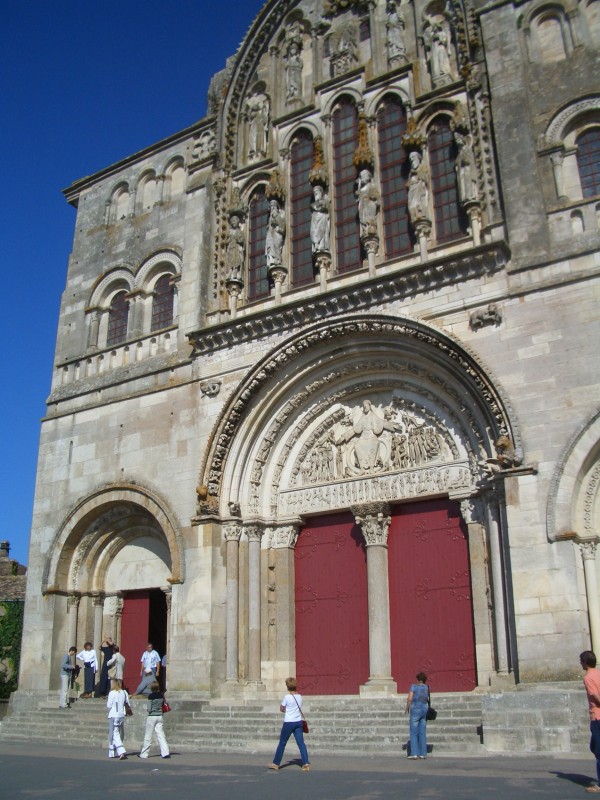
At Easter 1146 the Cistercian monk Bernard of Clairvaux launched the campaign for the 2nd crusade from Vézelay Abbey, this abbey was founded in 860 by Girart of Roussillon and was subjected by him and his wife to the apostolic see – most monasteries during the Merovingian and Carolingian period were subjected to the king. It was therefore no surprise that Vézelay was chosen by the pope to launch the campaign.The campaign was led by King Louis VII of France together with his wife Eleanor of Aquitaine and Holy Roman Emperor Conrad III. Eleanor took a leadership role in this campaign. She assembled some of her royal ladies-in-waiting as well as 300 non-noble vassals. The launch of the Second Crusade from Vézelay, the rumored location of Mary Magdalene´s burial, dramatically emphasized the role of women in the campaign.
Unfortunately Louis was a weak and ineffectual military leader with no skill for maintaining troop discipline or morale, or of making informed and logical tactical decisions. They stranded in Antioch – ruled by Eleanor’s flamboyant uncle, Raymond of Antioch – and failed to capture Damascus in 1147 and this left the Crusader States significantly weakened. Eleanor was severely disappointed with her husband’s performance, they traveled back on different ships and she divorced him as soon as they were back in France.
This failure set the scene for the Muslim successes during following campaigns. They were able to recapture Jerusalem from the Christians in 1187. The Kingdom was now reduced to a strip of land along the Mediterranean coast line, ruled from Acre.
The only success of this crusade was that the contingent of northern forces (Flemish, Frisian, Norman, English, Scottish and German crusaders) travelling towards the Holy Land stopped in Portugal and were able to expel the Moorish occupation force.
Bernard of Clairvaux fell greatly humiliated by the disaster of the Second Crusade and apologised for the sins of the crusaders which were the cause of their defeat. He tried to dissociate himself from the fiasco, he never recovered from this defeat and died in 1153.
In the meantime the situation in the Holy Land was again left in the hands of Melisende as well as her son Baldwin. There was no large support effort from Europe any more, only an occasional small group of crusaders on pilgrimage arrive to assist in a local battle, there never was a shortage of fights.
The relationship between mother and son was complex and not always easy, at a certain stage the kingdom was involved in a civil war that saw a split between the two rulers. But in 1153 they reconciled and Melisende did run the day to day affairs while Baldwin was mostly on campaign. This proofed to be a very successful partnership that lasted till her death in 1161. She clearly has earned the respect of the nobility and despite her sex was able to rule the kingdom on her own terms. Baldwin died a year later, childless.
His brother Almaric became his heir. He would be the last strong ruler of the Kingdom. In 1173 the Assassins of Syria enter negotiations with Amalric, with the aim of converting to Christianity. But as the Assassins by now were numerous and often worked as peasants, they paid high taxes to local Christian landlords, that Christian peasants were exempted from. Their conversion was opposed by the landlords, and the Assassin negotiators were murdered by Christian knights. After this, there was no more talk of conversion.
After the death of Almaric I in 1174, the decline started to set in. Three of his children however, would rule the kingdom after him:
- Sibylla of Jerusalem (1086 -1190),
- Baldwin IV (1174 – 1185) and
- Isabelle of Jerusalem (1172 – 1205).
During this period the Frankish population of the Latin States is estimated at not more than 150,000. The military force of the Templars was around 600 knights and 2,000 sergeants. This was not enough to successfully secure the States. There was often disunity between the Franks and regular conflicts between them and the crusaders, all of this was not very condusive for a successfull management of the territoriality. Interest from the European leaders was also fading, Count Philip I of Flanders was the only prominent European leader to visit the Holy Land during this period. The Knight Templars also became involved in the political situation of the country. [7. Krijgers voor God, Michel Nuyttens, 2007]
which Baldwin IV was the first of these children to take the crown. However, during puberty he was already diagnosed with leprosy and his sister was therefore groomed to take over after his (early) death which happened in 1185, this had been longer than expected and during his reign, despite his illness, he had proofed himself to be a capable ruler.
In 1176 Sibylla was married to William Longsword of Montferat (northern Italy). He died soon after, leaving a pregnant Sibylla behind. Her son Baldwin was born in 1177. Her 2nd marriage in 1180 was to the Frankish knight Guy of Lusignan (near Poitou in western France), who as we saw above had granted land to the Hospitallers in Acre.
Sibylla’s son Baldwin nominally reigned as a child king, this ended when he died the following year.
Baldwin’s regent Raymond of Tripoli unsuccessfully tried to claim the throne for himselfl.
Sibylla and Guy ruled the kingdom in a disastrous way that saw the country nearly wiped out by the powerful Egyptian Sultan Saladin during the battle of Hattin in 1187. Saladin was also amongst the crusaders a respected leader sharing the art of chivalry with them.
Guy was taken prisoner at the battle and Sybille personally led an army to defend Jerusalem, however the city capitulated, Sibylle was permitted by Saladin to escape with her daughters to Tripoli.
The capture of Jerusalem led to the Third Crusade.
The Third Crusade 1189 – 1192
Guy was released in 1188 and Sibylla joined him when he marched on Tyre in 1189. They were however, no longer recognised at the rulers of the remnants of the kingdom and it was decided to wait for the next crusade to arrive.
However, by this time, the aim of the game had changed. This was the first crusade proclaimed and led by lay persons (Emperor Frederick Barbarossa, King Philippe-Auguste of France and King Henry II of England). As Henry died before the campaign took off Richard Lionheart took his place.
This time Vézelay again played a key role as this town became the starting point of the campaign where the various armies met (See: Dukes of Burgundy).
The main aim was to recapture Jerusalem.
However, because it was lay-driven, money had to be raised by the participants. This caused the war to be far more politically driven. It was financed by Venice in exchange for the crusaders assistance to secure its naval and trading hegemony in the Mediterranean and the spoils for the Germans and French would be Constantinople and its Eastern Empire. Nevertheless a range of eschatological excitement was mixed into the campaign in order to obtain moral support.
The elderly Barbarossa was assisted by the Counts of Flanders (Philip), Holland (Floris), Brabant (Henry), Gelre (Otto) and Kleve (Diederik), soon after the start, Barbarossa drowned and Floris II died not long after him probably either from exhaustion or from the plague in Antioch. Philip of Flanders – the fist cousin of the recently diseased King Baldwin IV of Jerusalem – died at the battle of Acre.
The plague had also killed Sibylle and her daughters who were stalemated at the siege of Acre. While she had proven to be a woman to recon with the handling of the warlike situation during her reign was beyond her capacity. She was legally succeeded by her half-sister Isabelle.
This started a period of political intrigue Guy didn’t want to give up his positioned and was supported in this by Isabelle’s husband Humphrey of Toron, who she apparently liked very much. This led to the annulment of their marriage and Isabelle had to marry Conrad of Montferat (the brother of William, Sibylle’s husband).
It was not until the end of the crusade, when Guy’s main support Richard Lionheart left for England that Conrad could claim the title as King of Jerusalem. However, a few days later Conrad – days before his coronation in 1192 – he was stabbed to death by the Assassins in Acre. Isabelle was at that time pregnant of their child Maria who was born in that same year.
Henri de Champagne, the envoy of Richard Lionheart, married Isabella, eight days after the assassination, perhaps an indication of his possible involvement in this murder (as Lionheart had supported Guy).
The Third Crusade ended with the Treaty of Ramla, whereby Saladin agreed Christian pilgrims and crusaders to visit Jerusalem in order to fulfil their vows, however, after the signing of the Treaty it was agreed that the crusaders would return home.
Shortly after this Saladin died, which led to civil war within the region that he had been able to unite under his reign.
Henri de Champagne died 5 year later in 1197, after he fell out of a window, he left Isabelle with three more daughters. After his death Isabelle married Almaric, a brother of Guy of Lusignan.
Fourth Crusade 1202 – 1204
Still riling from the loss of Jerusalem the Fourth Crusade was preached by Pope Innocent III as early as 1198. Finally a group of Nobles from France and Italy answered the call and agreed to form the next crusade. There was also a contingent from Flanders involved. Most of them gathered in Venice from where boat transport to Egypt had been arranged for the 33,500 crusaders. However, only 12,000 men showed up.
The crusaders were now unable to raise enough money for the agreed transport costs and the old and blind doge Dandalo negotiate that as a payment the crusaders had to assist tVenice to recapture the Dalmatian port of Zara, from the (catholic) Hungarian King Emric, who actually had promised his support for the crusade. The Pope objected to this attack, which nevertheless took place.
From here the crusaders sailed on to Constantinople. Since the Great Schism of 1054 the Greek Orthodox Church now ruled the city. The Greek had not shown great enthusiasm for the crusades and instead had been involved in diplomatic arrangements with their Muslim neighbours.
In order the get the support for the Fourth Crusades the crusaders were asked to restore – with the assistance of his son Alexus Angelus – the power of the disposed Byzantine Prince Isaac II who had indicated that in exchange he would financially support the crusaders
Isaac II had been disposed of by his brother the no ruling monarch of Constantinople Prince Alexius III Angelus. However, the citizens of the city showed no interest in the restoration to the throne of the deposed ruler and his son. This led to siege of 1203, this saw a massive fire destructing 120 acres of the city. As a result the citizens abandoned the current ruler and accepted the crusaders’ supported Alexius IV and his blind father Isaac II.
However, the Byzantine were now short of funds to assist the crusaders and this led to a raid by the crusaders that saw the destruction of icons in order to retrieve the gold, this in turn brought the city up in arms and civil war erupted, which led to more fires and more destruction. Alexius IV was murdered by another Greek fraction and succeeded by Alexius V who didn’t want to give in to the crusaders who then launched yet another attack on the city, however this one failed.
A massive new siege was launched in April 1204 by both the crusaders and the Venetians. Many ancient Roman and Greek buildings as well as churches (including the Hagia Sophia) were indiscriminately destroyed and/or looted and many of its citizens were raped and massacred by the crusaders, which greatly upset Pope Innocent. This for ever sealed the split between the Roman and Greek Orthodox Catholic Churches.
The Latin Empire was established and Baldwin of Flanders was put on the throne (see: Flanders).
Hardly any of the crusaders made it to the Holy Land as most stayed around to divide the spoils and or went back to Europe. The Fourth Crusade led to the eventual total loss of the Holy Land as it had permanently undermined the military power of Constantinople and without a vibrant city at such a critical position there would be little hope for successful future campaigns. The sacking of Constantinople played perfectly into the hand of the Saracenes. With an impoverished Constantinople the whole Latin Empire suffered and started to lose its vitality.
The Latin Empire of Constantinople 1204 – 1261
Count Baldwin IX was one of the most prominent leaders of the Fourth Crusade and became, as Baldwin I, in 1204 the first emperor of the Latin Empire of Constantinople. He failed to make peace with the Bulgars and – year later – at the battle of Adrianople was killed by them.
His son Henry of Flanders was more successful, he became the 2nd emperor of Constantinople and under his reign the Latin Empire reached its height of power.
After Henry’s death in 1216, the throne officially went to his sister Yolanda of Flanders. However, she could not seriously oppose the King of France. He took effective control over Flanders and Hainault and as such was also in control of the Latin Emperor. Peter II of Courtenay, son of King Louis VI of France was married to Yolanda and send to Constantinople to become the next emperor. However, he never reached the Latin Empire and so Yolanda ruled as regent. She died in 1219. While technically her son Robert became the next emperor, he didn’t take the throne until 1221. He died in 1228 and was succeeded by his younger brother Baldwin II.
A year later the 12 year old Baldwin was betrothed to the 4 year old Marie of Brienne the daughter of the Queen of Jerusalem. Marie’s father John of Brienne – who had to hand over the title of King-regent of Jerusalem to the Holy Roman Emperor Frederick II – was now invited to become the emperor-regent of the Latin Empire, a title that he held until 1235, a year after the marriage contract was carried out.
By this time the Latin Empire had shrunk to just the city of Constantinople and Baldwin was desperately short of money to retrieve the lost territories. He was only partially successful, at least for a while.
However, in 1261 the city was finally captured by Michael VIII Palaeologus, who through his grandmother was related to the above mentioned Alexius III. This was the end of the Latin Empire and the Greek Palaeologan dynasty would rule Constantinople until it was captured by the Ottomans in 1453.
For over a century Baldwin‘s Flemish heirs continued the title of Emperor of Constantinople and were seen as the overlords of some of the remnant of the Latin Empire situated in and around the Aegean sea. This was largely titular as they only operated in-exile.
It took 800 years for the Roman Catholic Church to apologise for the massacre of Constantinople which was accepted by the Greek Orthodox Church.
Fifth Crusade 1217 – 1221
After the Fourth Crusade Queen Isabelle of Acre (as the kingdom was now mostly known) died in 1205, she was succeeded by her daughter Maria (of Montferat). She married the experienced crusader John of Brienne, who was able to keep the tiny kingdom safe. Marie died in childbirth in 1212 and John continued to reign for his daughter Yolanda.
John was involved in schemes that were developed to try and reconquer Jerusalem and this led to the Fifth Crusade.
However, because of total papal incompetence, also this campaign ended in utter disaster.
Together with the Frisian and the Flemish, Holland had contributed 300 ships to the crusade flotilla which left the Low Countries in May 1217, under the leadership of Count Willem. They finally arrived in the Holy Land nearly a year later.
In 1219 the crusaders scored some great victories in Egypt this led the Sultan of Egypt to allow the crusaders the take the city of Jerusalem as well as most of the lost castles in the Holy Land and the Holy Cross. The fanatic representative of the pope, Pelagius, refused and ordered that Jerusalem had to be taken by force. This basically was the turning point in the history of the crusades as the church was never been able again to take control of Jerusalem. Most crusaders left in anger the Holy Land, including Willem who took his remaining fighters back home, he travelled via Italy to inform Holy Roman Emperor Frederick II about the situation in Egypt.
For a range of reasons the Emperor never did send sufficient troops to follow the order of Pelagius. In the end the pope’s representative ordered the remaining crusaders to attack Cairo, despite warnings that this was impossible during the annual floods of the Nile, Pelagius however, claimed God’s help. When the water started to rise he deserted in a boot and left his army stranded, after which they also marched home.
See also: Holland
Sixth Crusade 1228 – 1229
King John of Acre, left for Europe after the failed crusade in order to get better support for the reconquering of Jerusalem. He only received the support of the next Holy Roman Emperor Frederick II. In 1225 he married Yolande the daughter of John of Brienne and Maria of Monferrat. The Emperor now claimed the prestigious title of King of Jerusalem by right of his wife.
Frederick left from Brindisi but had to return because of the outbreak of an epidemic, this gave the Pope the excuse – in the context of the Investiture Conflict – to excommunicating him (See: The battle between religion and state). Nevertheless without the Pope’s consent he left with a formidable army the following year. He first sailed to the Kingdom of Cyprus and claimed it as part of his newly won title; however, he failed to accept that the two kingdoms were separate which led to serious conflicts withy the local nobility.
He indeed recovered Jerusalem as well as the cities of Bethlehem and Nazareth, without any serious use of force. A 10-year truce was signed in 1229. This gave the Muslims the control over the Temple Mount, the al-Aqsa mosque and the Dome of the Rock in Jerusalem. After the truce expired, Jerusalem was taken again this time by the Khwarezmian Turks in 1244. The city was totally razed at the occasions.
Seventh Crusade 1248 – 1254
This than led to the next crusade, this time under the leadership of Louis IX of France. His main aim was to attack Egypt, he landed his ships at Damietta on the Nile. Various campaign were launched to conquer parts of Egypt in order to open the road to Jerusalem but all attempts failed and in 1250 Louis was made prisoner. A ransom of 50,000 gold bezants had to be paid for his release (an amount equal to the total annual revenue of France). Half of it was raised by his wife and half was promised after his release and upon his arrival in Acre (this was never fulfilled).
Diplomatic negotiations with amongst others included the Mongols and the Mamluks achieved little. By 1254 Louis had ran out of money and returned to France. Soon after this the Khwarezmians were replaced by the Mamluks, but no gains what soever were made by the crusaders.
After the Seventh Crusade no organised new effort was made by the Europeans to regain their power in the region.
The title ‘King of Jerusalem’ remained of course a sought after symbol. It was inherited by Holy Emperor Conrad IV of Germany and his son nicknamed ‘Conradin’ after his death in 1268 ( see: Sicilian Vespers)the title, after a succession struggle went to a second cousin of his father the King of Cyprus Hugh III Hugh and his descendents assumed his mother’s surname of Lusignan.
The territory now descended in internal strive, this happened in the background of the so called ‘Wars of Saint Sabas (1256-1270) a maritime conflict between Genoa and Venice in which the various nobles of the remnants of the Crusaders States also participated. This conflict started in 1256 when the Venetians were evicted from the city of Tyre after a conflict concerning land in Acre, than owned by the Monastery of Saint Sabas, claimed by both Genoa and Venetia. There were ongoing skirmishes, sieges and battles during which Acre was – in 1267 – utterly destroyed. Finally a treaty was signed in 1270, whereby Genoa received back the disputed trading quarter.
The title King of Jerusalem was bought by the King of Sicily and Naples, Charles of Anjou in 1277, however he never resided in the region. Charles had plans to recapture Constantinople by the events following the Sicilian Vespers prevented this from happening.
The only way for the remnants of the crusader states to survive was to play out the other powers such as the Moguls and Mamluks against each other. However, eventually also this came to an end with the battle of Acre in 1291, where the crusaders received their final defeat.
Up until today the title King of Jerusalem remains as eagerly sought after as ever and there is still is a string of claimants (see Wikepedia: Kings of Jerusalem).
The Shepherds’ Crusade (Pastoureaux)- 1320
This one emerged out of Normandy in 1320. One argument for the timing of this event has been that the repeated calls for popular crusades by Philips V of France and his predecessors, combined with the absence of any actual large scale expeditions, ultimately boiled over into this popular, but uncontrolled, crusade. Philip’s intent for a new crusade had certainly become widely known by the spring of 1320 and the emerging peace with Flanders and the north of France had left a large number of displaced peasants, country children, ex Templars and soldiers. It was a spectacle of a country gone mad, led by rouge clerics (or those to pretend to be priests) as well as by ex Templars who had been prosecuted and tortured and had seen many of their brothers burned as heretics at the stake. The result was a large and an often violent anti-Semitic movement killing local Jews, plundering royal estates, the wealthier clergy and Paris itself. The movement was ultimately condemned by Pope John, who doubted whether the movement had any real intent to carry out a crusade. Philip was forced to move against it, crushing the movement militarily killing most of them and driving the remnants south into Italy and across the Pyrenees into Aragon.
The Reconquista
The “Recapturing” of the Iberia Peninsula took almost 800 years (539 years in Portugal) during which several Christian kingdoms succeeded in liberating the Muslim-colonized areas of the Iberian Peninsula broadly known as Al-Andalus.
It began soon after the Islamic conquest – which started in 711 – with the formation of the Kingdom of Asturias by the Visigoths under the leadership of the nobleman Pelagius.
The first victory over the ‘Moors’ took place at the Battle of Covadonga in 722. Charlemagne reconquered the western Pyrenees and Septimania and formed a Marca Hispanica to defend the border between Francia and the Muslims. For most of the 500 following years Christians, Jews and Moors lived side by side in peace and there was considerable prosperity. This period was also essential for the survival of science and culture as the Islamic rulers were great supporters of it and freedom of religion allowed for a free exchange of information between the various faith. Many of the classical works were here translated back from Arab into Latin
More serious recapturing attempts attempts were made by crusaders.
On their way to the Holly Land during the 5th Crusade, a flotilla of 300 Frisian, Flemish and Holland ships had left the Low Countries in May 1217, under the leadership of Count Willem of Holland. They took the opportunity, while passing by, to liberated Lisbon from the remaining moors who still were holding on to a stronghold here. As a reward the King of Portugal offered the crusaders land in his country, which many took up and the crusading army was rapidly shrinking.
By 1249, the liberation of Portugal was complete as well as most of Spain. By that time the sole remaining Muslim colony in Iberia, the Emirate of Granada, became a vassal state of the Christian Crown of Castile. This arrangement lasted for 250 years until the Castilians launched the Granada War of 1492, which finally expelled all Muslim authority from Spain. The last Muslim governor of Granada, Muhammad XII, better known as King Boabdil, surrendered his kingdom to Isabella I of Castile, who with her husband Ferdinand II of Aragon were known as the Catholic Monarchs (los Reyes Católicos).
The Mongol Empire
Interestingly the major threat to the Muslims didn’t come from the west but from the east. By 1244 most of Palestine was under the control of the Mongols.
After establishing the Mongol Empire, Taizu became the Genghis Khan (emperor) and immediately launched the Mongol invasion. His successors made it all the way to Europe. But first the Muslims were con fronted with the relentless attach from the men on their fast horses.
But before that happend the Mongols had already advanced into Europe with invasions of Poland, Hungary, the Russian Principalities and Transylvania. The way of European warfare was no match for the the swift horse- based warfare of the Mongols. Whole armies were slaughter by relative few Mongol fighters. When the western flank of the Mongols plundered Polish cities, a European alliance consisting of the Poles, the Moravians, the Christian military orders of the Hospitallers, Teutonic Knights and the Templars assembled sufficient forces to halt the Mongol advance at Legnica, but only briefly. The Hungarian army, their Croatian allies and the Templar Knights were beaten by Mongols at the banks of Sajo River in 1241. After their victories over European Knights at Legnica and Muhi, Mongol armies quickly advanced across Bohemia, Serbia, Babenberg Austria and into the Holy Roman Empire. But before Batu’s forces could continue into Vienna and northern Albania, he received news of Ogedei’s death in December 1241. As was customary in Mongol military tradition, all princes of Genghis’s line had to attend the kurultai to elect a successor. Batu and his western Mongol army withdrew from Central Europe the next year. It was only because of this event that a massive disaster for Europe was averted.
By 1279 the Mongolian Empire was the largest the world had ever seen. It had devastated Russia to such an extend that it would take centuries before this region recovered.
Because of infighting and other problems in their home land the Mongols didn’t return into Eastern Europe until 18 years later. However, this time the forces in Lithuania and Poland were able to stop the invaders, be it at great cost, devastation and the plundering of several cities.
Next was the Middle East. The centre of the Islamic Empire at the time was Baghdad, which had held power for 500 years but was suffering internal divisions. When its caliph al-Mustasim refused to submit to the Mongols, Baghdad was besieged and captured by the Mongols in 1258, an event often considered as the single most catastrophic event in the history of Islam. With the destruction of the Abbasid Caliphate, Hulagu had an open route to Syria and moved against the other Muslim powers in the region. His army advanced towards Ayyubid-ruled Syria, capturing small local states en route. The sultan Al-Nasir Yusuf of the Ayyubids refused to show himself before Hulagu; however, he had accepted Mongol supremacy two decades earlier. When Hulagu headed further west, the Armenians from Cilicia, the Seljuks from Rum and the Christian realms of Antioch and Tripoli submitted to Mongol authority, joining the Mongols in their assault against the Muslims. While some cities surrendered without resisting, others such as Mayafarriqin fought back; their populations were massacred and the cities were sacked.
The Mongols opened the up the gateway to China and this had enormous consequences for both the West and the East. After 1241 significant diplomatic contacts were established between the Mongol Emperor and the European kings. This also increased trade along the Silk Route. During the so called ‘Pax Mongolica’ the old Viking trading routes in eastern Europe were revived and linked to the Hanze network. The Flemish Franciscan monk William of Rubroeck (Rubroeck, near Kassel) was one of the first westerners to visit the Mongol capital and his extensive works were among the first that informed the west about the rich civilisation in the East. Amazingly he also met other Europeans in the capital Karakorum. However, the most famous records of this period are the reports of Marco Polo who left Venice in 1271 and returned in 1295, he also was a guest at the court of Kublai Khan in Khanbalik (Peking).
One of the tasks that were given to these travelers was to inquire about the monsters that the Europeans believed were living in these regions, such as the dog-heads, the one eyed people with their heads in their chests and the one legged people. This was important to know in relation to possible missionary works and it needed to be established if these monsters were human or not. They were very surprised to hear that these monsters were unknown to them and instead the Mongols asked the Europeans about the monsters that they believed lived in their lands.
Until l the disintegration of the Mongol Empire in 1360s there also remained ongoing contacts between the Pope and the Crusaders on the one side and the Mongols on the other side, often looking at alliances aimed at fighting the Saracens. While there were minor successes non of them were of a long lasting nature. Also the message from both parties remained non-negotiable ‘ convert to Christianity’ and ‘ submit to our power’.
Pax Mongolica was followed by an aggressive reaction towards foreign merchants and this became the driver behind the emerging west European maritime explorations, to find new trading routes to obtain the treasured products from the East.