The collapse of the Roman Empire
It is not easy to put a date on the start of this period. There are a number of pointers. Obviously the decline of the Roman Empire played a key role in this. This started already in the 3th century and in particular in north-western Europe this allowed the Germanic tribe to travel more or less freely into Roman territory and many tribes moved permanently into the area. In particular the Saliers where already at the end of the 3rd century well and truly establish in the area below the large rivers in the Low Countries. They became the dominant Germanic force when they merged with other tribes to the Franks. During the late Roman period most of the military leaders in this region (and even beyond) were coming from the Germanic tribes who had been able to rise through the military ranks to become the leaders in the boarder regions.
The Romans permanently left the region in 402 and control was basically in the hand of the Romanised Germans.
Another date of course is the final fall of Rome in 476. But its decline started as soon as the Emperor Constantine moved the capital to Byzantium in 325, which was consequently renamed into Constantinople.
When that same emperor, roughly at the same time, decided that the Roman Empire would adopt the Catholic faith as the state religion another important development was set in motion. Most Roman centres throughout very rapidly also became the seats of bishops and with the ongoing decline of the Empire, the Catholic Church started to take over also an important part of the administration of the areas where they were active and this rapidly expanded from the 6th century onwards. The rapid development of monasteries added to the increase of power of the Church among the rural population, especially when after 1100 they were all fully brought under the control of Rome.
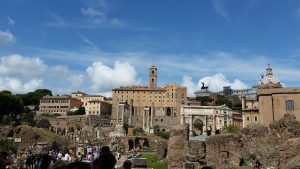
Dark Ages in north-western Europe
Nowadays the term Dark Ages is no longer seen as acceptable, however, it could well be argued that the term is applicable to large parts of the region we cover in this research, north-western Europe.
Chris Wickham in his book “The Inheritance of Rome” describes this period as “Radical material simplification”, meaning that the standards of living were plummeting. During this time we see a decline in population, increased violence and military activity, decline of cities and a move back to subsistence rural life; lay literacy and innovations also disappeared from Europe.
The Latin language did survive and Rome, Roman life and the idea of an empire remained an ideal throughout the period.
After very slow developments in the Bronze and Iron Ages we start seeing parts of the area emerging during Roman times. This becomes a border area and with a large military presence this created good economic opportunities and at the same time a stable political situation.
This came to an abrupt end around 250AC, there could be a few reasons for this:
- It could have been influenced by climate changes that increased the levels of groundwater what would have made agriculture difficult or impossible,
- Possible changes in the Roman administrative and military systems that saw a withdrawal of troops and as such a decline in the economy;
- Increased invasions from the Salli (from near the river IJsel) into what is now Brabant and Belgium.
There is no conclusive evidence for any of these scenarios. The fact however remains that the region became depopulated, trade dried up and communities basically went back to what they looked like in those pre-historic times. There was no longer the critical mass for new ideas and innovations, communications declined and trade largely disappeared. This lack of progress among people who again lived – as in prehistoric times – in small isolated communities rapidly reverted to paganism, superstition and magic.
After the final collapse of the Roman Empire (476) this decline only deepened and spread to other areas along the rivers Rhine and Maas into what is now Germany and also northern France, a similar situation of decline occurred in England.
The following period of Barbarian invasions and migrations and the waring fractions of the Merovingians did not help either and most of the land lay wasted and large parts were taken back by the forests. What we saw happening was a process of social fragmentation – every man for himself . People organised their lives around their own local situation, banding together for local protection. They looked for local strongmen who emerged as war lords to fend off both local and foreign invaders thus carving out their own little empires. These strongmen grew into local lords who also did justice and organised local food and production systems (textiles).
While the effects of the Justinian plague of 542 also reached this region the question is if this had any serious effect on the already thinned-out population but certainly what was left of the cities in this region saw death rates of 30% and higher, this further increased through epidemic waves over following decennial.
While stability returned during the Carolingian period, the collapse of the empire after the death of Charlemagne under the pressure of the invasions of the Vikings in northern Europe, ended that brief period of recovery.
In the following century war lords had grown into local counts who still had to fight for themselves as again there was no central government to protect them. Once the Vikings had left and/or settled down there were a lot of unemployed warriors (knights) who now started the create havoc and within a hundred years every single bit of land had its own lord, knight or count, all fighting with each other in order to increase their land and their power.
Most likely it was the change in climate rather than any human intervention that turned the tides from 1000 onward, agriculture production boomed and finally the region came to live again; it is only from that time onward that – for the first time in history – we can talk of the development of a more prosperous and civilised life for the people in this region.
By that time the states of medieval Europe had emerged in a structure that is still very visible today: England, France, Germany, Spain, Italy, etc. However in the old Middle Kingdom, the border region between France and Germany, nation building didn’t take place and here the situation remained a continuation of smaller counties and duchies often fighting between themselves as well as against the invading French and Germans.
During the 14th century for example Oss became one of the reoccurring targets during the Brabant-Gelre wars and when they finally finished in the 16th C, Brabant became a colony of Holland and suffered from severe economic depression that lasted until the 19th century.
In some parts of the region the only light in these Dark Ages was Christianity. Ootmarsum certainly was a less darker place during this period than for example Oss. The church during this period was the only stable element in Europe and in the old Roman cities further south continued with what was left of Roman administration, legislation, management, etc, in particular the bishops can be seen as the ‘governors’ of these cities and the people that lived around them. Further north there were only a few monasteries but again it wasn’t until the 10th and 11th centuries that they started to have an impact on these more northern regions.
Reorientation and reshaping
In the centuries following the collapse of the western part of the Roman Empire there was little indication that Europe would develop in the way it did. At that time one would have placed safe bets on Byzantine and the Caliphate as the way Europe would develop.
However, by the 7th century it becomes possible to see the way Europe is going to develop in what it is today and this significantly different from the period before that.
For the previous 1500 years, developments in Europe had concentrated around the Mediterranean and trade, culture, communication and contacts took place within the groups of people around this basic, the Greek, Romans, Persians, North Africans.
That unity started to break down. It was first weakened by the collapse of the Western Roman Empire, however under Barbarian rules people like the Goths, Vandals and Visigoths still very much formed part of the Mediterranean realm, but the strong ties started to weaken.
Also what weakened was the power of ruling secular class – the senatorial families – who during the first one or two centuries under barbarian control, still maintained their strong positions throughout what had been the Roman Empire. These families had been well educated, cultural, well travelled and literate and this secular power was gradually replaced by ecclesial powers in the form of bishops, monks and priests. In this process the key centres of learning started to decline and a vast amount of knowledge started to disappear from society.
While the Roman Empire continued in the east, in the 7th century their influenced also weakened, cities started to decline and what was left of the empire shrunk into what is now Anatolia, the Balkans and Greece.
A catalyst in the reshaping of the cultural and economic map of Europe was the Arab Conquest and their subsequent refocussing on Persia, rather than on the Mediterranean. Interesting archaeological evidence in the Levant shows a slow abandoning of trade centres from the coastal area into the mainland and trade routes started to run quite differently. There is no evidence of any destruction of these abandoned places and they certainly kept flourishing during the early period of the Conquest, it indicates a slow decline and abandonment.
And lastly what shaped the new orientation is the rise of northern Europe with the Franks, Angles, Saxons and Irish Celts.
Obviously all of the above elements influenced each other and there is not one single reason of this reorientation.
The cultural and commercial reshaping of Europe took several hundreds years to complete and by the 11th century a new cultural and commercial realm started to take shape.
While the focus of Europe had been shifting from the Mediterranean towards the north, the world view of the people who lived here hadn’t changed. Maps still very much use the Mediterranean lands in the center, with the rest of Europe, Asia and Africa as blocks centered aground it. This world view would only start to change after new land discoveries towards the end of the 15th century.
Economic Developments
No market economy
After the Roman Empire had collapsed money became very scarce and more or less disappeared from the economy. The early Middle Ages and even beyond that, was a booty driven economy, favouring only the chieftains of the clans and the family members they believed they could trust. So what ever wealth meant at that time it was only in the hands of less that 1% of the people. In this respect the ‘campus maii’ was an important spring event. Here the warlords would meet to discuss their raids for the upcoming season. This raiding culture resulted in a more or less permanent state of war. Under Charlemagne these summits were also used to discuss other political and economic issues.
At the start of the Merovingian period slavery was still continued from Roman times, but there were also free farmers. But – in exchange for ‘protection’ – the emerging war lords had increasingly bonded peasants working for them.
From a Gift-giving based economy
The booty economy relied on blood relationships and on trying to tie in others in the campaign. If successful the participants were rewarded with a share of the booty. Increasingly the raids alone didn’t deliver enough of the ‘gifts’.
In order to maintain the relationships an elaborate system of gift giving existed and for that purposes apart from raids trade was established. The aristocracy had to more and more use the services of specialised merchants for the supply of their prestige and luxurious goods. such as: salt and silk and for military purposes there was also a trade in copper and iron as well as in the end product of this weapons. We referred to the salt and weapon trade before in relation the Celts along the river Meuse (The King of Oss). Aristocratic women were often also seen as a trading object in the gift exchanges.
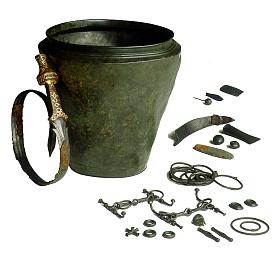
Trade in the early Middle Ages basically only existed to support the ‘gift exchange’ system for the purpose of patronage between the king and their nobles. Trade was there only to supply the elite with highly valued produce that served as gifts. This system is still in place in some tribal societies.
Trade as we know it was rather limited in those days as there was hardly any surplus to trade with. Furthermore merchants could easily become the bounty of a raiding party. This led to special protection of merchants and trading activities (markets) by the kings.
This ‘protection’ in turn became part of the system of privileges during the Merovingian and Carolingian period and from there it became part feudal privileges given to the lower nobility and later to cities such as the rights to collect tolls and market dues and the rights to punish and collect the associated fines.
Slowly we see that the ‘gift giving’ culture started to change for booty and luxurious trading goods, to privileges such as the building of defense walls, dig moats and built castles. Through the bannum these military rights were inextricable linked to kings and as such never challenged, as well as the rights to use land the land for its prudence (agriculture, hunting, fishing, forestry, etc).
Slowly what in its origin was a gift giving tradition became a set of privileges and this became common law and under the feudal system this was often very severely misused, these gifts became taxes and personal services (serfdom) levied both by landlords and the church.
To an Agriculture based economy
It has been estimated that the population of Europe doubled between 600 and 1000 from about 12 to around 20 million, an annual rather meagre growth of around a quarter of a percent. An estimated 15 million of them lived in the Carolingian Empire that included France, the Low Countries, half of Germany, Austria, and Italy. The population density is estimated at around 2 to 5 people per square kilometre. The increase of the population in the 9th and especially from the 10th century onward saw an intensification of a more efficient agriculture based economy; this was largely due to the so called Medieval Warm Period (MWP). During the period (800-1300) warmer weather increased to amount of arable land. Close to 100% of people who lived in Carolingian Europe at that time relied on agriculture for their survival.
It is estimated that by the 10th century the population above the main river system had increased from 10,000 at the end of the Roman period to 40,000.
Unlike the situation in the warmer Mediterranean regions, agriculture in northwestern Europe provided such a low yield that it could not and did not contribute much to the economic activity i.e. there was no surplus to trade. For centuries, the yield remained the same. 1:3 or 1:4 in relation to seedlings. In particular after the WMP, a cold spring, a wet summer or a plant disease meant famine. On average one in four harvests failed. It could well be that a few communities further up had a better harvest, but lack of communication and transport (trade) meant that there was hardly any opportunity to ‘import’ food.
Innovation did not happen. While during the migration period rye was introduced in western Europe, coming from Turkestan, agriculture technology stood still during most of the early Middle Ages. Towards the end of the period contacts with the Arab countries finally led to innovations that in its turn led to an increase of the yield and the opportunity for population increase.
The nobility had to establish large and productive landholdings (domains/hoven) in order to maintain provisions for their own campaigns. Here they produced the foodstuffs to maintain their families, their entourage and their campaigns. These extensive self-sufficient domains formed a powerful part of the political unity of the Merovingian and Carolingian periods.
Initially the king had no permanent places of settlement and travelled from place to place to tap into the produce provided by these domains, once such a place was exhausted they travelled on again. (Interestingly these travelling courts with all of its staff became in itself places of attractions which pulled in many others such as artists, performers, traders, merchants, etc).
The Twentse hoven (domains)
During the Carolingian period domains were first established in the Rhine land and in the eastern part of the Low Countries. There were six major domains in Twente all roughly 10 kilometres apart from each other. They all had their own central functions such ad administration, jurisdiction, tax collection, bonded labour, storage, etc. They were: Oldenzaal, Ootmarsum, Delden, Weddehoen, Borne and Goor [1. B.H. Slicher van Bath: Mensch and land in de Middeleeuwen, 1944]. After Charles Martel defeated the Frisii in 719 their land (including Twente) became part of the Bishopric Utrecht.
Already in 797 the hoven of Mander and Hezinge (under Ootmarsum) are mentioned in an official Charter from Oodhelm whereby he donated the farms to the Church of Wichmond near Zutphen. These farms were managed by the court of the major-domo (who lived elsewhere) he was in charge of the production and the management of the farm and he was also in charge of the various feudal and servitude obligations of the people. This system operated outside the normal civil system (city, province) of the day. Because of their often rather isolated positions they were among the last elements of the feudal system that finally got dismantled.
Appeal was possible at the court-mayor in Ootmarsum. This also had become a hereditary function and was – for centuries – held by the family Beverforde. The court was finally abolished in 1812, during the Napoleonic Period.
The vassal court to which Ootmarsum belonged was in Colmschate (Deventer).
Apart from these in origin Frankish domains also the Deaneries of the Utrecht based St Pieter and St Jan had properties in Twente resp. in Albergen and Espelo and in Dulder.
The domain system started to decline when the money economy was started up again during the 13th and 14th centuries. These domains changed into large farming estates.
Money matters
After the fall of the Roman Empire the economy had fallen back to bartering trade. The first small silver coins that were minted again were known as sceattae (wealth). From the 7th and 8th century onward they were minted in England, Frisia and Jutland. In the Merovingian lands Pippin reformed the system in 755 and replaced the sceatta with fixed valued solidi, a uniform Frankish coin, bearing his name (sceatae didn’t bear the names of kings). Under the gift giving scheme as mentioned above, soon certain nobles received a minting privilege and especially during the Carolingian period we saw a significant increase in this activity, what of course could be interpreted as an increase in economic activity.
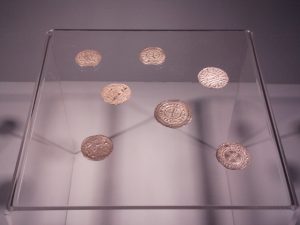
As in indication of their emerging power, it is during this time that we are also seeing some of the cities minting their own coins. Officially minting was an official monopoly of the emperor, nevertheless during the Carolingian period some 30 cities had their own mint, including Dorestad and Maastricht.
Charlemagne in 781, introduced the silver denarii. In 794 he fixed the weight and the exchange rates between the coins: twenty solidi made a pound and twelve denarii equalled one solidus (the denarius became the penny and was the most popular coin).
Louise the Pious and Charles the Bald followed up on Charlemagne’s work and further regulated the Carolingian money market. Charles designated mints for new coins at the courts of: Quentovic, Rouen, Reims, Sens, Paris, Orléans, Chalon-sûr-Saône, Melle and Narbonne. On July 1 856 everybody had to exchange their silver bullions for the new coins.
Under Carolingian rule the local economies were revived and this had a long lasted effect on the economic future of Europe. However, it still would be several hundred years before money would become the major form of payment for transactions.
The Ottonian kings in East Francis (Holy Roman Empire) took over monetary policies from the Carolingians and the Cologne denarius became one of the most successful coins of the time.
My birthplace Vught was one of the first places in Brabant, together with Antwerp that had minting and toll rights in the 11th century (first record for Fughte dates back to 1028).
Merchants
The emerging centralised structures of the Merovingian and Carolingian era also favoured a broader economic growth and by leaps and bounces progress started to emerge which would in norhtwestern Europe lead to the developments of very rich cities, among the most prosperous in Europe.
As the war booty alone did no longer deliver enough of the ‘gifts’. The aristocracy had to more and more use the services of specialised merchants for the supply of their prestige and luxurious goods. Over time, trade, in a much broader way, would become the backbone of the local economy.
Interestingly some of the early merchants in Austrasia were the successful slave traders. Christian people such as Charlemagne where uncomfortable with this human trade and tried to ‘regulate’ this by ordering bishops to monitor these transactions.
He also ordered a ban on the export of weapons, The Rhineland blacksmith were world-famous for their trade and there was a large international demand for their products.
Slowly -within the more central governed lands – the ‘natural’ state changed from permanent war to peace. Under the ‘kings peace’ no fighting was allowed within the Empire and as a result trade flourished during the reigns of for example of the Merovingian king Dagobert and later on under Charlemagne, key products were: grain, wine, iron, lead, military hardware, salt, wool and many other goods. However, soon after the collapse of the Carolingian Empire these early economic booms faded away again.
The area between the Seine basin and the river Rhine became the early economic motor of Europe, it were the Frisians who dominated the river trade in the early Middle Ages.
The arrival of regional market places
Since ancient times the Mediterranean had been the centre of trade. Even after the collapse of the empire the Mediterranean remained the economic centre of Europe (and beyond). However, slowly but steadily changes started to occur.
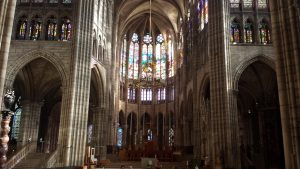
An important event happened under the reign of the Merovingian king Dagobert I (died in 639). Since the crowning of Clovis, there had been a strong link between the Merovingians and the monastery of St Denis. The monks here lived under the rule of St Martin and unlike the Benedictines they didn’t profit from the privileges and immunities provided under the Episcopal structure of the Church. This would have played a role in Dagobert providing the monastery of St Denis (near Paris) with the privilege of holding an annual fair to provide a more stable income for the community of both religious and lay people.
This support and the entrepreneurial spirit of this close nit community turned this fair into – most probably – the first large trading event in northern Europe. This also stimulated the Frisii to further develop their trading skills and their reach.
Despite’s Dagobert’s initiative in St Denis, the Merovingians mainly stuck to their traditional form of wealth creation: their annual raid parties. The southern parts of Europe were, in the 7th century, still reasonable easy hunting grounds for the raiders; however the heydays of these old Germanic tribal traditions were clearly coming to an end.
Pippin the Short (as the first Carolingian king) confirmed the privileges of St Denis in 753. He also ordered the introduction of designated market days in other episcopal towns that did not already have them organised.
His aim was to fix times and places where commercial transactions could be monitored, thereby enriching the treasury with the various sales imposts, cartage and tolls that were levied at the places and at these events. Markets grew into regular events, attracting ever larger numbers of buyers and sellers. Kings, dukes, counts and other rulers all showed a keen (financial) interest in these commercial activities. Inventories and audits of market towns were conducted regularly in order to eliminate illegal gatherings and ensure the regulations. Bishops, abbots and counts all became involved in these regulations in order to secure their cut of the increase in commercial activities. These activities were a severe impediment on an efficient economic system. Ships carrying goods would easily have to pay tolls and dues at a dozen places; this of course significant increased their costs, but even more disrupting was the fact that at these tolls significant delays occurred because of the inspections which sometimes required the unloading of the goods and the requirement to use local ships for the next part of the journey.
Nevertheless the emergence of trade led to an instant success of these early markets and Charlemagne had to issue a capitulary urging farmers not to waste their time at market places. Many of such warnings regarding markets and fairs have been issued over the following one thousand years plus. It is not without reason the connotation with fair is not just with an economic market activity, but equally with fun and partying. Obviously that his been the case form those very early days onward.
Initially most of these new markets in Europe north of the Alps were as elsewhere held once a week, often at Saturdays. Under its city privileges Oss was allowed to have a weekly market but this one was on Tuesday (a Saturday market was added later but always remained of less importance). After more than 600 years, both these two markets still exist and there will be thousands of such examples throughout Europe. Some of these northern fairs became of international importance: Lyon, Frankfurt, Vienna, Cracow, Antwerp, Ghent, Bruges, Bergen-op-Zoom.
Trade protection and trade privileges
In order to stimulate trade, specific privileges were developed by the Carolingian kings:
- Under the ‘kings peace’, Charlemagne offered reasonable secure conditions for long-distance trade.
- In 828 Louise the Pious issued a capitulary securing the protection of international merchants travelling to trade at the court.
- One of the first international free trade agreements was signed in 840 between King Lothar I and the city state of Venice, allowing free passage of merchants throughout northern Italy.
However, these emerging economic developments needed more than these supporting privileges. More and better demand and supply management systems and a range of new economic skills to secure longer term economic sustainability. It were the merchants in these cities rather than the nobility (landowners) who started to take up a leadership role in this new economic direction.
The nobility typically had their power bases in the country, where they owned their lands and as such they never became seriously involved in the economic activities; as these were concentrated in the emerging cities. However, as mentioned above, based on their privileges trade opened up interesting taxing possibilities for the landowners – over which domains these goods needed to be transported. Both the old Roman highways and the river ways were used to link cities such as Dorestad, Marseille, Bordeaux, Corvey, Calais, Rouen, Paris, Ghent, Maastricht and Narbonne, to just name a few.
But the real value of trade was embedded in the activity itself. Trade creates wealth and wealth creates political power and very rapidly the cities became more and more powerful and this in its turn – at least for the following centuries – drew power away from the nobility. The early towns and villages that had some regional importance, perhaps because local fortifications or because of link to one of the many emerging monasteries became the first the trading settlements and they became also regular venues for fairs and markets. Some good examples of this development can be found in Flanders as early as in the 9th century, towns such as St Omer, Bruges, Ghent and Kortrijk (Courtrai) were amongst the earliest settlements that started to emerging as trading places. Soon the towns started to set their own rules for the conduct of business, with a growing merchant class, they were far better equipped to manage their economy than the nobility.
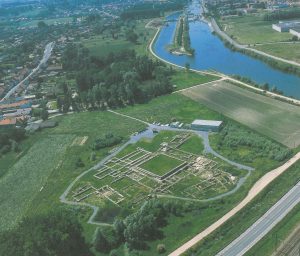
Increasingly also commercial centres were established outside the walls of the city, several of these so called ‘emporiums’ or ‘portus’ were established along the river Scheldt, including one at Ename.
Developments in the East
While we concentrate on the developments in north-western Europe, it is important to note that in the early Middle Ages the centre of economic and scientific had moved to the east. Since Emperor Constantine had moved the capital of the Roman Empire to Constantinople in 325 the west started to decline, this was further assisted by the invasions of the Germanic tribes, whose major activity was raiding rather than ’empire building’. The Greco-Roman tradition continued here whereby many Greek scholars became the leaders in academic and professional pursuit.
Famous physicians included: the brothers Stephanus, Dioscorus and Alexander Anthemius, another brother Olympicos was a famous jurist. Pappus of Alexandria was perhaps the most famous mathematician of his time. Anthemius of Tralles and Isidore of Miletus, can perhaps be best described as engineers. They built the world famous Hagia Sophia in Constantinople within the incredible short period of 5 years (532-537).
The work of John the Cappadocian on the Justinian Code in 529 is still the foundation of many of the legal systems in Europe.
The end of the early Middle Ages
So it wasn’t from around 1,000 that Europe was able to pick up its pieces again and culture, knowledge and economic progress started to occur again. The invasions from the Vikings, Magyars and Alans had stopped. Another element that had distracted many rulers during large parts of this period were the many heresy disputes and infighting. Towards the end of this period this had died down, but as we will see later this would flair up again in a big way.

The climate stared to warm, which allowed for increased yields especially north of the Alps and this led to a population boom.
Christianity had also a positive effect on society, it provided for a political and cultural unity as well as on governance and administration and slowly we can start to see the signs of civilisation again.
The crusades also played a key role in this of course it was in itself impressive that in 1095 the continent was able to get a pan-European army together that was able to conquer Jerusalem. But far more important these developments also assisted in regaining the long lost knowledge from the Greek and Romans; this was re-discovered thanks to Arab philosophers, scientists and teachers. Trade was another side effect of the crusades as well as the earliest form of tourism and international money transfer (Knights Templar).
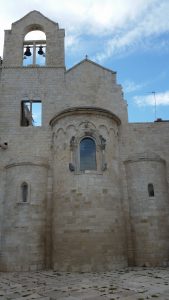
At that time we also see countries such as Spain, Britain, France and Germany starting to emerge proto-countries and Italy continued again its function as the cradle for cultural developments.
Following this period we see a rapid expansion of Europe and the start of the European economy and by 1500 Europe started to colonise the rest of the world.
Back to when this all began, the the latter day of the Roman Empire. Romans permanently left the region in 402 and control was basically in the hand of the Romanised Germans.
Another date of course is the final fall of Rome in 476. But its decline started as soon as the Emperor Constantine moved the capital to Byzantium in 325, which was consequently renamed into Constantinople.
When that same emperor, roughly at the same time, decided that the Roman Empire would adopt the Catholic faith as the state religion another important development was set in motion. Most Roman centres throughout very rapidly also became the seats of bishops and with the ongoing decline of the Empire, the Catholic Church started to take over also an important part of the administration of the areas where they were active and this rapidly expanded from the 6th century onward. The rapid development of monasteries added to the increase of power of the Church among the rural population, especially when after 1100 they were all fully brought under the control of Rome.
The baptism of the Merovingian King Clovis in 500 in Reims is anther important date in this context.
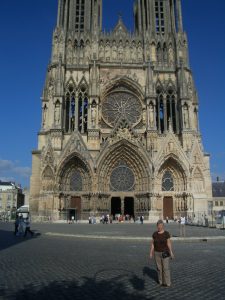
The interaction between these three elements (Romans, Germans, Church) led to the ideal aim of that period; one homogeneous world, one religion, one church and one emperor. This ideal was maintained throughout the Middle Ages.
Some of the philosophers of late Antiquity warned against this monolithic approach, namely people like Plotinus and perhaps even more so his pupil Porphyr and in general the Neo-Platonists. Their dark view of things to come in the way of ‘ free thinking’ also resulted in the name that this period received that of the ‘Dark Ages’.
One of the major elements that suffered during this period was the collapse of Roman culture. Without the integrity of the Empire, there no longer was that free exchange of culture. Literacy declined as well and soon this was only limited to a handful of senior church officials. Literacy among the emerging aristocracy was poor and they depended on clerics, who became widely deployed at the various Frankish courts.
Perhaps one of the most serious effects of the cultural collapse and the consequent limited continuation within an increasingly becoming dogmatic Church, was that this caused the end of reason. Nevertheless Christianity was one of the few lights in the Dark Ages.
On the other side the survival of Roman (and Greek) culture through the Church assisted the formative period in which the medieval administrative and political systems developed as well as trade. And overtime systems like education and care emerged again.
Equally difficult is to split this period again, but in general three periods are recognised;
- The Early Middle Ages – the prolonged transition from Antiquity to the Middle Ages
- The High Middle Ages – also sometimes called the prolonged 12th century; and
- The Late Middle Ages – with institutionalised governing bureaucracies and the monetisation of economies
The Merovingian and Carolingian periods are an integral part of the Early Middle Ages, but because of their self contained histories they are covered separately.
The History of Northwestern Europe (TOC)