Bucketty, 5 June 2007
Last week I received an email from Margriet Bot, the Consul General of the Netherlands, inviting me to attend a function at the Dutch Consulate in Sydney. The occasion was a meeting between Ayaan Hirsi Ali and members of the Dutch community. I did not hesitate for a moment and accepted the invitation immediately.
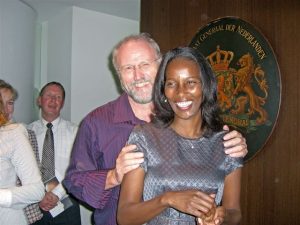
I was even more delighted when a follow-up email arrived, inviting me to join a small dinner afterwards at Margriet’s home with her partner Edmond. We would be only eight people in total—an extraordinary opportunity to get to know Ayaan a little better. As Louise was in Florence at the time, I attended on my own, as did Ayaan, and we ended up sitting next to each other.
The reason for Ayaan’s visit to Australia was the promotion of her book The Infidel. The title says it all. The book has become an international bestseller and tells the shocking story of her life.
The event at the Consulate quickly turned into a lively and intense discussion among some sixty Dutch attendees. Margriet opened the evening with a warm and very personal introduction—something she does exceptionally well. After briefly outlining her life story, Ayaan opened the floor to questions. She was immediately bombarded, including with very personal questions. When Margriet tried to shield her, Ayaan waved it away. She wanted to engage, and she wanted us to engage with her. The atmosphere was electric, but in a very positive way. In the end Margriet had to intervene, otherwise Ayaan would have continued for much longer. She clearly loved being among fellow Dutch people, and the entire discussion took place in flawless Dutch.
To the surprise of many, one of the first things Ayaan said was that she loves the Netherlands. All of her friends still live there, she visits regularly, and she intends to return. This was striking, given what had happened only two years earlier, when questions were raised about the legality of her Dutch citizenship. In order to enter the Netherlands she had used a different name and had not disclosed that she had lived in Kenya before arriving. Although this was known to the authorities, the issue was reignited by the then Minister for Immigration, leading to a political storm that eventually caused the fall of the government. Despite this, Ayaan was allowed to keep her Dutch passport, reflecting the continued sympathy many Dutch people feel for her.
By that time she had already decided that she had achieved politically what she had set out to do. She had forced a European-wide debate on the treatment of women under Islamic law and on the suppression of free will under theocratic regimes. She also needed personal space and had accepted a research position in Washington DC, where she now lives.
After the consulate event we moved on to dinner at Margriet and Edmond’s home. During dinner I sat next to Ayaan. She is a proud Somali woman—very beautiful, with long legs and strikingly long fingers. I could feel a warmth radiating from her presence. She has a beautiful smile, combined with a certain shyness and innocence that I had not expected from someone who dares to confront some of the most dangerous people on earth. She is, without exaggeration, a brave person.
Throughout the evening our discussions were typically Dutch: animated, deeply involved, and at times heated. Edmond opened some of his best wines, and the entire night became one of those rare treasures of life. Ayaan’s mobile phone rang several times during dinner. She did not answer; she knew it was her bodyguards checking in, but she did not want to leave. She clearly enjoyed the gezelligheid. You could see that this was genuine.
When I met her in Sydney she was accompanied by heavy security: two bodyguards in her car and two in a following vehicle. She was remarkably relaxed about it, although she joked that she cannot fall in love without first having the man checked by security. She told me she loved Sydney because she could be anonymous.
Anonymous? In the preceding days there had been full-page newspaper articles about her visit. I told her that in one week she had received more press coverage in Australia than all Dutch royals, ministers, and prime ministers combined over the past two decades. Australia was fascinated by her. Everyone I spoke to had heard of her, read about her, heard her on the radio, or seen her on television.
It was well after midnight when we finally, and reluctantly, broke up. We all received a big hug from her, accompanied by the traditional three Dutch kisses. She left in her security car, which sped away, followed by the other bodyguards. That moment brought us all back to reality. That was her life, while we casually went our own ways in complete freedom. She left the seven of us richer, warmer, and more determined to do our bit to make the world a better place.
Only then, in reflection, did the full weight of her story settle with me.
Ayaan Hirsi Ali was born in Somalia, a country that for decades has lacked most basic state functions—no stable government, no banking system, no public education or healthcare. And yet, as I know from our own telecommunications research, Somalis are proud and remarkably resilient people, organising economic and social life through informal systems, including sophisticated mobile payment networks that operate far beyond what one would expect.
Ayaan fled Somalia as a young girl—but only after enduring female genital mutilation, inflicted by her own mother and grandmother under a centuries-old custom still practised in parts of the Islamic world. Thinking of this, while sitting next to this warm, intelligent, and beautiful woman, sent shivers down my spine.
She fled first to Kenya, and in 1992 to the Netherlands, where she was welcomed, educated at Leiden University, and became a passionate advocate for the rights of women oppressed under Islamic law. Her activism eventually led her into Dutch politics, first through the Labour Party and later as a Member of Parliament for the Liberal Party.
Her documentary on the mistreatment of Islamic women led directly to the murder of filmmaker Theo van Gogh by an Islamic fundamentalist—an event that shocked the Netherlands and the world, especially a country long known for its tolerance.
During our conversations she was clear and uncompromising. Western democratic values, she argued, are fundamentally incompatible with religious fundamentalism. Negotiation does not work with people who do not recognise secular law and whose lives are oriented entirely toward the afterlife. Excessive tolerance, particularly in the Netherlands, has allowed fundamentalism to grow unchecked in segregated communities, schools, and families.
She warned that Australia could learn from Europe’s mistakes, and earlier that day she had already met with politicians in Canberra. They were so impressed that she was invited back for further discussions. We made a pact that, upon her return to Sydney, we would have another dinner.
I mentioned to Ayaan that I had a granddaughter just 5-month-old who had a similar name Aiyana and we had a discussion about her, Ayaan’ name means ‘God’s Gift’ We discussed that we hoped that when she grows from a small girl into a beautiful young woman, she will live in a world that—thanks to people like Ayaan—is a little fairer, a little braver, and a little safer for women everywhere.
Paul